



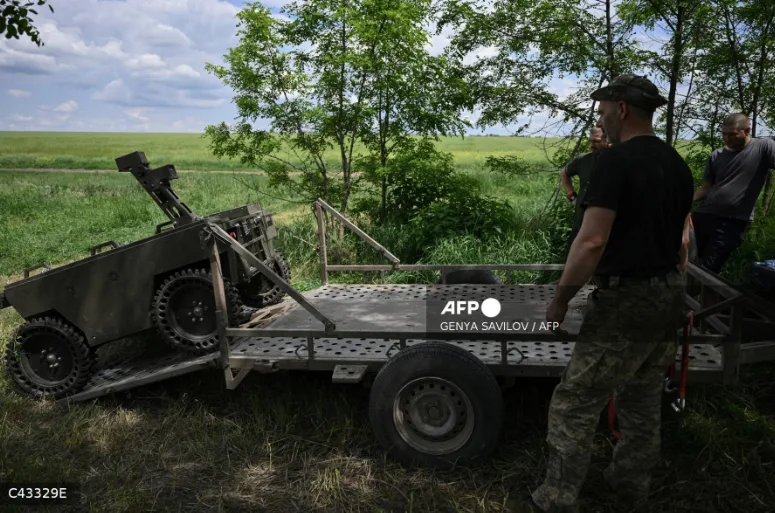
Ukraine combat robots are moving closer to frontline deployment as engineers and military units continue developing artificial intelligence-powered systems. This progress continues despite a recent shake-up in the country’s defence leadership.
According to AFP, Ukrainian engineer Eduard Trotsenko is among those pushing the boundaries of battlefield robotics. He is developing machines designed to reduce the number of soldiers exposed to some of the most dangerous areas of the war with Russia.
Inside his workshop, Trotsenko moves between robots, weapons and computers while testing ideas that appear increasingly inspired by science fiction.
Among his concepts are mechanical birds capable of landing on high-voltage power lines to recharge themselves. Additionally, there are robot dogs that could eventually operate on the battlefield.
“In order to save human lives, to save soldiers, there must be robots,” Trotsenko said.
The 55-year-old engineer is founder and chief executive of Ukrainian robot manufacturer Temerland.
Before Russia’s full-scale invasion, Trotsenko worked on charging stations for electric vehicles. The war prompted him to redirect his engineering experience towards unmanned military systems.
Ukraine combat robots target dangerous frontline missions
Trotsenko specialises in unmanned ground vehicles designed to operate in areas where sending soldiers carries a high risk of death or injury.
Such machines are increasingly used to transport supplies and evacuate wounded troops from areas exposed to drones and artillery.
These dangerous stretches of territory have become known among soldiers as “kill zones” because aerial drones constantly monitor and attack movement on the ground.
Ground robots allow Ukrainian units to complete some missions without sending additional troops into those areas.
Trotsenko is now working beyond logistics.
His company has developed combat prototypes that could carry weapons. These include one fitted with a rocket-propelled grenade launcher and another equipped with a heavy machine gun.
Artificial intelligence installed on the machines is expected to assist with their operation.
“They’re currently being tested in some brigades,” Trotsenko said, adding that the company was awaiting approval from Ukraine’s General Staff for wider deployment.
Ukraine expands drone warfare
Unmanned systems have become a central feature of the war between Ukraine and Russia.
Aerial drones conduct reconnaissance, identify targets and carry explosives, while ground systems increasingly transport ammunition, food and other supplies.
Ukraine has built a large domestic drone industry since Russia launched its full-scale invasion in February 2022.
President Volodymyr Zelensky has repeatedly promoted the country’s defence technology sector as a major advantage against Russia’s larger military resources.
The rapid development has also encouraged private companies and small engineering teams to work directly with military units.
Trotsenko said competition among private firms helps developers modify equipment quickly. They can do this based on feedback from soldiers using the technology at the front.
“In a private company, you can take risks more quickly,” he said.
Fedorov dismissal raises concerns
The dismissal of defence minister Mykhailo Fedorov in July raised questions. There are doubts about whether Ukraine would maintain the same pace of technological reform.
Fedorov had become closely associated with the military’s shift towards drones, artificial intelligence and other emerging technologies.
During his time at the defence ministry, he backed the creation of the Defense AI Center A1. It was designed to integrate artificial intelligence across the military.
The centre brings together battlefield experience, data and engineering expertise. The goal is to shorten the time between developing new technology and deploying it to military units.
Fedorov also encouraged greater involvement by private technology companies in defence procurement and development.
His departure during a government reshuffle triggered demonstrations in Kyiv, with protesters demanding his return.
The political upheaval also intensified criticism of then commander-in-chief Oleksandr Syrskyi. He had clashed with Fedorov over the direction of military reforms.
Syrskyi was later replaced by Major General Mykhailo Drapatyi following mounting public pressure.
Despite the changes, people involved in Ukraine’s defence technology industry believe the transformation has advanced too far to be reversed.
“The young people there won’t let it go. There’ll definitely be drones,” Trotsenko said.
Military says technology movement is bigger than government
A Ukrainian military commander using the call sign “Jason” also dismissed concerns that the technological drive depended entirely on Fedorov.
Jason leads a unit operating ground drones similar to those developed by Trotsenko.
He said one of their greatest advantages was their ability to perform dangerous missions without putting soldiers directly at risk.
“You can afford to lose a drone, but not a person,” he said.
“The probability of human losses there is reduced.”
Jason argued that Ukraine’s military technology revolution did not originate solely from orders issued by government officials.
Instead, he said engineers, programmers and soldiers began developing solutions independently after Russia invaded.
“It’s not that simple. The technological initiative was not flowing from the top down. It wasn’t a government order,” he said.
According to him, the invasion triggered an “explosion of bottom-up initiative,” with young engineers creating products. They are presenting these products directly to military units.
Soldiers tested the systems they considered useful and provided feedback for improvements.
That process eventually brought programmers, telecommunications specialists and engineers more deeply into the armed forces.
Jason said one of the biggest obstacles now was finding enough professionally trained personnel. These people must be capable of operating and developing increasingly sophisticated systems.
Engineers imagine robotic future of warfare
Back in his workshop, Trotsenko is already looking beyond the ground vehicles currently being tested.
He believes future conflicts could involve humanoid machines carrying out tasks traditionally assigned to soldiers.
Operators could potentially control such robots from other countries or even from hospital beds while recovering from injuries.
His proposed mechanical birds offer another glimpse into that vision.
Trotsenko imagines machines capable of travelling through the air before landing on electricity infrastructure to recharge. This could potentially allow them to remain deployed for extended periods.
Some of these concepts remain experimental, but Ukraine’s current battlefield has provided engineers with an unusual environment. It allows for rapidly testing emerging military technology.
For Trotsenko, the transformation from traditional warfare towards machines capable of assisting or replacing soldiers has already begun.
“Things have really taken off,” he said.