





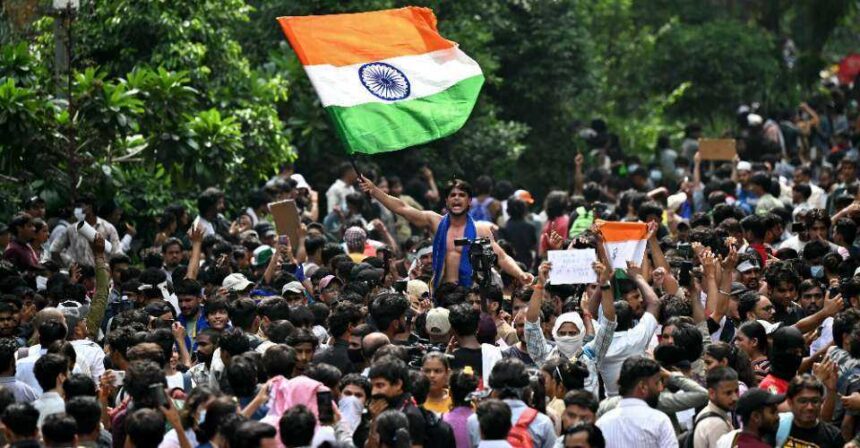
Two weeks after youth-driven protests culminated in the resignation of India’s education minister, Prime Minister Narendra Modi’s government is confronting the broader political consequences of a movement that has become one of its most significant challenges in years.
The protests, organised by the online Cockroach Janta Party (CJP), began in New Delhi before spreading to other cities. What initially centred on allegations of examination irregularities soon developed into a wider campaign focused on unemployment, limited opportunities for young people and concerns over what opponents see as the increasingly authoritarian character of Modi’s government.
Although the demonstrations have largely subsided after several major demands were met, the unrest has raised questions about the government’s response, the future of the youth movement and its potential political impact.
The departure of the education minister on July 25 represented an unusual concession by Modi, who has spent more than a decade projecting an image of political strength and determination.
In the aftermath, authorities have sought to reconnect with young voters, while parliament has approved tougher penalties for the leaking of examination papers.
Police in several cities have also dropped cases filed against protesters following widespread criticism of the force used to disperse the demonstrations.
The unrest further highlighted the growing importance of India’s rapidly evolving digital environment, with protesters relying heavily on social media platforms to coordinate activities and amplify their demands.
Modi, who has long been an active user of X, has also sought to reach younger audiences on Instagram, where he released his first vertical-format videos in an apparent effort to connect with the platform’s predominantly youth-oriented audience.
The demonstrations also drew attention to the increasing use of artificial intelligence-based camera systems by authorities to track and identify people involved in protests.
Several women who posted videos from the demonstrations said they were subsequently subjected to rape threats and other abusive messages after their footage attracted widespread attention online.
A shutdown of internet services around the main demonstration site in New Delhi further complicated communication among protesters, prompting young people to develop alternative methods of keeping in contact.
According to internet monitor Access Now, India recorded the world’s second-highest number of internet shutdowns last year, with local restrictions imposed during protests as well as periods of conflict and communal violence.
Although allegations of examination leaks triggered the initial demonstrations, dissatisfaction quickly expanded into broader concerns among young Indians about employment prospects, economic mobility and declining confidence in public institutions.
For many participants, the prospect of struggling to find secure employment after years of education and preparation for fiercely competitive examinations has come to represent a much larger concern about their economic future.
That wider sense of frustration could allow the movement to retain momentum even after the immediate dispute over examination irregularities has been addressed.
Resolving cases of exam cheating may therefore do little to settle the deeper grievances that brought thousands of young people onto the streets.
The protests have created a youth movement with millions of followers across online platforms, although its ability to translate that digital reach into sustained political influence remains uncertain.
The CJP has announced plans for a “nationwide listening tour” aimed at gathering the concerns of young Indians, while continuing to support demonstrations linked to examination irregularities.
Protests have continued in the eastern state of Jharkhand, an indication that the discontent that first erupted in the capital has not entirely faded.
CJP founder, Abhijeet Dipke, has called for “a public movement to restore trust and neutrality in public institutions”.
“The public has become very frustrated and tired of these things. That is why our movement got such massive support,” he said.
But “for now, the CJP will function as a pressure group”, Dipke added, rather than a political party.
The protests could also put pressure on India’s established political parties to pay greater attention to the priorities of younger voters.
Young people represent a vast potential voting bloc, but converting the momentum generated by street protests into electoral support presents a considerably more difficult challenge.
With almost three years remaining before the next national election, Modi’s ruling party and opposition groups are likely to seek ways to channel the anger and economic frustrations voiced by young Indians into political support.