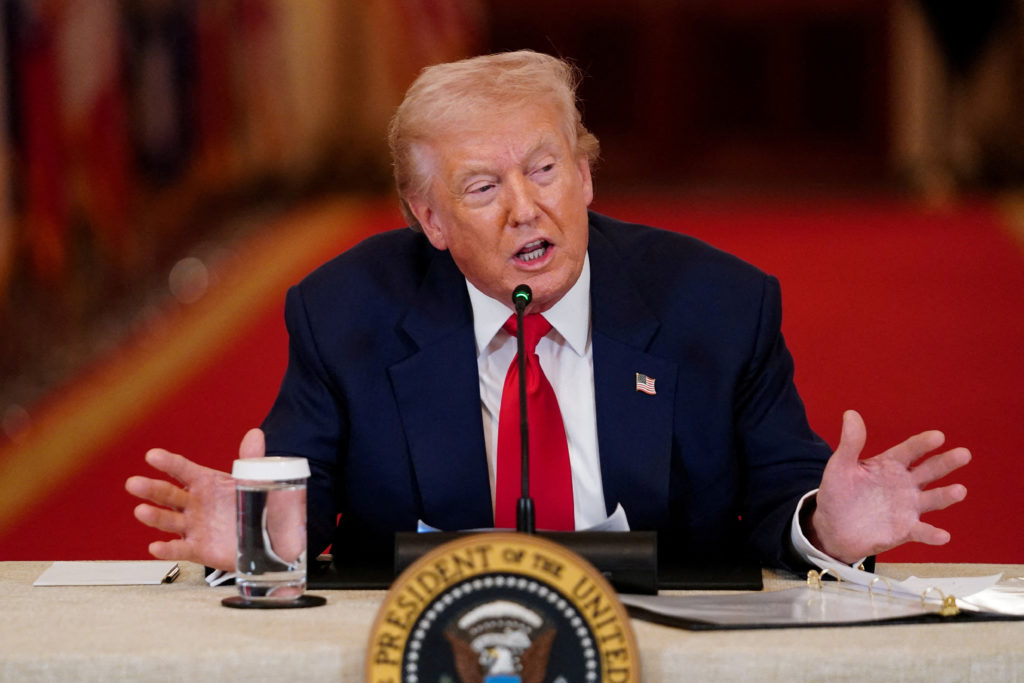
United States President Donald Trump has signed an executive order designating the Oval Office as a national monument in an effort to prevent future presidents from making major changes to the room.
Trump signed the order on Thursday, saying it would stop future administrations from destroying or significantly altering the historic office.
“We’re making it a national monument, and it will not be allowed to be touched by anybody, destroyed, ripped down by stupid people, in order to build something in a slightly different shape,” Trump told reporters.
The order also covers some rooms surrounding the Oval Office and directs the National Park Service to maintain them in a way that protects their historic character and architectural integrity.
However, the order does not prevent a president from redecorating the office or changing its furnishings.
It specifically states that the designation does not “restrict the President’s authority to redecorate the monument, select furnishings, or make ordinary operational and security modifications that do not substantially impair the monument’s historic structure or architectural character”.
Trump has made major decorative changes to the Oval Office during his second term, including adding numerous gold features, a large gold sign outside the office and other furnishings.
He defended the changes, saying the White House and Oval Office had needed repairs before his administration took office.
“We like the Oval Office, and it’s a symbol, like the White House itself. It’s a symbol of our country and the greatness of our country,” Trump said.
The president also claimed the building had suffered from broken windows, cracked walls and damaged stone.
The order came months after Trump demolished the White House East Wing as part of a project to build a new ballroom. The project was approved by Congress but has faced legal challenges.
The White House is already designated a National Historic Landmark, a status intended to protect the building from major changes.
Trump has the authority as president to create national monuments, which generally receive federal protection.
However, Greg Werkheiser, a historic preservation lawyer, told the BBC that the new designation may have limited legal effect because Congress has exempted the White House from parts of the National Historic Preservation Act to allow presidents to make necessary changes.
“Furniture and decor is completely up to the president’s discretion,” Werkheiser said, adding that presidents can generally make such changes as long as they do not damage permanent art or architecture.
He criticised the Trump administration’s approach to other historic sites, describing the new order as “hypocrisy”.
Trump has also pursued other construction and renovation projects in Washington, including plans for a new triumphal arch and work at the Kennedy Center.
The president previously suggested that the Oval Office might need to be demolished because of security concerns raised by the US Secret Service.
However, he later rejected the idea, saying the room was a special place.
The Oval Office has existed in its current form since the early 1930s following changes made during the presidency of Franklin D. Roosevelt.
During the 2026 midterm election campaign, Democrats also criticised Trump’s redesign of the White House. Former President Barack Obama compared the gold decorations to a White House redesigned by Saddam Hussein.