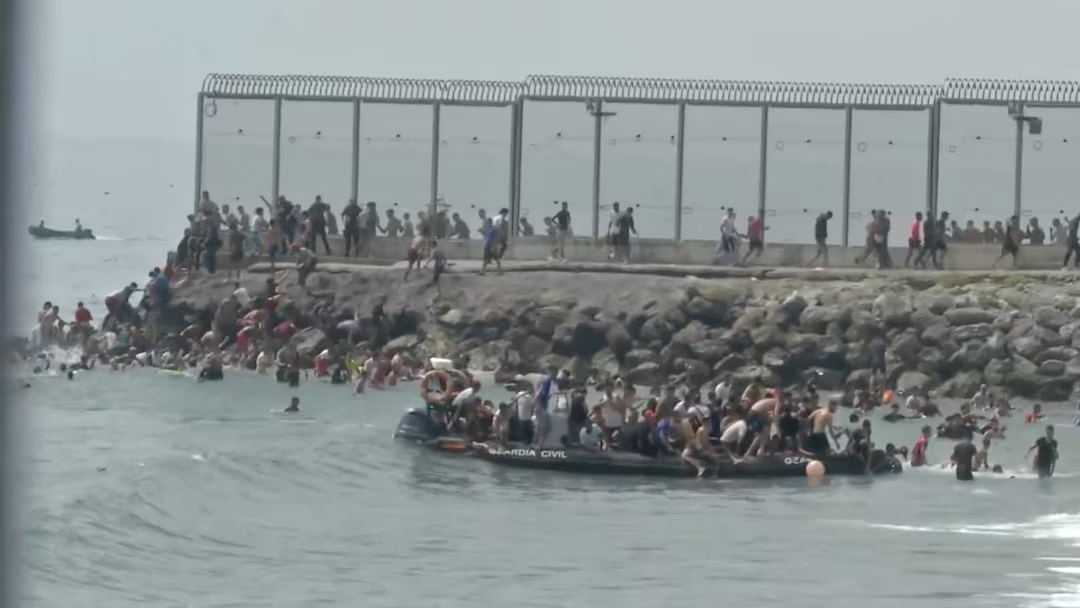
Spanish authorities have reported an unprecedented influx of migrants to the Canary Islands, with almost 2,000 people reaching the Atlantic archipelago on Tuesday, marking the highest number of arrivals recorded in a single day.
The latest surge occurred just days before Spain’s national elections, with immigration expected to feature prominently in political debates and influence voters’ decisions.
The islands, situated off the coast of West Africa, have continued to experience significant migrant arrivals despite efforts by European authorities to curb irregular migration.
According to Spain’s maritime rescue service, a total of 1,990 migrants arrived aboard 15 boats. Rescue teams escorted the vessels, including several dinghies, to the island of El Hierro as successive groups of migrants were brought ashore.
Reacting to the development, Canary Islands regional leader Fernando Clavijo described the unprecedented arrivals as a historic occurrence during an interview with Spanish radio station Cadena Ser.
“Sadly, this is a historic day,” the Canary Islands’ regional leader Fernando Clavijo said in an interview with Spanish radio Cadena Ser.
Clavijo disclosed that approximately 100 of those rescued were minors. Among them was a four-day-old baby who was reportedly born while the mother was making the dangerous journey across the Atlantic.
The Canary Islands, a popular European holiday destination known for their favourable climate throughout the year, have remained one of the principal gateways for migrants seeking to enter Europe. However, the Atlantic crossing remains perilous, with thousands of people believed to have lost their lives attempting the journey.
Although the archipelago is approximately 105 kilometres from the closest African coastline, many migrants travel considerably longer distances to avoid security patrols. Such journeys can take several days or even weeks, with some boats losing their bearings and drifting into the vast Atlantic Ocean.
More than 26,000 migrants have arrived in the Canary Islands since the beginning of the year, with November accounting for roughly half of the total. Tuesday’s record followed another major influx on November 7, when approximately 1,400 migrants reached Gran Canaria, setting the previous record for arrivals within a single day.
The migration crisis has also attracted international attention. During a visit to the islands in June, Pope Leo XIV condemned human traffickers for taking advantage of vulnerable migrants, warning that those responsible for exploiting their desperation would face God’s wrath.
Migration departures from West Africa typically increase at certain periods of the year, particularly in November, when many people attempt the crossing before worsening winter weather makes conditions at sea more dangerous. The relatively calm waters experienced in recent days have also encouraged more departures.
Clavijo said the majority of the boats that arrived on Tuesday originated from Senegal and Gambia. He noted that despite initiatives by the European Union to discourage irregular migration in West Africa, many people continued to undertake the dangerous journey because they saw it as their best opportunity to secure employment and improve their living conditions.
Explaining the circumstances surrounding the latest arrivals, he said favourable weather conditions and the presence of a full moon had contributed to the increase in departures.
“The sailing conditions were favorable and there was a full moon, so these people looking for a better future ended up on our shores,” Clavijo said.
The regional leader also raised concerns about the capacity of El Hierro to accommodate the growing number of arrivals. The island, which is the westernmost territory in the Canary archipelago and has a population of approximately 12,000, is struggling to cope with the sudden influx of migrants.
He said many of those rescued arrived in physically exhausted and vulnerable conditions, placing additional pressure on the island’s limited resources and emergency facilities.
Although Clavijo expressed satisfaction with arrangements for relocating adult migrants to mainland Spain, he said additional assistance was required from other Spanish regions to accommodate unaccompanied minors. Such children require protection and care under the responsibility of government authorities.
The latest arrivals have also intensified the political debate surrounding immigration ahead of Sunday’s elections, with Spain’s conservative Popular Party seeking to defeat the incumbent Socialist-led government.
However, the party is expected to require support from the far-right Vox party to form a government if it secures enough electoral backing. Vox has made immigration a central issue in its campaign, advocating the deportation of migrants and policies that prioritise Spanish citizens over recent foreign arrivals.
Clavijo, who belongs to the regional Canary Coalition party, criticised political narratives portraying migrants as a threat to society. Although he did not directly mention Vox, he condemned attempts to encourage hostility towards people arriving on the islands, describing such rhetoric as “a xenophobic discourse of bad people.”
He also criticised a recent agreement involving Austria, Denmark, Germany, Greece and the Netherlands to transfer migrants to Rwanda, dismissing the arrangement as impractical and inappropriate.
Expressing his opposition to the direction of European migration policy, Clavijo said: “Europe is on the wrong path,” Clavijo said.