





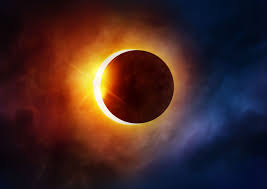
Excitement was building across Spain as online forums buzzed with discussions about possible cloud cover and recommendations for the best locations to witness the rare celestial event.
Hours before the country was due to experience its first total solar eclipse in more than a century, anticipation was already running high.
“It’s going to be spectacular,” said César González, an astronomer and science communicator at the Madrid Planetarium. “A total solar eclipse is one of the best spectacles in nature.”
González said he intended to set off early on Wednesday and head north towards the Spanish city of Burgos in search of an ideal viewing location. “And the first isolated field I find, where I can see the horizon and the sky is clear, that’s where I’ll stay. I’ll spend the whole day there waiting,” he said. “There are no words to describe it to another person who has never felt or seen a total solar eclipse.”
Spanish authorities have projected that up to 6 million people could travel into the eclipse’s path on Wednesday. The roughly 200km-wide route runs from A Coruña in northwestern Spain to the Mediterranean island of Mallorca, while a narrow section of Portugal, as well as areas of Greenland and Iceland, are also expected to witness totality.
Across western Europe, tens of millions of additional spectators are expected to watch the event. The eclipse will obscure the sun almost completely in several countries, including the UK, France, Belgium, Switzerland and northern Italy.
Spain, however, is expected to offer some of the most favourable viewing conditions on mainland Europe, according to González. “The band of affected land [to watch the totality] is very small,” he said. “It will also be seen in parts of Greenland and Iceland, where the visibility conditions due to the weather are much worse. So the only country in the whole world where it is possible to contemplate the total eclipse in good conditions is Spain.”
About 460,000 visitors are estimated to have travelled to Spain for the event, with hotels recording reservations made months earlier by travellers from countries including Japan and the US. More than 300,000 visitors are expected to move towards rural towns and villages in search of prime viewing locations for the brief period of less than two minutes when the moon’s shadow will pass across the Earth.
“I’m so excited to see it,” said Angela Jones Rieksts from Halifax in eastern Canada. She spoke to the Guardian while travelling towards Burgos with her 21-year-old daughter.
Her first total solar eclipse experience came about two years earlier, when she watched one closer to home in the Canadian city of Miramichi. “I was just absolutely awestruck,” she said. “It felt almost like God’s eye was staring back at me from heaven.”
She said the sight moved her to tears and sparked a new passion for following eclipses around the world. “When it was over, I said to myself, ‘I have to see this again’.”
The excitement was evident throughout Spain, where many opticians and pharmacies had reportedly run out of solar eclipse glasses. Spanish airline Iberia also announced plans to broadcast live images from a charter aircraft positioned at an altitude of 10,000 metres to give passengers a view of the eclipse. Madrid’s Prado Museum joined the preparations as well, releasing an AI-generated video imagining how the changing light during the eclipse could affect the appearance of its artworks.
Spanish authorities had spent months preparing for the expected influx, including planning for as many as 1.5 million extra vehicle journeys. With weather warnings predicting temperatures reaching 40C and heightened wildfire risks, more than 24,000 police officers were scheduled to be deployed across the country.
For Stéphanie Racco of France, travelling to witness Wednesday’s eclipse was the result of plans that began months earlier. “I read the news around December,” she said. “I said, ‘OK, I have to go’. Because the last eclipse I saw was in 1999, north of Paris. And it was fantastic and something I want to share with my kids.”
Racco and her eight-year-old twins left the Côte d’Azur last Thursday and travelled at a relaxed pace towards Salou, a resort town located south of Barcelona.
She said she was surprised that her family appeared to be among the few visitors who had travelled specifically for the astronomical event. “I think I’m the only one in this hotel who has come just for the eclipse,” she said with a laugh.
While other tourists headed for nearby beaches and water parks, Racco concentrated on identifying the best location from which to watch the eclipse on Wednesday. “Salou could be a good spot, but I’m not sure because I’m seeing a lot of clouds,” she said, adding that she was prepared to drive “for a few hours into the countryside” if necessary. “So it might be a bit freestyle.”
She also had an alternative plan in case weather or other circumstances prevented her from seeing the eclipse in Spain. “I just saw that next year, there will be one in Egypt,” she said. “So maybe if I miss this one, I’ll try again next year.”