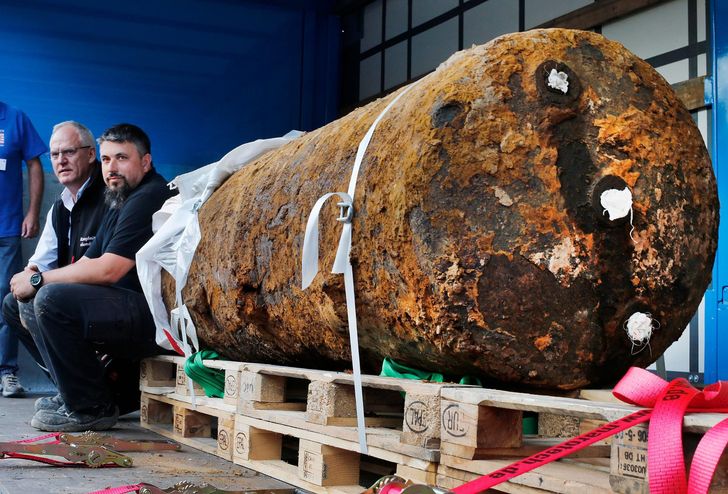
Wildfires sweeping across Europe this summer have revealed a dangerous legacy beneath scorched forests and fields: unexploded bombs and mines left behind from World Wars I and II.
The aging munitions pose an additional threat to firefighters, emergency responders and residents as extreme heat and changing weather conditions disturb areas once considered relatively safe.
Several of the weapons have detonated amid the intense heat, with explosions reported in France, Belgium, Germany and the Netherlands. In the Netherlands, a bomb-disposal unit was sent to inspect a forest threatened by flames near Limburg, an area that saw heavy fighting in 1944.
Sarah Njeri, a peace and conflict scholar at London’s School of Oriental and African Studies, said the combination of climate change, wildfires and explosions was evidence that Europe’s “climatic luck” was fading. For decades, relatively stable temperatures and predictable rainfall helped keep buried munitions undisturbed.
“Climate change is now doing the work of unburying and reactivating what was previously stable,” Njeri said. Fires can ignite old munitions but can also burn away the scrub and brush that hides them.
This year’s wildfire season was intensified by heavy rainfall in January, which encouraged vegetation to flourish before the growth dried out under summer conditions. A combination of extreme temperatures, drought, low humidity and strong winds then created highly favorable conditions for fires, according to a study released last month by the World Weather Attribution group.
Flames Sweep Across Former Battlefields
As the fires spread, they crossed areas long recognized as containing unexploded wartime ordnance, exposing a lethal remnant of conflicts that ended decades ago.
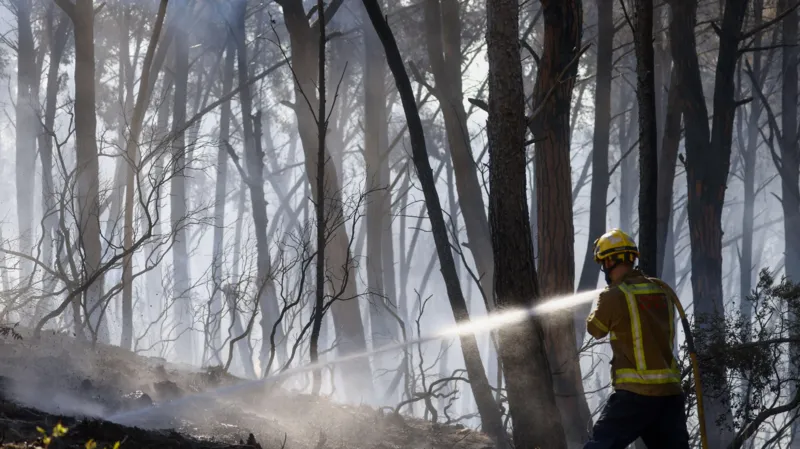
Near Bordeaux in southwestern France, a major wildfire burned through tinder-dry woodland and uncovered a cache believed to contain ammunition dating to World War II.
In Belgium’s eastern province of Liege, Gov. Herve Jamar said “a few sporadic detonations” had been heard recently. Emergency services were adjusting their operations because of the possibility of buried munitions in areas affected by the fires. Although he said firefighters were not in immediate danger, local media published photographs showing a firefighter handling a rust-covered bomb.
During World War II, bombs, mines and booby traps were scattered throughout the High Fens, a dense peat-bog forest in the province. Bernard Collard, a local historian who operates the Truschbaum Museum near Belgium’s German border, said the weapons killed six civilians during the four years following Germany’s surrender in 1945.
“When you go into a forest like this, you are not sure where the explosives are,” he said. He remembers his father detonating a found bomb in a quarry.
The fire in the High Fens, which extends into Germany, is burning across an area marked by some of the fiercest fighting of World War II. Nazi and Allied forces fought there during the Battle of the Bulge.
The blaze is also near the locations of two less widely known battles around Elsenborn Ridge and in the Hurtgen Forest. The fighting in the Hurtgen Forest lasted 88 days and resulted in the deaths of approximately 33,000 American and 28,000 German troops.
Belgium Handles Thousands of Explosive Remnants
Collard has permission to use a metal detector across former battlefields that have since become forests, agricultural land and pasture. His discoveries have included mortar shells, machine guns, helmets and cigarette cases, as well as a human skeleton.
“You never know what you might come across, and you shouldn’t take it lightly,” Collard said while standing in a field that was once the scene of intense fighting. Nearby, blueberry bushes now grow over old foxholes, trenches and artillery craters.
He regularly works alongside Belgium’s demining specialists. “It’s part of our history. We live with it,” Collard said.
Jonas Tepe, a spokesperson for Germany’s North Rhine-Westphalia state, said unexploded ordnance becomes particularly hazardous during wildfires because extreme heat can cause explosives to detonate.
Belgium’s Ministry of Defense said it receives requests from the region roughly once a week to help make explosives safe. However, the ministry does not classify the area as a “hot spot” compared with other parts of Belgium. Calls are more frequent in the west, including around Ypres, where farmers still refer to the annual plowing of fields as “the iron harvest” because it regularly uncovers remnants of World War I trench warfare.
Nationwide, Belgium’s Explosive Ordnance Disposal and Destruction Service handles more than 3,000 reports each year and removes between 200 and 250 tons of munitions left behind by the two world wars.
Drought Also Reveals Hidden Weapons
Extreme drought has created another pathway for wartime explosives to reappear, as declining water levels in rivers and lakes expose weapons that have remained submerged for decades.
In Slovakia, falling levels of the Danube River revealed two naval mines. Police recovered the weapons and placed them in a trench for controlled destruction. In Hungary, authorities shut Budapest’s Margaret Bridge after a World War II bomb was discovered near its base as water levels dropped.
Germany also uncovered a World War II-era bomb as the Rhine River receded.
Christina Greene, a University of Arizona researcher who co-authored an article with Njeri examining the risks posed by wildfires and unexploded ordnance in Europe, said climate change was causing the consequences of past conflicts to resurface.
Greene said “the legacy of war keeps creeping up” because of climate change.
“It’s reliving the legacies of war and conflict in a way that we haven’t had to deal with in a while in certain places.”