



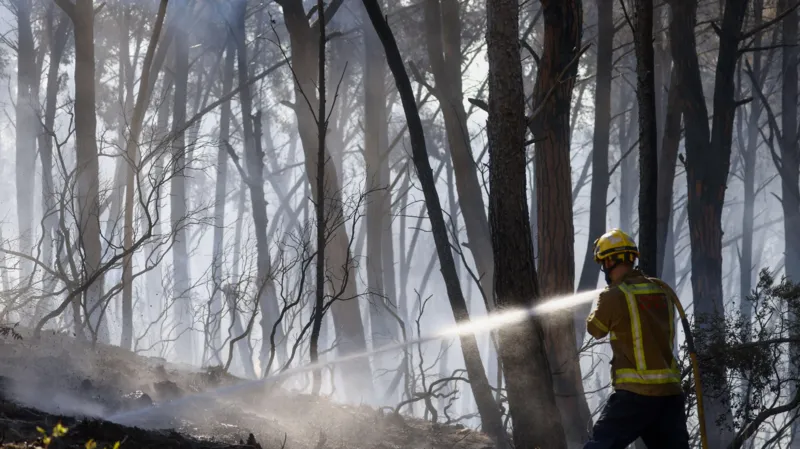
Toronto recorded the worst air quality among major cities worldwide on Wednesday as smoke from wildfires in northwestern Ontario blanketed the skies and drifted into the northeastern United States, triggering health warnings and urging residents to reduce outdoor exposure.
Wildfires continue to burn across sparsely populated regions hundreds of miles away from Toronto, sending thick smoke across a large area.
However, the fires themselves are not posing a direct threat to major cities.
Environment Canada recorded Toronto’s Air Quality Health Index at 10+, a level categorized as “very high risk.” Forecasts indicated that dangerous air conditions could remain in place until Thursday night.
New York City began experiencing the impact of the smoke several days earlier, with neighbouring New Jersey preparing to host the World Cup final on Sunday. Local officials issued air quality alerts after pollution levels reached unhealthy levels, advising residents to limit strenuous outdoor activities and take additional breaks if they must remain outside on Wednesday and Thursday.
The National Weather Service warned that smoke from the wildfires could continue affecting the region through the end of the week.
“We probably haven’t seen the worst of it yet for New York City. We probably haven’t seen the worst of it yet for the Great Lakes and upstate and New England yet either,” said Dan Westervelt, Lamont associate research professor at Columbia University.
IQAir, a Swiss-based air quality monitoring company, ranked Toronto as the city with the poorest air quality globally, ahead of Kinshasa and Delhi. New York City was ranked fifth.
Wildfires also left two groups of children from Minnesota stranded during a camping trip in the Canadian wilderness organized by the YMCA, a global Christian youth organization, according to the Minnesota Star Tribune, which cited a YMCA official. The report said one group was evacuated by helicopter with assistance from the Canadian military.
“Both groups have been rescued and are on their way back home to safety,” Minnesota Governor Tim Walz said on X.
The City of Toronto canceled the FIFA Fan Festival and the England-Argentina World Cup watch party scheduled at Nathan Phillips Square because of deteriorating air quality.
In the New York metropolitan area, more than 80,000 spectators are expected at an outdoor stadium in New Jersey for the World Cup final on Sunday. An additional 50,000 people are expected to gather in Manhattan’s Central Park to watch the match, despite hazy skies caused by the smoke.
New York Governor Kathy Hochul said on social media that smoke and haze from Canadian wildfires had created unhealthy air conditions across the state. She urged residents, particularly those with existing health conditions, to take precautions.
The Government of Canada said the 2026 wildfire season started more slowly than in 2023 and 2025, the country’s two most severe wildfire years, but warned that above-average temperatures were increasing the likelihood of more fires.
Government figures showed that about 835 active wildfires were burning across Canada on Wednesday, with 112 classified as out of control. Approximately 1.9 million hectares (4.7 million acres) of land have been affected, with most fires concentrated in Manitoba, Saskatchewan and Ontario.
Greg Evans, a professor of chemical engineering and applied chemistry at the University of Toronto, said the city was facing the combined effects of extreme heat and wildfire smoke.
“I expect that this will occur more frequently over the coming decades so cities and residents need to prepare for this in the future,” he said.
Toronto resident Paula Oreskovich said she noticed the smoky smell and haze when she went outside in the morning. She expressed concern over worsening air quality, noting that wildfire smoke has become a repeated feature of recent summers.
“I think you have to be silly if you’re not going to be concerned about climate change. It’s definitely here, it’s definitely happening, and it’s happening globally,” Oreskovich said.