





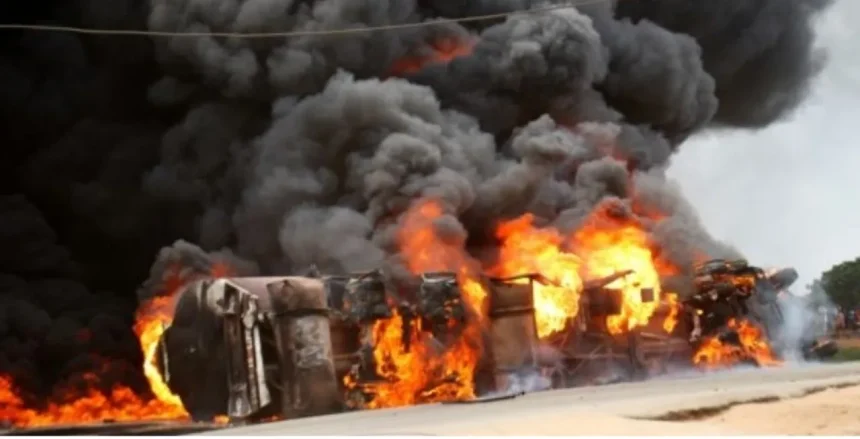
A tanker navigating the Strait of Hormuz off the coast of Oman caught fire early Tuesday after it was struck by a projectile, according to the British military.
The incident marks the latest attack on a commercial vessel transiting the strategically vital waterway at the entrance to the Persian Gulf, a route that has historically carried about one-fifth of the world’s seaborne oil and natural gas trade during peacetime.
Iranian state television reported that the liquefied natural gas tanker was targeted after allegedly ignoring warnings, though it stopped short of officially claiming responsibility for the attack. Tehran has consistently maintained that vessels should only use routes approved by Iranian authorities when passing through the strait and has previously been accused of targeting ships that sailed along an alternative corridor closer to Oman’s coastline.
The latest incident comes as the United States seeks to advance negotiations with Iran aimed at fully reopening the Strait of Hormuz, curbing Tehran’s contested nuclear program, and securing a lasting end to the conflict that began on Feb. 28. However, earlier attacks in the waterway have triggered U.S. retaliatory strikes, followed by Iranian attacks on Gulf Arab states, fueling fears of a broader regional escalation.
Diplomatic discussions between Washington and Tehran are reportedly suspended until after the burial of Iran’s late Supreme Leader Ayatollah Ali Khamenei, who was killed during the early stages of the war. In recent days, mourners attending his funeral have increasingly been seen chanting calls for the death of U.S. President Donald Trump.
Khamenei’s body was flown overnight to the Shiite religious city of Qom, where thousands of mourners gathered on Tuesday to pay their respects.
The United Kingdom Maritime Trade Operations (UKMTO) said the tanker was struck near Limah, Oman, while attempting to travel south through the Strait of Hormuz toward the Gulf of Oman. According to the agency, the projectile impacted the vessel’s port side.
UKMTO added that there had been no environmental damage resulting from the attack and confirmed that investigations into the incident are underway.
Iranian state television, citing unnamed sources, suggested that the operation targeted a tanker transporting natural gas from Qatar. Despite the report, Iranian authorities have not issued any formal statement claiming responsibility for the strike.
Last Thursday, Iran’s joint military command warned that all oil tankers transiting the Strait of Hormuz must adhere to routes authorized by Tehran. The military also cautioned that any U.S. military interference in the waterway “will be met with a rapid and decisive reaction.”
Speaking at the White House on Monday, President Donald Trump warned Tehran to reach an agreement with Washington.
“I’d rather make a deal, because I don’t want to affect 91 million people,” Trump said. “We can knock down their bridges in one hour. We can knock out their energy supply.”
As part of an interim arrangement, Iran and the United States had agreed to permit ships to pass through the strait without fees for 60 days. Tehran, however, has insisted on controlling designated shipping routes and intends to impose transit charges afterward, a proposal that would depart from decades of established maritime practice.
The United States and several Gulf Arab nations have rejected any plan allowing Iran to levy fees on vessels using the strait. Previous efforts by Oman and a United Nations agency to establish an alternative route closer to Oman’s coast had already sparked attacks across the Middle East, underscoring the fragile security environment.
Shipping intelligence firm Kpler reported that at least 108 vessels transited the Strait of Hormuz over the weekend using multiple navigation routes.
Meanwhile, Iranian state television broadcast live aerial footage on Tuesday showing hundreds of thousands of mourners walking toward Jamkaran Mosque, south of Qom, for funeral ceremonies honoring Khamenei. The mosque holds special significance in Shiite Islam as it is traditionally believed to have once hosted Muhammad al-Mahdi, the 12th and final Shiite imam, who disappeared in the ninth century and is expected to return to establish justice.
Banners and posters bearing images of Khamenei and his son, Iran’s new Supreme Leader Ayatollah Mojtaba Khamenei, were visible throughout the procession. Mojtaba Khamenei has not appeared publicly during the funeral events, which are scheduled to continue over several days. Reports suggest he remains in hiding after allegedly being wounded in the airstrike that killed his father.
Before the ceasefire reached in April, Israel targeted several senior Iranian officials during the height of the conflict, in some cases reportedly exploiting their public appearances to determine their locations. Israeli officials have also threatened to target the younger Khamenei.
Iranian authorities have imposed extensive security measures for the mourning period, closing roads, restricting airspace, and disrupting normal daily activities. The ceremonies, which began on Saturday, are expected to conclude on Thursday with Khamenei’s burial at the Imam Reza shrine in Mashhad, his birthplace. He was 86 years old.