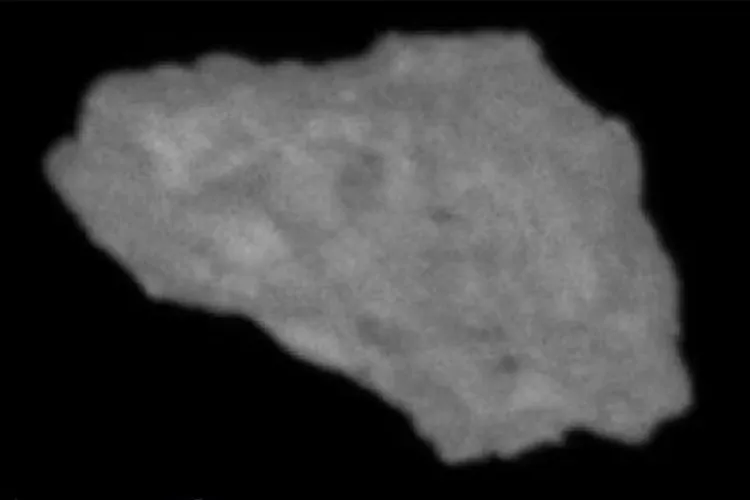
China’s Tianwen-2 spacecraft has captured a new image of Earth quasi-moon, Kamoʻoalewa. This comes after completing a 13-month journey to the tiny asteroid.
According to People, the Chinese mission reached 469219 Kamoʻoalewa, the official name of the asteroid, on July 4. Scientists first discovered the asteroid in 2016, and it has since attracted attention because of its unusual path near Earth.
The China National Space Administration said Tianwen-2 now sits about 20 kilometres from the asteroid. The agency also released a fresh image taken by the probe.
The mission aims to collect about 100 grams of samples from Kamoʻoalewa’s surface and return them to Earth. The spacecraft will leave the asteroid in April 2027, while its return capsule should reach Earth in November 2027.
After delivering the samples, Tianwen-2 will use a gravity-assist manoeuvre to travel toward comet 311P/PANSTARRS. It could arrive there in January 2035.
CNSA said the probe will continue more detailed scientific studies of the asteroid before sampling begins.
“Going forward, the probe will gradually conduct more detailed scientific explorations to obtain information on the asteroid’s shape, material composition, and internal structure. This will provide support for preparations for sampling,” the agency said.
Although scientists describe Kamoʻoalewa as an Earth quasi-moon, the asteroid does not directly orbit Earth. Instead, it orbits the Sun while staying close enough to Earth that it appears to travel around the planet.
The Planetary Society says Earth currently has seven known quasi-moons. There is also an unknown number of minimoons and possible ghost moons.
The name Kamoʻoalewa comes from the Hawaiian chant Kumulipo. According to the University of Hawaii, the name refers to a celestial object that appears to oscillate. This matches the asteroid’s movement in the sky as seen from Earth.
China’s Tianwen-2 mission could help scientists better understand the origin, structure and composition of this Earth quasi-moon. It will also support future asteroid exploration and sample-return missions.