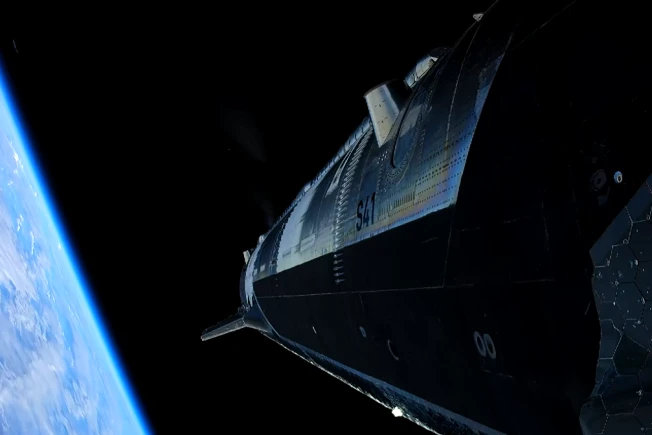
SpaceX has achieved a major milestone in its Starship programme, sending the world’s largest rocket into Earth orbit for the first time while overcoming multiple engine problems during the flight.
The Mission 14 launch took place on September 28, 2026, from SpaceX’s Starbase facility in Texas.
The vehicle lifted off at 7:48 p.m. CDT following a roughly 30-minute delay caused by propellant-loading operations and final system checks.
The launch itself came after a last-minute regulatory hurdle, with the Federal Aviation Administration granting approval for the mission just two days before the planned liftoff.
Engine failures test Starship’s redundancy
The 33-engine Super Heavy booster experienced an engine failure during its climb. Despite the malfunction, the vehicle continued its ascent, demonstrating the redundancy built into the booster’s propulsion system.
A more significant problem emerged after Starship separated from the Super Heavy. One of the spacecraft’s three vacuum-optimized Raptor engines shut down earlier than planned during the second-stage burn.
The failure created uncertainty over whether Starship would have sufficient propulsion to complete its orbital insertion and subsequently carry out the maneuvers required for a controlled return to Earth.
SpaceX engineers continued monitoring the spacecraft as it progressed through the mission. Starship ultimately reached an orbit approximately 170 miles (275 kilometers) above Earth.
However, the spacecraft did not remain in orbit for the maximum duration originally envisioned. Mission controllers shortened the flight to about two hours to reduce the risks associated with leaving the vehicle stranded in orbit or allowing it to make an uncontrolled atmospheric reentry.
Starship subsequently completed a controlled descent into the Pacific Ocean off Hawaii.
First commercial Starship mission
Mission 14 also represented another significant development for SpaceX: the flight served as Starship’s first commercial mission.
During its brief orbital journey, the spacecraft successfully released 26 Starlink V3 satellites. The payload was well below Starship’s projected maximum capacity, with the vehicle eventually expected to transport as much as 100 tonnes of cargo.
The deployment nevertheless demonstrated one of the central purposes of the Starship system — providing a high-capacity platform capable of delivering large numbers of satellites and other payloads into orbit.
Reusability remains the next major challenge
Both components of the launch system were treated as expendable vehicles during Mission 14. The Super Heavy booster and Starship were ultimately lost during their respective landing operations.
SpaceX’s longer-term objective, however, is considerably more ambitious. The company aims to recover both stages, return them to the launch area and capture them using the tower at Starbase, enabling rapid reuse.
That capability would be a crucial step toward the company’s vision of a fully reusable heavy-lift launch system.
A rocket on an unprecedented scale
The significance of the mission also stems from the extraordinary size of the vehicle involved.
Starship stands about 397 feet (121 meters) tall and has a launch mass of roughly 5,000 tonnes. Its Super Heavy booster produces approximately 16.7 million pounds of thrust at liftoff, making the system the largest and most powerful rocket ever built.
The scale is difficult to compare with earlier generations of launch vehicles. NASA’s Saturn V, which carried astronauts toward the Moon during the Apollo era, was itself a towering and enormously powerful machine. Starship, however, is designed around the fundamentally different concept of recovering and reusing the launch system rather than discarding it after a mission.
Mission 14 therefore represents more than simply another launch for SpaceX. It marks a significant demonstration of Starship’s ability to reach orbit, survive propulsion problems and deliver commercial payloads, while also highlighting the substantial engineering challenges that remain before the system can achieve routine, rapid reusability.