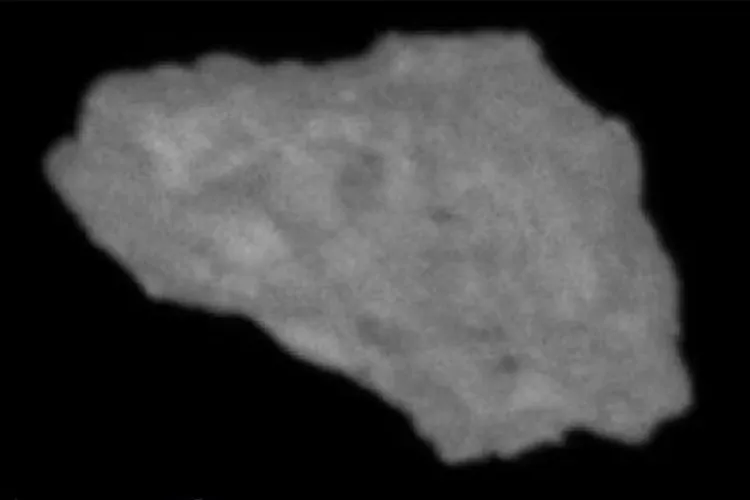
A small asteroid designated 2026 SZ2 passed within about 9,200 miles (14,800 kilometers) of Earth’s surface on Sunday, September 20, making a relatively close approach but posing no danger to the planet.
The asteroid reached its closest point to Earth at 21:19 UTC (5:19 p.m. EDT), according to data compiled by The Watchers from NASA’s Center for Near-Earth Object Studies and the Minor Planet Center.
Although some reports put the asteroid’s distance at 13,100 miles (21,100 kilometers), that figure is measured from Earth’s center rather than its surface. Once Earth’s radius—about 3,960 miles—is taken into account, the asteroid’s altitude above the ground was approximately 9,200 miles.
That brought 2026 SZ2 well inside the altitude of the geostationary satellite belt, where spacecraft orbit roughly 22,236 miles (35,786 kilometers) above the equator. However, the comparison does not mean the asteroid came close to any individual satellite. Geostationary spacecraft occupy a relatively narrow region above the equator, while an asteroid can travel through a vast volume of space.
Asteroid was detected hours before flyby
The asteroid was first spotted at approximately 06:56 UTC on September 20 by the University of Arizona’s Mount Lemmon Survey. Its discovery came about 14 hours and 23 minutes before closest approach, leaving astronomers less than a day to observe and track the object.
Additional observations were subsequently collected by observatories in Arizona, Hawaii, China and the United Kingdom. The Minor Planet Center recorded 27 observations, with 26 contributing to an orbital calculation based on an observation period of roughly one day.
The official record identifies 2026 SZ2 as an Aten-class near-Earth object, a category of asteroids whose orbits generally lie within Earth’s orbital distance around the Sun and cross Earth’s path.
NASA’s Small-Body Database provides the asteroid’s orbital solution. The Watchers estimated its relative velocity during the encounter at 7.99 kilometers per second, or about 17,900 miles per hour. Its reported absolute magnitude was 30.5, indicating that it would appear extremely faint when viewed from a standard reference distance.
Small size meant little risk
Scientists estimate that 2026 SZ2 was only 7 to 15 feet (2.1 to 4.6 meters) across. At that size, an object entering Earth’s atmosphere would generally be expected to break apart at high altitude rather than reach the ground as a substantial impactor.
The size estimate itself is uncertain. Astronomers generally calculate the dimensions of small asteroids from their observed brightness, but brightness also depends on how reflective the object’s surface is. Consequently, two asteroids with similar apparent brightness can have significantly different physical sizes.
The asteroid’s trajectory is also less certain than those of objects that have been monitored for years. Its orbit was calculated from observations spanning only about one day, meaning additional observations could alter the precision of predictions about its longer-term path.
How close was the encounter?
Astronomers commonly express asteroid flybys using lunar distances, with one lunar distance representing the average distance between Earth and the Moon—about 238,900 miles.
At its closest, 2026 SZ2 reached approximately 0.055 lunar distances from Earth’s center. Because lunar-distance measurements use Earth’s center as the reference point, the corresponding altitude above Earth’s surface is necessarily lower.
The September 20 encounter was close by astronomical standards, but it was not the closest asteroid encounter of the year.
As of September 21, 118 known asteroids had passed within one lunar distance of Earth during 2026, according to the figures cited in the report. Asteroid 2026 SZ2 matched the 0.055-lunar-distance approach of 2026 RT34, which passed Earth on September 13.
Two objects had come closer during the year: 2026 PC6, which passed at about 0.053 lunar distances in August, and 2026 JN4, which entered Earth’s atmosphere in May.
Small asteroids can arrive with little warning
The encounter also highlights the continuing challenge of detecting very small near-Earth objects before they approach the planet.
Earlier in September, asteroid 2026 RW1 entered Earth’s atmosphere over the Indian Ocean roughly seven hours after it was discovered. It was reported as the 13th known asteroid to have been detected before impact.
Such objects can be difficult to spot because of their small size and faint appearance. Survey telescopes are increasingly capable of detecting them, but some are still identified only hours before an atmospheric entry or close approach.
The risk changes considerably as asteroid size increases. The object responsible for the 2013 airburst over Chelyabinsk, Russia, was estimated to be about 20 meters across. Its explosion in the atmosphere shattered windows and injured around 1,500 people, most of them as a result of flying glass.
At an estimated 2.1 to 4.6 meters, 2026 SZ2 was substantially smaller.
Closer than Apophis—but vastly smaller
NASA’s Jet Propulsion Laboratory has pointed out that small asteroids in the 5- to 10-meter range have been observed passing Earth at distances comparable to those expected for the much larger asteroid Apophis.
Apophis, estimated at roughly 340 meters across, is scheduled to pass about 19,000 miles above Earth’s surface in April 2029. That encounter will attract significant attention because of Apophis’ size.
By comparison, 2026 SZ2 actually came closer to Earth than Apophis is expected to in 2029, but the two objects are dramatically different in scale. Apophis is roughly 100 times wider.
Close approaches provide a test of detection systems
For astronomers, the significance of 2026 SZ2 lies less in the encounter itself than in what it demonstrates about the ability to find small objects.
Modern sky surveys continue to identify increasing numbers of small asteroids. A growing number of recorded close approaches does not necessarily mean that more asteroids are suddenly coming close to Earth. It also reflects improvements in the ability of telescopes and automated survey systems to detect objects that might previously have gone unnoticed.
The September encounter demonstrates both sides of that progress: astronomers detected 2026 SZ2 before its closest approach, but they had only hours to refine its trajectory and assess the encounter.
There is no action required from the public because of the flyby.
For future claims about potentially dangerous asteroid approaches, NASA’s Center for Near-Earth Object Studies and the Minor Planet Center provide authoritative information on orbital calculations, close-approach distances and observation records. Reports should also be checked carefully to determine whether a quoted distance is measured from Earth’s center or from its surface.
For 2026 SZ2, the remaining uncertainties concern primarily its exact size, composition and long-term orbital trajectory. Additional observations could improve those estimates.
The asteroid’s passage ultimately offered a striking example of how close small objects can come without posing a significant hazard. At roughly 9,200 miles above Earth’s surface, 2026 SZ2 passed considerably closer than the geostationary satellite altitude. But its small size meant the encounter was not a threat—and its detection before the flyby demonstrated that asteroid-survey programs can sometimes identify even small objects before they reach their closest point, although the warning period can still be measured in hours rather than days or weeks.