




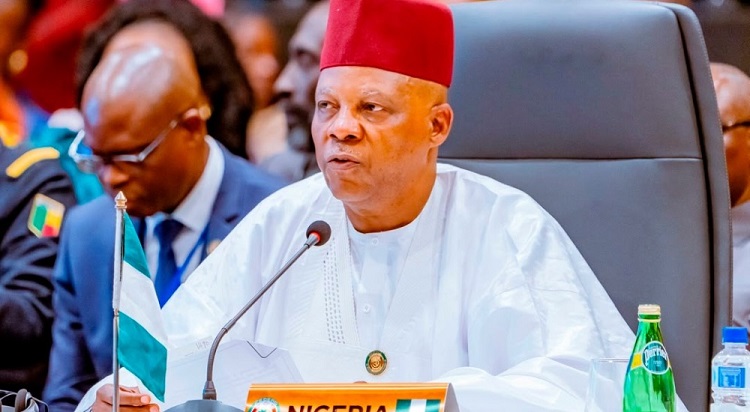
Vice President Kashim Shettima has arrived back in Nigeria after representing President Bola Tinubu at the 18th BRICS Leaders’ Summit in New Delhi, India, where he engaged Indian authorities and other BRICS members and partners on ways to deepen Nigeria’s economic and diplomatic relationships.
Shettima returned on Tuesday after attending the summit’s high-level meetings and holding several bilateral discussions covering areas such as trade, investment, energy, technology, healthcare and other sectors considered strategic to Nigeria’s development.
One of the key engagements during the visit was his meeting with Indian Prime Minister Narendra Modi, where discussions centred on strengthening economic ties between both countries, including the possibility of India resuming larger purchases of crude oil from Nigeria.
The discussions took place amid a sharp reduction in the volume of trade between Nigeria and India. Bilateral commerce, which stood at approximately $14.95 billion in the 2021–2022 financial year, declined to $7.13 billion in 2024–2025 before rising again to roughly $9 billion in 2025–2026.
Indian High Commissioner to Nigeria, Abhishek Singh, had earlier provided the figures, linking a substantial part of the decline to the reduction in India’s purchase of Nigerian crude.
Against that background, Modi advocated a return to stronger crude oil purchases from Nigeria, saying improved energy cooperation could contribute to rebuilding bilateral trade and commercial relations.
Shettima, in response, indicated that the Nigerian government would consider the proposal as part of the Tinubu administration’s strategy to attract fresh investments and establish partnerships that could strengthen the country’s productive capacity.
The Vice President nevertheless emphasised that Nigeria was interested in broadening its economic relationship with India beyond the traditional focus on the exchange of commodities.
He pointed to pharmaceuticals, defence, digital technology and the creative sector as areas with significant potential, stressing that cooperation with India should generate employment, encourage the transfer of knowledge and technology, and create greater economic opportunities for Nigeria’s large youth population.
The Nigerian and Indian leaders also considered possible collaboration in renewable and clean energy, electricity, healthcare, fintech and other emerging areas of mutual interest.
Shettima said the administration was seeking partnerships capable of supporting local manufacturing and increasing value addition within Nigeria instead of maintaining an economic relationship primarily based on commodity transactions.
During his visit, the Vice President also held discussions with World Trade Organisation Director-General, Ngozi Okonjo-Iweala, reaffirming Nigeria’s support for multilateral cooperation and the pursuit of a global economic system that offers greater inclusion.
While addressing the BRICS summit, Shettima conveyed President Tinubu’s call for reforms to global governance structures and international financial institutions.
He also presented Nigeria as a strategic gateway to Africa’s expanding consumer market through the African Continental Free Trade Area, while calling for stronger cooperation with BRICS countries and partner nations in areas including agriculture, artificial intelligence, digital infrastructure, manufacturing, healthcare, energy and human-capital development.
The Federal Government equally highlighted India’s women-led self-help group system as a model from which Nigeria could draw lessons in expanding women’s economic participation.
Minister of Women Affairs, Imaan Sulaiman-Ibrahim, said the government was adapting aspects of the Indian approach through the Nigeria for Women Programme Scale-Up and Women Affinity Groups, with the objective of widening women’s access to funding, skills development and markets.
She said increasing the number of women participating in productive economic activities was essential to the administration’s target of building a $1 trillion economy.
“Women’s economic empowerment is fundamental to our ambition of building a $1 trillion economy. We must deliberately bring millions more Nigerian women into productive economic activity,” the minister said.
Modi also thanked Nigeria for the hospitality extended to the large Indian community residing and operating businesses in the country.
Nigeria and India agreed that greater involvement of the private sector would be essential to expanding their bilateral relationship, particularly in industries where Indian companies possess significant expertise and where there is strong demand in Nigeria.
The two countries also pledged to maintain regular political and economic engagement through the India-Africa partnership framework as well as other multilateral channels.
Politics Nigeria reported that Shettima left for New Delhi, India, on Friday as the Federal Government intensified efforts to expand Nigeria’s economic partnerships and strengthen its strategic relations with emerging global powers.