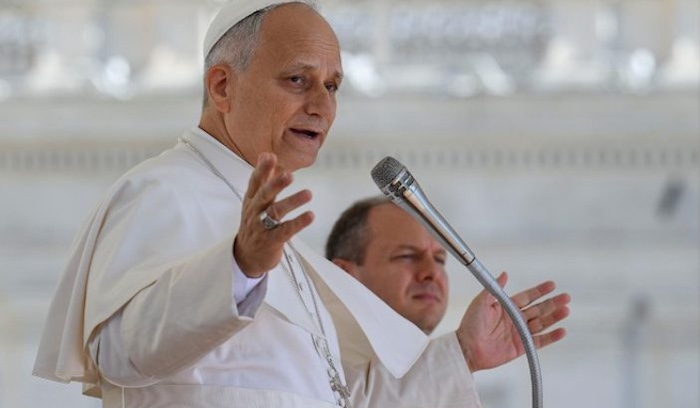
Pope Leo has called on governments worldwide to slow down the rapid development of artificial intelligence, warning that unchecked technological growth could deepen global conflict, spread misinformation, and push humanity toward a future of unending war.
The appeal came in his first major doctrinal document released on Monday, a nearly 43,000-word encyclical titled “Magnifica Humanitas” (Magnificent Humanity), which lays out one of the most forceful papal interventions yet on AI, global conflict, and modern ethics.
Leo, the first US pope, urged political leaders to take greater responsibility for regulating AI systems, insisting that societies must not surrender control of powerful technologies to private interests alone.
“What is needed is a more active political involvement that is capable of slowing things down when everything is accelerating,” he wrote.
He further called for robust legal frameworks, independent oversight, informed users and a political system that does not abdicate its responsibility, stressing that global policy must keep pace with technological acceleration.
The pope also warned that competition between AI companies risked becoming dangerously unchecked, calling for a cooling of the race to dominate emerging technologies.
Addressing the use of AI in warfare, Leo issued one of his strongest statements yet, insisting that such systems must never be given autonomous lethal authority. Any deployment of AI in military operations, he said, must be subject to the most rigorous ethical constraints, adding that it is not permissible to entrust machines with life-and-death decisions.
The encyclical also broadened its focus to global conflict, lamenting what it described as a rising culture of violence and weakening international cooperation.
“The past 60 years have been marked by conflicts of astonishing brutality, often affecting civilian populations on a massive scale,” he wrote.
“Humanity is slipping into a violent culture of power, where peace no longer appears as a responsibility to be taken on, but as a fragile interval between conflicts,” he added.
Leo also questioned long-standing Church teaching on war, declaring the traditional doctrine of “just war” increasingly obsolete.
“The ‘just war’ theory which has all too often been used to justify any kind of war, is now outdated,” he stated. “The use of force, violence and weapons reflects a relational poverty that always has disastrous consequences for civilian populations.”
He warned that some world leaders could even resort to war as a political distraction. “We cannot rule out the possibility that some leaders may consider armed conflict as an effective way of diverting attention from domestic problems and a cynical tool for managing difficulties,” he wrote.
The pope also condemned emerging forms of exploitation linked to the AI industry, describing them as new forms of slavery, including unsafe labour conditions in resource extraction and technology manufacturing.
“In some regions of the world, children and adolescents work in dangerous conditions, crushing the materials from which rare earth elements are extracted,” he wrote. “The bodies of these people are scarred, injured and worn down so that computational flow may continue uninterruptedly,” he added, warning that the situation deeply challenges the moral conscience of our time.
Leo also made a rare acknowledgment of the Church’s historical role in slavery, offering an apology on behalf of the institution. “This constitutes a wound in Christian memory,” he wrote. “For this, in the name of the Church, I sincerely ask for pardon.”
Drawing on biblical imagery, he compared unchecked technological ambition to the Tower of Babel, warning against human systems built without moral grounding.
“With the heart of a shepherd and a father, I ask everyone to abandon the construction of yet another Tower of Babel and to join forces in building up the common good,” he stated.
He urged global leaders and citizens not to succumb to despair over the scale of AI’s risks. “A subtle temptation may emerge, namely the thought that the problems are too big and we are too small,” he wrote. “Yet, no one is without responsibility. We all have our own areas for action.”