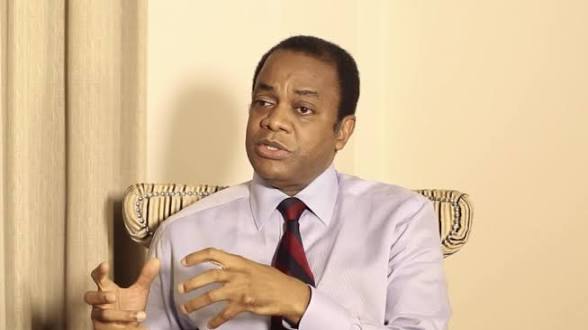
The presidential candidate of the People’s Redemption Party, Donald Duke, has criticised the rising cost of crude oil production in Nigeria, attributing much of the increase to security expenses and ageing infrastructure.
He argued that the country spends disproportionately on protecting its oil resources, a situation he said has contributed to higher production costs and the persistent rise in petrol prices.
Duke made the remarks during an interview with ARISE NEWS on Thursday, where he advocated measures to reduce the cost of producing and refining crude oil. According to him, addressing the underlying expenses associated with the petroleum sector could make petrol more affordable and help ease the financial burden on Nigerians.
“The actual production cost of a crude in Nigeria is anywhere between $12 and $15. What takes it up to $25 or $45 is security costs and dilapidated infrastructure. So you’re paying more for security than producing the oil and even the NNPC says that they’re trying to bring it down to $20 a barrel. So in other words, the oil producing companies have added the security. You can’t tell me that you pay about $10 or $15 to secure one barrel that is produced actually between $12 and $15,” he said.
The former governor of Cross River State maintained that the government should focus on improving citizens’ economic productivity by tackling the challenges that make basic goods and services increasingly expensive. He argued that policies aimed at reducing these costs should form a central part of the government’s priorities.
“I think the fundamental objective of government is the productivity of its citizens. So you’ve got to tackle all the things that are inimical to the productivity of your citizens,” Duke said.
He identified affordable energy as a major requirement for improving productivity, questioning why Nigerians continued to pay elevated prices for petrol despite the country’s status as a crude oil producer. He also pointed to the volume of oil produced locally as a factor that should inform discussions about domestic fuel affordability.
“Now, energy is a kernel of it. Energy, capital, those things are very important. You’re an oil producing country. Supposedly you produce 1.7, 1.8 million barrels a day,” he said.
Duke further clarified that his earlier proposal was to bring petrol prices down to ₦300 per litre rather than ₦200. He argued that earnings generated from other petroleum products could be used to offset some of the costs associated with petrol, thereby creating room for a lower pump price.
“The point is, the margins that you make from other products, you can even use it and further dampen the price,” he said.
Outlining his proposed pricing structure, Duke explained that the cost of transporting crude oil and processing it into refined products should be factored into the final price. He estimated transportation expenses at $38 per barrel and refining costs at approximately $10 per barrel.
“Transportation takes it to $38. The refining costs about $10 a barrel. So that gives you $48,” he said.
He also highlighted the potential contribution of petroleum by-products to the overall economics of refining, arguing that revenue from these products could help reduce the amount consumers ultimately pay for petrol.
However, Duke conceded that his proposed target of ₦300 per litre might no longer be achievable under current circumstances. He attributed the difficulty partly to forward-sale agreements involving crude oil that he said had been entered into by the administration of the All Progressives Congress (APC). He maintained that a higher price of about ₦700 per litre would still represent a considerable reduction from the prevailing level of ₦1,300.
“The 300 figure is not tenable because the APC government, right, did a forward sale that didn’t make sense. But the reality is that you now have to blend. And if you blend it to say 700, 700 is still far better than 1,300,” he said.
To reduce the cost of supplying refineries, Duke proposed that the government first secure whatever domestic crude oil remained available before purchasing additional volumes directly from oil producers operating in Nigeria. He argued that sourcing crude locally could help lower freight expenses and reduce the overall cost of supplying refineries.
“If you don’t have the Nigerian crude, which is the fault of the same government, it’s APC. I’m coming, I’m coming. If you don’t have that crude, then you now go into the blended. What do you have and what can you buy? And try and buy it from the producers in Nigeria if they will allow you. So that at least you gain on freight,” Duke said.
He also advocated a contract-refining model in which the government would provide crude oil to a refinery, pay an agreed processing fee and retain ownership of the resulting petroleum products. Under the arrangement, he explained, the government would be responsible for determining how the refined products and by-products were distributed and sold.
“Now, you contract refine. Recall, several years back, we used to swap crude for products, right? So it’s literally the same thing. You swap this, and I gave you my breakdown that it’s $10 maximum. I’m using the maximum here, $10 per barrel for refining.
“So it’s not, and it’s your crude. So you’re giving the refinery and saying, look, we agree on a price. I pay you that price. The product is mine. I know the by-products and how I distribute it, how I sell it, you know, it is left to me,” he said.
Duke insisted that lower petrol prices remained possible even if the government could no longer achieve his initial ₦300-per-litre target. He said combining available domestic crude with additional supplies purchased from joint-venture partners could produce a lower average cost than consumers currently face.
“If you take what you have and buy it back from your JV, JV partners and blend and put it together and blend the prices, the average, it will not be 300. It will be far less than what you’re paying today,” he said.
Asked whether ₦700 or ₦800 per litre would constitute a more achievable price under the circumstances, Duke indicated that such a benchmark would be relevant if the government could not secure crude oil at its disposal.
“Benchmark. Yes. If you’re not, if the crude is not yours.”
Beyond production and refining costs, Duke dismissed concerns that reducing petrol prices within Nigeria would inevitably encourage the diversion of fuel to neighbouring countries. He argued that the government should improve border surveillance and enforcement rather than maintain high domestic prices as a means of discouraging smuggling.
“Are you going to punish your citizens for your inability to map your borders? Let me give you another solution. You see, as a government, you must constantly think of solutions to problems,” he said.
As an alternative, Duke proposed introducing distinct colours into domestically supplied fuel to make it easier for authorities to identify petroleum products allegedly moved across Nigeria’s borders. He suggested that the approach could help security agencies trace the source of fuel discovered in neighbouring countries.
“You can dye your fuel. You can dye your fuel black if you wanted to. It doesn’t affect its application. And if you dye it black and you see black fuel or green fuel around your neighbouring countries, you have NIA. They go there in cooperation with the nation’s security agencies and find out how that black fuel, which is unique to Nigeria, got there,” Duke said.