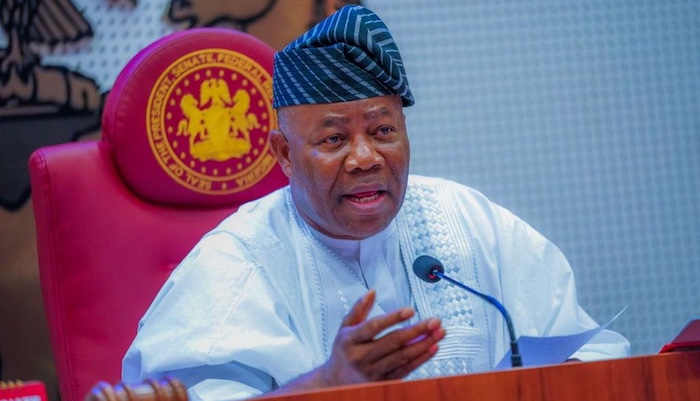
Members of the 10th Senate have voiced support for Senate President Godswill Akpabio to retain his position in the 11th National Assembly, with Senate Chief Whip Tahir Monguno and Senator Cyril Fasuyi insisting that the Senate presidency is not open for contest.
The lawmakers made their positions known during plenary on Tuesday, expressing confidence in Akpabio’s chances of returning to lead the upper chamber. Monguno, who represents Borno North, declared his support for Akpabio’s re-election, while Fasuyi of Ekiti North also endorsed the Senate President’s ambition to secure another term.
“Insha Allah, by the grace of God, the majority of us are going to make it back to the Senate, and this seat is hereby declared: there is no vacancy,” Monguno said. The Senate Chief Whip extended his declaration beyond the office of the Senate President, expressing similar support for the Deputy Senate President and other principal officers of the upper legislative chamber.
Fasuyi aligned himself with Monguno’s position, arguing that the leadership position was already occupied and should not be regarded as available for another contender. “I hereby support the motion ably moved by Senator Monguno that the seat of the Senate President in the 11th Assembly is not open to any contest. It is already occupied by Senator Godswill Obot Akpabio,” Fasuyi said.
Following the declarations, Akpabio sought to establish whether the lawmakers’ position enjoyed the backing of the wider chamber. He called on senators who agreed with the position to indicate their support by saying “aye,” prompting an audible response from the chamber. However, when he invited those opposed to speak, no audible objection was recorded. “I think that settles it,” Akpabio said.
The show of support comes amid growing political calculations ahead of the inauguration of the 11th National Assembly, with Imo State Governor Hope Uzodimma also seeking to become the next Senate President. Although the endorsements by Monguno and Fasuyi point to backing for Akpabio within the current Senate, the leadership of the next Assembly will ultimately be determined through the prescribed election process.
Meanwhile, Akpabio has urged Nigerians to exercise caution when interpreting debates in the National Assembly, warning against taking individual contributions out of context or presenting them as the Senate’s final position. His remarks followed public controversy surrounding deliberations on whether suicide should remain a criminal offence, with the Senate President insisting that legislative discussions routinely involve opposing arguments before a final resolution is reached.
“When we discuss here, we discuss for and against, and in the course of our discussions, whatever we say should not anger anybody outside this chamber, because at the end, what matters is our final decision,” Akpabio said. He maintained that lawmakers must be allowed to examine issues from different perspectives without having their comments misrepresented or used to undermine their public standing.
The controversy followed debate on the Suicide Prevention Bill 2026, sponsored by Senator Asuquo Ekpenyong, who represents Cross River South. The proposed legislation passed its second reading during Tuesday’s plenary in Abuja, triggering public discussion over the appropriate legal and social response to suicide attempts, including whether survivors should face criminal prosecution or be offered medical and psychological assistance.
Akpabio said disagreement among lawmakers was an essential part of the legislative process, explaining that members must be able to challenge proposals and support one another where necessary to develop effective laws. “We want to make the best laws, so we are bound to oppose each other, and we are also bound to support each other,” he said.
He also called on television presenters, political analysts and other public commentators to avoid attaching partisan motives to legislative discussions or drawing conclusions before the Senate reaches a final decision. “No matter the discussion, please take the final decision of the Senate into consideration. Don’t go and sit down in panels and try to do politically motivated discussions,” he added.
Addressing the broader debate on religion and violence, Akpabio rejected attempts to associate terrorism exclusively with a particular faith, arguing that violent acts should not be used to cast aspersions on entire religious communities. “Terrorists are not Muslims. Terrorists are not Christians. Terrorists are human beings who believe in taking their lives and the lives of others,” he said.
The Senate President further argued that Islam prohibits both suicide and the taking of innocent lives, cautioning against interpretations that portray suicide bombers as acting on religious promises of rewards in paradise. He said discussions about suicide-related legislation must recognise the differences between individuals experiencing mental health difficulties and those who intentionally take their own lives or kill other people.
“You have to distinguish between suicide committed by people who are mentally disturbed and suicide intentionally committed by people who are physically sound,” Akpabio said. He added that lawmakers were seeking to develop legislation capable of addressing societal challenges while taking relevant circumstances into consideration.
In defending his position on religious tolerance, Akpabio cited his record of maintaining relationships with Nigerians of different faiths during his time as governor. He said he had sponsored 5,800 Muslims to the Holy Land and more than 10,000 Christians to Rome and Jerusalem, presenting the initiatives as evidence of his support for people across religious divides.
Akpabio also referred to his longstanding relationship with members of his staff who practise Islam, saying he viewed them as family rather than defining them primarily by their religious identities. “My ADC for 19 years is a Muslim. I don’t recognise him as a Muslim. I recognise him as a brother,” he said.
He further disclosed that Muslims accounted for more than 65 per cent of his staff, maintaining that his relationships with people of different religious backgrounds contradicted any suggestion that he would speak negatively about Islam. “There’s no way I will talk down on the Muslim religion,” he said.
The Senate President called on Nigerians to concentrate on the substance and eventual outcomes of legislative proceedings rather than selectively interpreting statements made during debates. He maintained that public discussions should reflect the Senate’s final decisions and avoid attributing positions to lawmakers that do not accurately represent their views.
The plenary was therefore marked by two major developments: declarations of support for Akpabio’s bid to retain the Senate presidency in the 11th National Assembly and his appeal for a more measured public interpretation of legislative debates, particularly on sensitive issues involving suicide prevention, mental health and religion.