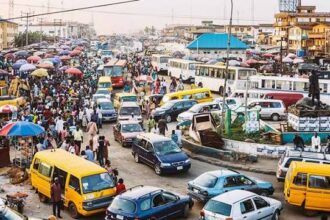




The Federal Government has proposed N2.47 trillion in the 2026 budget for the rehabilitation and reconstruction of 124 strategic roads across the country, with the projects aimed at improving transportation, supporting economic activities and strengthening critical infrastructure.
An examination of the 2026 budget indicates that the road projects are distributed across the northern and southern regions of the country.
The targeted routes serve as vital transport corridors for agriculture, commerce and the movement of goods. Analysts believe upgrading the roads could lower logistics costs, improve access to markets and drive economic expansion.
One of the major projects is the dualisation of the 105-kilometre Borno-Kano Road, which has been allocated N13.3 billion. The road is expected to facilitate the movement of agricultural produce from Borno, Yobe, Jigawa and Bauchi states into Kano, a major commercial centre in the North-West.
Also included is the rehabilitation and construction of the Lokoja-Abuja Road, a key link connecting northern and southern Nigeria. The two sections of the highway have received a combined allocation of N12.6 billion.
The Enugu-Port Harcourt Road also features prominently in the budget, with N19.6 billion earmarked for Sections III and IV. The highway is expected to improve connectivity between the South-East and South-South while linking major industrial, commercial and logistics centres.
In Lagos State, the government has proposed N4.2 billion for the rehabilitation of the 30.6-kilometre Gbagi-Apa-Owode Road in Badagry. The project is intended to improve access to the Owode/Seme border with the Republic of Benin, strengthen cross-border trade and reduce transportation costs for businesses.
Another N1.4 billion has been set aside for access roads connecting the Second Niger Bridge with Onitsha in Anambra State and Asaba in Delta State.
The Kano-Katsina Road, regarded as one of northern Nigeria’s most significant highways and a major route to the Niger Republic, is expected to receive N23.6 billion for its dualisation.
“You know, the road links Kano’s markets with Katsina and neighbouring Niger Republic, supporting domestic and cross-border trade. Farmers of crops like sorghum, millet, groundnuts, onions, rice and tomatoes can easily find a ready market in Kano. Infrastructure can be an enabler for most of the roads in the 2026 budget,” said an emerging markets analyst, Ike Ibeabuchi.
The budget also provides N7.7 billion for the Aba-Owerri-Ikot Ekpene Road, a strategic highway connecting Akwa Ibom, Abia and Imo states. The corridor links major commercial, industrial and agricultural centres and is expected to improve market access for manufacturers, including Aba’s shoe industry.
Similarly, N1.4 billion has been allocated for the rehabilitation of the Ikorodu-Shagamu Road, an alternative route to the Lagos-Ibadan Expressway, while another N1.4 billion is earmarked for repairs on the Iganmu Bridge in Lagos. Economists say the bridge is critical to linking the Lagos port corridor with other parts of the city.
The government also plans to spend N1.75 billion on rural feeder roads in Ikirun, Kwara State. Analysts say the project will connect farming communities to markets and processing centres while helping to reduce post-harvest losses.
Other infrastructure projects captured in the budget include N3.5 billion for the upgrade of the Ekiti Cargo Airport, N7 billion for the reconstruction and rehabilitation of the Abeokuta-Ibooro Road and N4.2 billion for the construction of the Ibi Bridge in Taraba State to improve connectivity across the Benue River.
In Kano State, N7 billion has been allocated for the Kano-Dayi Road to improve access for farming communities. Another N4.2 billion is proposed for the rehabilitation of the Kunya-Kanya-Barbura-Mutum Road in Jigawa State, while N6.3 billion is earmarked for the reconstruction of the FCET New Site-Bagwai-Gwarzo Road in Kano.
The budget further includes N25.2 billion for the construction of the four sections of the Ota-Idiroko Road and N3.5 billion for the dualisation of the Bende-Ohafia Road, including the construction of four bridges.
In Kogi State, N3.5 billion has been proposed for the rehabilitation of the Kabba-Iyamoye-Omuo-Ekiti-Ikole-Ifaki-Ado Ekiti corridor to improve connectivity among the affected communities. Another N7 billion is allocated for repairs to washout sections in Rivers, Delta and Akwa Ibom states, while N17.8 billion is budgeted for Phases One and Two of the dualisation of the Benin-Akure-Ijesha Road.
The government has also proposed N14 billion for the Kano Bypass and N12.6 billion for the rehabilitation of the Onitsha-Owerri Road to facilitate trade between Onitsha and neighbouring states.
According to findings by The Punch, full implementation of the proposed budget could significantly improve Nigeria’s infrastructure stock, currently estimated at between 30 and 35 per cent of Gross Domestic Product. The figure remains well below the 70 per cent benchmark recommended by the World Bank for middle-income and developing economies.
Former Minister of Finance and Coordinating Minister for the Economy, Olawale Edun, had disclosed that Nigeria faces an annual infrastructure investment gap estimated at $14 billion.
The Alvin Report noted that years of inadequate investment in infrastructure have contributed to the country’s current challenges, warning that with Nigeria’s population growing by about three per cent annually, the infrastructure deficit could widen to between $20 billion and $25 billion by 2035.
“Nigeria risks slower growth, higher poverty, and reduced competitiveness if it does not close this gap”, the report warned.
The Nigerian Economic Summit Group also observed that weak physical and technological infrastructure continues to undermine Nigeria’s competitiveness compared to peer economies. It said poor electricity supply, inadequate transport systems and limited logistics capacity have continued to increase business costs and reduce productivity.
“These shortcomings have discouraged investment, undermined efficiency, and left Nigeria lagging behind countries that have modernised their infrastructure to drive competitiveness and economic growth.
A consultant economist, Chukwunonso Iheoma, expressed concern that the full allocation may not be released, warning that failure to implement the projects would represent another missed opportunity for Africa’s fourth-largest economy.
“It is not just about how much is budgeted; it is how much is released. We have been struggling with the implementation of the budgets since this administration came to power.
“Right now, the 2025 budget is still being implemented. So, tell me, when will this budget be implemented? There is no guarantee that half of the budget will be implemented.”