The death toll from the powerful earthquake that struck south-western Japan has increased to 30, while emergency teams continue searching for survivors trapped beneath collapsed buildings and damaged infrastructure.
Rescue operations remain focused on a heavily damaged shopping centre, a paper mill and several homes destroyed by the disaster.
The 6.8-magnitude earthquake struck Kumamoto Prefecture on the island of Kyushu on Tuesday, leaving at least 62 people injured, according to the prefectural government. Authorities said nearly 5,000 members of Japan’s Self-Defence Forces (SDF) have been deployed to assist in rescue efforts despite sweltering temperatures expected to reach 35 degrees Celsius on Thursday.
Officials also reported that a 5.8-magnitude aftershock overnight further complicated the operation.
Rescue workers are concentrating efforts at the Aeon shopping centre in the town of Kashima, where thousands of shoppers were present when the quake struck. Around 170 emergency personnel are combing through the wreckage in search of survivors.
Aeon said approximately 3,000 customers were safely evacuated to a parking area before a gas explosion occurred in another section of the mall. Twelve people have so far been rescued from the collapsed structure, but six of them later died.
The company disclosed that everyone caught in the explosion were employees who had re-entered the building after customers had been evacuated. During a press conference on Wednesday, Aeon’s president bowed in apology, acknowledging the company had failed to anticipate the explosion. Investigations into the cause are ongoing.
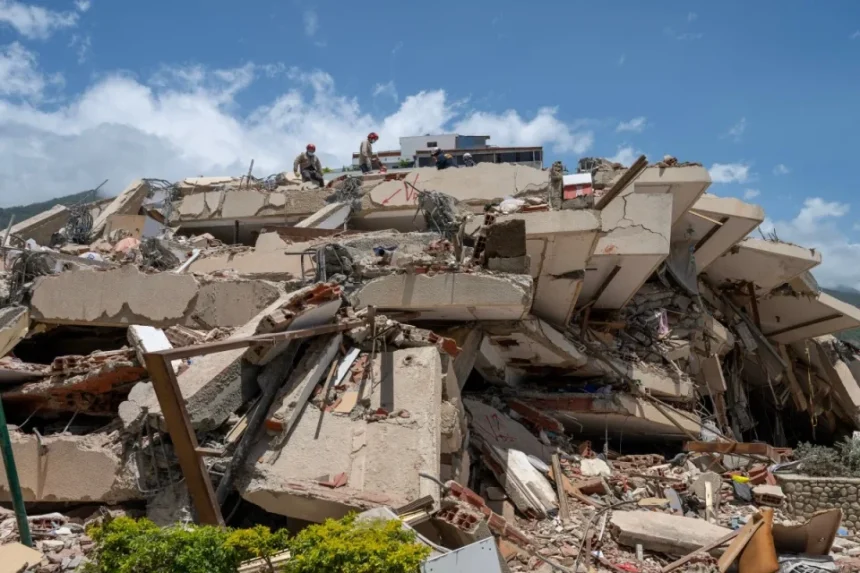
Television footage from inside the shopping centre showed collapsed ceiling sections, twisted metal and scattered debris as rescue workers wearing helmets and protective masks searched through the damaged complex.
Elsewhere, police officers and SDF personnel are continuing to search for one missing worker at the Nippon Paper mill in Yatsushiro after a chimney collapsed during the quake. Ten workers had initially been trapped, with eight confirmed dead and two sustaining serious injuries.
In the first reported foreign fatality linked to the disaster, the Vietnamese government said a Vietnamese technical intern was killed when a crane collapsed onto him at the factory where he worked.
The earthquake also severely disrupted essential services across Kumamoto. Officials said nearly 23,000 households remain without electricity, while about 75,000 homes have no running water. Approximately 15,000 residents have been relocated to 400 emergency shelters.
Defence Minister Shinjiro Koizumi announced on Wednesday evening that the SDF had begun airlifting coolers to evacuation centres in Kumamoto, while naval vessels were transporting water and food supplies to affected communities.
“We’re doing everything possible to make saving lives a priority, making efforts to deliver life-saving supplies, beginning with water,” said Koizumi.
Aerial footage released by police revealed extensive destruction, with several homes completely flattened and some swept into a nearby river after collapsing.
Residents described the earthquake as the most powerful they had ever experienced. The tremor registered the highest level on Japan’s seven-point shindo seismic intensity scale.
“It was the strongest quake I ever experienced,” Kanzo Matsumoto, 73, the operator of a luxury onsen hot spring inn in Yatsushiro, told Agence France-Presse.
Japan’s Geospatial Information Authority reported that sections of the ground shifted by as much as 87 centimetres during the earthquake.
The quake also damaged the base-isolation system at Yatsushiro Town Hall, an earthquake-resistant technology designed to reduce the impact of severe ground shaking. The system had been rebuilt following the devastating earthquakes that struck the region in 2016.
The disaster has also affected industrial production across Kyushu, prompting several automotive and semiconductor manufacturers to suspend operations. Toyota announced it would halt activities at three regional plants through Friday while assessing the impact on suppliers and logistics. Honda also suspended operations at one of its motorcycle factories until Friday.
Taiwan Semiconductor Manufacturing Company (TSMC) has resumed operations at its Kumamoto facility. However, Sony, Renesas and Tokyo Electron have temporarily halted production as assessments continue.
Kyushu serves as a major hub for Japan’s automotive and semiconductor sectors, accounting for roughly two-fifths of the region’s industrial output. Analysts believe most factory shutdowns are precautionary measures aimed at protecting workers rather than the result of significant structural damage to production facilities.
Kumamoto was previously devastated by two major earthquakes in 2016 that claimed 273 lives, making the latest disaster another significant test of the region’s resilience.