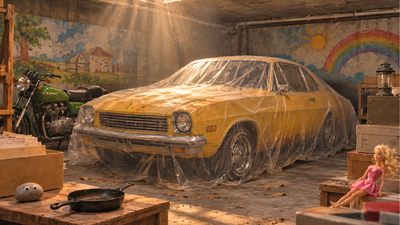
A time capsule buried beneath the ground in Seward, Nebraska, for five decades has finally been opened, revealing thousands of historical keepsakes, personal messages and a 1975 Chevrolet Vega that remarkably survived its 50-year underground stay.
The yellow Chevrolet Vega emerged from a concrete vault in 2025 with only a few visible rust spots on its hood. Its licence plate, bearing the number “2025,” marked the year the long-sealed container was finally opened. The vehicle had been protected beneath a plastic covering, according to The Drive.
The extraordinary project was initiated by Harold Davisson, who arranged for a massive 45-ton concrete vault to be sealed on July 4, 1975. His intention was for future generations to uncover its contents exactly half a century later. Guinness World Records recognises the structure as the world’s largest time capsule, a distinction it reportedly held when it was sealed and continues to maintain.
Davisson’s motivation was deeply personal. Concerned that he might not live long enough to watch his four grandchildren grow up, he wanted to leave behind something that would help them understand who he was and remember him, his daughter, Trish Davisson Johnson, told KLKN-TV.
To bring his unusual idea to life, Davisson approached construction professional Dick O’Dell with a hand-drawn proposal. O’Dell’s widow, Karen, recalled that Davisson presented the sketch and asked, “Can you build the world’s largest time capsule?”
The project did not end with the original vault. In 1983, Davisson added a pyramid-shaped structure above it, which housed a Toyota Corolla. The vehicle and its contents were removed in 2024 to test the recovery process ahead of the main excavation.
Johnson told KLKN-TV that the preliminary operation required six people to work for approximately four to five hours as they removed “all that cruddy stuff.”
However, accessing the main underground chamber proved considerably more challenging. According to Today, the operation to open the vault lasted three days. The breakthrough eventually came on June 26, 2025, after the city brought in a larger contractor equipped with more powerful drilling equipment, KLKN-TV reported.
When the vault was finally accessed, workers discovered an extraordinary collection containing more than 5,000 objects contributed by approximately 3,000 people, according to Today.
Among the recovered possessions were pet rocks, personal memorabilia, a Kawasaki motorcycle and a distinctive teal suit that reflected the fashion trends of the 1970s and was described as “very, very much 1975.”
Letters were also among the most significant discoveries. Although many had survived their lengthy burial, their envelopes had deteriorated, making it difficult to establish the identities of some of the people who originally wrote them, KLKN-TV reported.
The recovered collection was subsequently made available to the public on July 4, 2025, marking the 50th anniversary of the capsule’s burial. Some letters were distributed during the opening celebrations, while additional correspondence was arranged on display racks inside the House of Davisson.
The arrangement allowed residents and visitors to examine the surviving messages and identify letters that might have been written for them, Nebraska Public Media reported.
The yellow Chevrolet Vega also became part of plans to celebrate the remarkable discovery. According to The Drive, city officials intended to restore its running condition and feature it in a Fourth of July parade.
Johnson also expressed hope that the thousands of recovered possessions could be reunited with their original owners within six months.
Seward’s 2026 Fourth of July celebration poster subsequently advertised a presentation by Johnson about the time capsule at the House of Davisson. However, the announcement did not specifically mention the Chevrolet Vega, and its eventual restoration, parade appearance and the completion of the planned return of personal belongings could not be independently confirmed.
A contrasting fate for another buried car
The Nebraska discovery also highlights how differently vehicles can fare after decades underground.
Unlike the Chevrolet Vega, which emerged in relatively impressive condition, a Plymouth Belvedere buried inside a concrete vault in Tulsa, Oklahoma, in 1957 suffered extensive deterioration.
When that vehicle was uncovered 50 years later, its protective chamber contained nearly 2,000 gallons of standing water, leaving the car in significantly worse condition.
The contrasting discoveries demonstrate the unpredictable challenges involved in preserving automobiles and personal possessions underground for decades, even when elaborate protective structures are used.