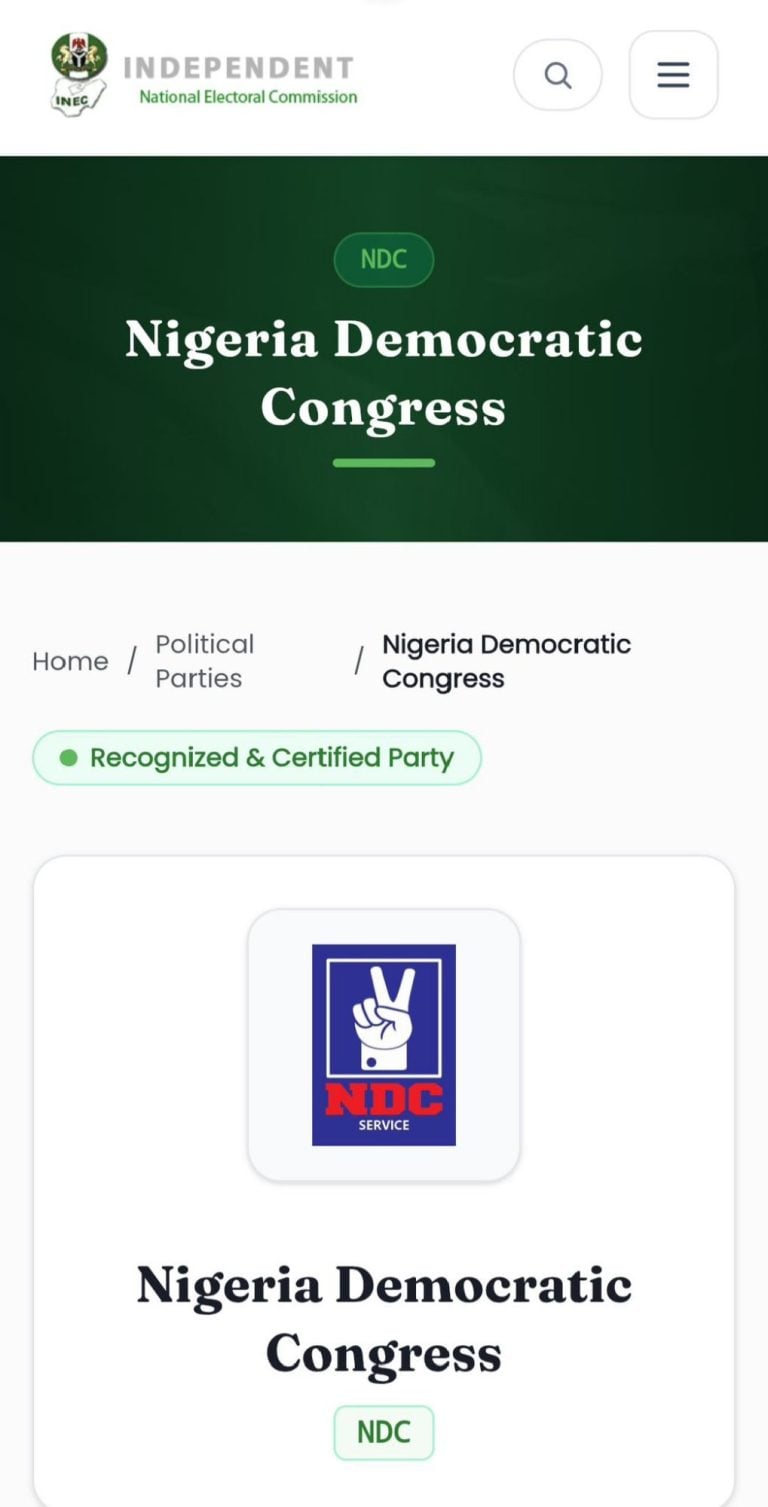
The governorship candidate of the National Democratic Congress in Nasarawa State, Musa Shugaba Abdullahi, has unveiled an ambitious development agenda centred on healthcare, education, infrastructure, economic empowerment and security.
Shugaba disclosed the plans after being affirmed as the party’s governorship candidate at its substitution primary held in the state on Wednesday. The exercise was witnessed by officials of the Independent National Electoral Commission.
The substitution primary also produced candidates for five other constituencies in the state. They include Iliya Emmanuel Ayas for Kokona West State Constituency, Lucy Kigbu Anzaku for Keffi East, Mohammed Rabo Ramalan for Keffi West, Micah Mamman for Obi I State Constituency and Hussaini Mustapha Ganuwa for the Toto/Gadabuke Federal Constituency.
The party constituted a three-member committee to oversee the exercise, comprising Dr Peter Onigah as chairman, Hon. Alfred Perekere as secretary and Tony Jude as a member.
Addressing supporters after his affirmation, Shugaba said his administration, if elected, would pursue policies aimed at improving living standards and expanding opportunities for residents across the state.
Healthcare
Healthcare featured prominently in his proposed development plan, with the candidate expressing his intention to turn Nasarawa into a major destination for medical treatment in Nigeria.
He said the state could attract patients who currently travel to countries including India, the United Kingdom, the United Arab Emirates, Qatar and Saudi Arabia for healthcare.
«“We want Nasarawa State to be the medical hub of Nigeria. People going to India, Dubai, Qatar, Saudi Arabia and the UK, we want them to come to Nasarawa State for medical treatment.”»
He said achieving the objective would require substantial investment in healthcare facilities as well as improvements in the quality and availability of medical services.
Free Education
On education, Shugaba proposed free and compulsory schooling for children and young people from age three through 19.
According to him, the policy would be aimed at cutting illiteracy and addressing some of the social problems affecting young people in the state.
He also proposed government assistance for residents aged between 19 and 25, particularly those pursuing National Certificate in Education (NCE), Ordinary National Diploma (OND), vocational training and selected healthcare-related programmes.
Under the proposal, government could either subsidise part of the cost of tuition or cover school fees, depending on available resources, while families would remain responsible for feeding and other personal expenses.
Nursing, medical laboratory science and selected vocational programmes were among the areas he mentioned as potential beneficiaries.
Shugaba said expanding access to education could also contribute to reducing youth unemployment and social vices. He further advocated a combination of conventional and religious education as part of efforts to prepare young people for adulthood.
Community-Based Infrastructure
The NDC candidate also promised broad infrastructure development across Nasarawa State, but said projects would be based on the particular needs of individual communities.
Rather than adopting a uniform approach, he said his administration would first identify the priorities of each locality before deciding on projects.
“Every community has its own specific need. What is needed here might not be what is needed in the other local government or the other one,” he said.
Economic Empowerment
Shugaba also outlined plans for an empowerment programme designed to help residents achieve greater economic independence.
He said the government would consult communities before introducing intervention programmes, arguing that residents should have a say in determining the type of support most useful to them.
“I cannot decide for you without sitting with you and saying this is what I identify for you. Maybe what I want for you is not what you want,” he said.
He linked economic empowerment to a reduction in dependence on handouts and other social challenges, arguing that people with sustainable livelihoods would be better positioned to provide for themselves and their families.
Security
On security, Shugaba acknowledged that many of the agencies responsible for maintaining law and order are controlled by the Federal Government.
He nevertheless pledged to establish closer cooperation between the state government, the Federal Government and security agencies to address insecurity across Nasarawa.
“If there is a way we can partner with the Federal Government and reduce insecurity to the barest minimum, I want to do that,” he said.
The candidate expressed gratitude for his emergence and apologised to party members and supporters for arriving late at the event, attributing his emergence to what he described as divine intervention.