The Edo State Government and the Benin Traditional Institution have pledged stronger collaboration with the National Drug Law Enforcement Agency to tackle drug trafficking, illicit cultivation and substance abuse, with Governor Monday Okpebholo and the Oba of Benin, Oba Ewuare II, promising to mobilise their respective institutions in support of the campaign.
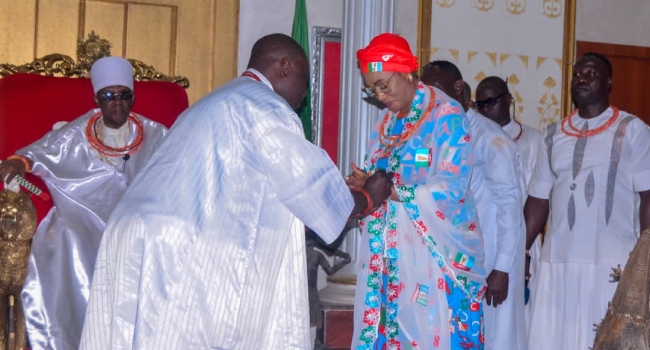
The commitment was made during separate engagements in Benin City yesterday, when the NDLEA Chairman and Chief Executive, Brig. Gen. Mohamed Buba Marwa (rtd), visited the Edo State Government House and the palace of the Benin monarch alongside senior officials of the agency. The visits were aimed at securing broader institutional and community support for efforts to curb the growing threat of illicit drugs.
The renewed push comes against the backdrop of disturbing drug-related statistics in Edo State. According to the NDLEA, its operations in the state during 2025 resulted in the arrest of more than 1,200 suspected drug traffickers and the confiscation of over 30 tonnes of illicit substances.
Beyond conventional enforcement measures, the agency is seeking to address the economic factors driving cannabis production through its Alternative Development Programme, which is designed to encourage farmers involved in illicit cultivation to embrace lawful agricultural activities such as cassava, yam and maize production.
The initiative represents an attempt to tackle the underlying economic motivations behind cannabis farming by providing affected communities with sustainable livelihood opportunities rather than relying exclusively on arrests, prosecutions and drug seizures.
Receiving the NDLEA delegation, Governor Okpebholo identified substance abuse as a major contributor to criminal activities in the country, particularly kidnapping, and assured the agency of his administration’s readiness to support its operations.
The governor argued that drug consumption was closely associated with criminal behaviour, citing experiences from security operations to explain the relationship between illicit substances and kidnapping.
“At the root of virtually every crime is the issue of drugs. From our experience, even kidnappers first ask their victims for drugs before demanding ransom. That shows that illicit drug is our enemy,” the governor said.
He praised NDLEA personnel operating in Edo State for their efforts and promised that his government would provide the necessary assistance to expand the agency’s activities and strengthen its campaign against drug-related offences.
“Your officers and men in Edo are doing excellent work. We are ready to work with you, we are ready to partner with you, and we are ready to support you with any request you bring before us,” he said.
In recognition of his administration’s commitment to the anti-drug campaign, the governor was decorated as a Grand Ambassador of the War Against Drug Abuse (WADA), an initiative established to promote public awareness and collective action against substance abuse.
Speaking on the importance of the Alternative Development Programme, Marwa maintained that sustainable solutions to illicit cannabis cultivation must address the financial considerations influencing farmers’ decisions. He argued that enforcement operations, although necessary, would have limited long-term impact without alternative sources of income for those engaged in illegal farming.
He disclosed that Nigeria had taken the lead in Africa by incorporating alternative development into its national drug control strategy. According to him, the programme has received backing from the United Nations Office on Drugs and Crime (UNODC) and the Federal Government through the Renewed Hope Agenda.
Marwa explained that the initiative was built on the understanding that cannabis farmers needed economically sustainable alternatives before they could be expected to abandon a crop that offers substantial financial returns but exposes them to the risk of arrest and prosecution.
“The growers themselves have confided in us that they are grateful for this initiative. Even though there is more money in cannabis, they will at least have peace of mind when they cultivate licit crops. With cannabis, they are perpetually ill at ease in their homes with their families for fear of NDLEA,” he said.
The NDLEA chief executive further revealed that Ondo State hosted the programme’s pilot launch in January, adding that Edo would become the next beneficiary following Okpebholo’s endorsement of the initiative.
Under the arrangement, participating farmers will be supported in transitioning from cannabis cultivation to approved agricultural ventures. The intervention will include access to farming inputs and the development of essential social infrastructure such as roads, schools, healthcare centres and water facilities to improve living conditions in affected communities.
During his subsequent visit to the palace of the Oba of Benin, Marwa appealed to the traditional ruler to use his influence to discourage cannabis cultivation and drug-related commercial activities throughout the Benin Kingdom.
He described drug abuse as one of Nigeria’s three most pressing challenges, estimating that more than 15 million Nigerians were affected by substance abuse. He said the country’s prevalence rate was about three times higher than the global average.
Marwa expressed concern that the problem had spread into schools and local communities, warning that addressing the situation required the active participation of traditional institutions and other influential stakeholders.
Providing further insight into the scale of the problem, he disclosed that cannabis represented approximately 75 per cent of the 16 million kilogrammes of assorted illicit drugs seized by the agency across the country over the past five years. The figure, he said, highlighted the considerable contribution of locally produced cannabis to Nigeria’s drug trafficking challenges.
He called on traditional rulers, religious bodies, civil society organisations and media practitioners to intensify public enlightenment and complement the NDLEA’s enforcement activities with sustained grassroots mobilisation.
“It is the job of the NDLEA to enforce the law against drug trafficking, and as well help those who are addicted to drugs with counselling, treatment and rehabilitation. But this is an assignment that we cannot do alone. It is a whole-of-society approach,” he said.
The NDLEA chairman emphasised that traditional rulers occupied a strategic position in the campaign because of their influence, authority and acceptance within their respective communities. He maintained that their involvement would help strengthen public resistance to drug trafficking and substance abuse.
Marwa also applauded Oba Ewuare II for his interventions in addressing various social challenges, particularly kidnapping and human trafficking. He attributed part of the progress recorded in the fight against human trafficking within the Benin Kingdom to the monarch’s sustained efforts.
In his response, the Oba of Benin expressed appreciation to the NDLEA chairman for acknowledging the traditional institution’s contributions to tackling drug abuse and other societal problems.
The monarch agreed that addressing social challenges required cooperation among relevant institutions and commended Marwa for his commitment to combating substance abuse and related criminal activities.
However, Oba Ewuare II disclosed that he had some recommendations concerning the operations of the agency, which he preferred to submit privately rather than discuss during the public engagement.
“I have a suggestion that I will make in writing to NDLEA. I would not want to state it here in public. I want to put it quietly as my own thinking on how to improve the work of NDLEA,” he said.
The monarch also used the occasion to announce the anticipated return of another batch of Benin artefacts taken from the royal palace during the British invasion of 1897.
According to him, 40 additional artefacts were expected to arrive in Benin City from Sweden within the week, with a delegation scheduled to travel to Lagos to receive the objects from the Swedish Museum.
“More and more artefacts are coming, the delegation will be handed over 40 artifacts from the Swedish Museum,” he said.
Oba Ewuare II also criticised individuals he accused of attempting to take possession of returned artefacts through fresh acts of looting, insisting that the palace had resisted such efforts.
“We battled prospective relooters of our artefacts, we battled them,” he said.
He maintained that the traditional institution had remained determined to protect the returned cultural treasures against any further attempts at appropriation, stressing that he would not allow such incidents to occur during his reign.
Meanwhile, Marwa extended the agency’s stakeholder engagement beyond the state government and traditional institution, taking the anti-drug mobilisation campaign to the transport sector.
He met with officials of the National Union of Road Transport Workers (NURTW) in Edo State, led by Comrade Saturday Oamen, where he urged transport operators to become active participants in efforts to prevent drug trafficking and substance abuse.
The NDLEA chairman encouraged union leaders to use their extensive networks and influence among commercial drivers and other transport workers to discourage drug-related activities, particularly within motor parks, which he identified as strategic locations for grassroots awareness campaigns.
The agency’s engagement programme was also expected to extend to religious organisations and civil society groups as Marwa continued efforts to build a broad-based coalition involving government institutions, traditional authorities, transport operators and community stakeholders in the fight against illicit drugs.