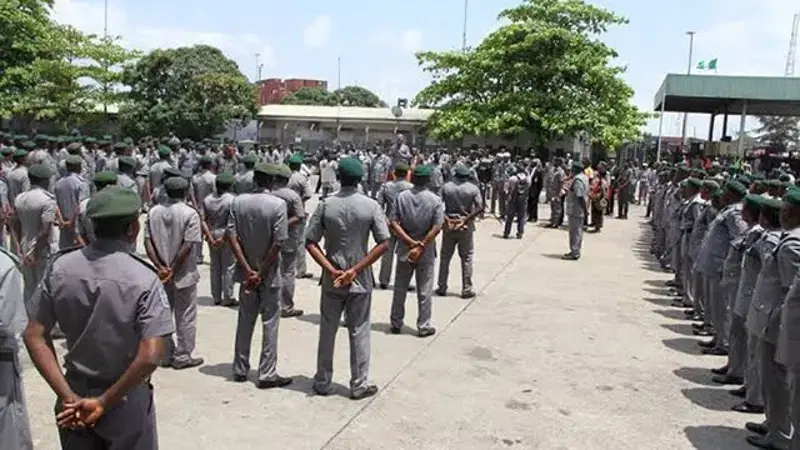
The Nigeria Customs Service is intensifying its fight against cross-border financial crimes, including money laundering and terrorism financing, through a renewed partnership with six security and regulatory institutions aimed at improving intelligence exchange and strengthening joint operations.
The initiative brings together the Economic and Financial Crimes Commission (EFCC), the National Drug Law Enforcement Agency (NDLEA), the Nigeria Police Force (NPF), the Nigeria Financial Intelligence Unit (NFIU), the Nigeria Immigration Service (NIS) and the National Counter-Terrorism Centre under the Office of the National Security Adviser. The collaboration is expected to enhance the capacity of the participating institutions to identify illicit financial activities and disrupt criminal networks exploiting Nigeria’s borders.
The development followed a three-day inter-agency engagement organised by the Customs Service from October 27 to 29, 2026. According to a statement released on Sunday by the Service’s spokesperson, Abdullahi Maiwada, the meeting was designed to address existing shortcomings in intelligence sharing and strengthen the monitoring of suspicious cross-border financial transactions.
The renewed cooperation comes against the backdrop of continuing security concerns surrounding the use of Nigeria’s borders for smuggling, narcotics trafficking, illegal financial transfers and other organised criminal operations.
Combating such activities requires coordinated intelligence gathering and timely interventions because financial crimes and terrorism financing frequently involve interconnected networks operating across different jurisdictions. Given its responsibility for monitoring the movement of goods and cargo through Nigeria’s borders, the Customs Service occupies a critical position in identifying questionable trade activities and transactions that may be associated with organised crime.
However, the success of these efforts largely depends on effective communication between border authorities, law enforcement institutions and financial intelligence agencies, particularly in the exchange of actionable information.
At the meeting, the Chief Executive Officer of the NFIU, represented by the Chief Operating Officer, Intelligence Security Service Sector, Muhammed-Mustapha, acknowledged the Customs Service’s contributions to border protection and the campaign against smuggling.
He recalled the longstanding relationship between the two institutions, pointing out that Customs was among the first government agencies to establish a working relationship with the financial intelligence body following its creation.
“When NFIU was created, NCS was the first to collaborate with us. No particular agency understands things better than how Customs does globally,” Mustapha said.
Also participating in the discussions was a World Customs Organisation (WCO) mentoring delegation led by Shahiduzzaman Sarkar. The team shared international perspectives and institutional approaches to tackling money laundering and terrorism financing, while advocating stronger operational ties with the Nigerian Customs Service.
The WCO delegation emphasised that effective responses to financial crimes require institutions to work together, rather than operate independently, particularly when dealing with criminal activities that cut across national boundaries.
Despite the shared commitment to improved cooperation, the engagement brought several institutional challenges to the fore. Participants highlighted inadequate communication channels, administrative delays and data privacy concerns as factors limiting the smooth exchange of intelligence among government agencies.
The participating institutions subsequently considered possible solutions to these challenges, with discussions focusing on strengthening communication frameworks, reducing bureaucratic obstacles and improving the coordination of intelligence-sharing activities.
As part of the programme, the Nigeria Customs Service also presented awards and World Customs Organisation certificates to participating agencies in recognition of their contributions to the collaborative initiative.
Meanwhile, the Service has intensified efforts to modernise its operations, presenting its digital transformation strategy and adoption of emerging technologies to an international audience as part of a broader drive to improve customs administration, border security and trade facilitation.
The NCS showcased its ongoing reforms at the World Customs Organisation Smart Customs Project Global Event 2026, which took place at the organisation’s headquarters in Brussels, Belgium, between October 29 and 30.
Representing Nigeria at the event, Assistant Comptroller Omolara Adedeji outlined the Service’s technological investments, including its Unified Customs Management System, popularly known as B’Odogwu, as well as the integration of artificial intelligence, data analytics and electronic cargo tracking into its operations.
Delivering a presentation titled, “Nigeria Customs Service: The Journey Towards Smart Customs,” Adedeji explained that the modernisation agenda was designed to improve service delivery, strengthen operational controls and promote greater transparency across customs procedures.
“The NCS is undergoing a deliberate transition from traditional Customs operations towards integrated digital operations. Through the Service’s Modernisation Project, we are strengthening automation, electronic processing and data-driven decision-making to build a more efficient, responsive and technology-driven Customs administration,” she said.
She identified smart technology and smart data as the fundamental components of Nigeria’s Smart Customs strategy, explaining that both pillars would drive the transition towards a more digitally integrated customs administration.
According to her, smart technology encompasses automated processes, interconnected operational systems, digital platforms and improved information and communications technology infrastructure. Smart data, on the other hand, involves the application of intelligence-led enforcement, analytical tools, data-supported risk assessment and more effective information exchange.
Adedeji further highlighted B’Odogwu as a central element of the Service’s ongoing digital transformation, noting its capacity to support automated customs procedures, electronic documentation and more efficient interactions between government institutions and private-sector stakeholders.
The presentation underscored Nigeria Customs’ ambition to leverage technology not only to strengthen revenue administration and border controls but also to create a more transparent and efficient environment for legitimate international trade.