


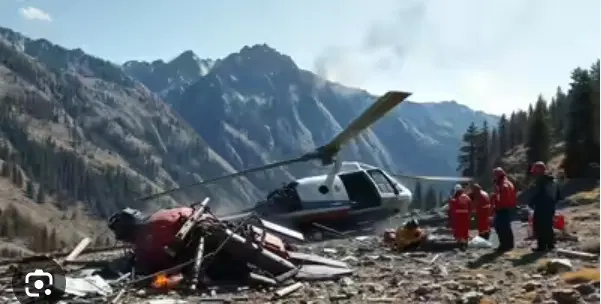
A United States Air Force officer has revealed how he survived nearly two days alone in hostile territory after his F-15E Strike Eagle was shot down over Iran, describing the ordeal as both a fight for survival and a remarkable example of military teamwork.
The weapons systems officer, identified publicly only by his callsign, “Dude 44 Bravo,” was aboard the fighter jet during a mission on April 2 targeting industrial facilities associated with Iran’s drone and missile programs, according to US Central Command commander Admiral Brad Cooper.
The aircraft was flying south of Isfahan when it was hit by a shoulder-fired missile. Bravo compared the impact to being struck by a freight train.
The two crew members initially attempted to keep the $30 million aircraft flying, but the damage proved too severe. They eventually had no choice but to eject.
The pilot, known as “Alpha,” reached the ground safely. Bravo’s descent, however, quickly turned into a life-threatening emergency.
Parachute failure
After ejecting, Bravo looked upward and discovered that his parachute had been damaged.
With no functioning canopy to slow his descent, he plunged toward the ground at an estimated 70 to 100 mph.
He later recalled that seeing the damaged parachute was among the most frightening moments of his life. He said he stopped briefly to pray before committing himself to surviving the ordeal.
The impact left him with a broken back, arm and shoulder, along with a sprained ankle. Despite the injuries, he immediately moved away from the crash site because he knew Iranian forces could be searching for the downed crew.
At daylight, he discovered that he had landed in a valley surrounded by steep cliffs. Rather than remain in the valley, Bravo decided that gaining higher ground would give him a better chance of spotting approaching forces.
He eventually climbed toward a ridgeline roughly 7,000 feet above sea level, despite his injuries.
His mindset, he later said, was simple: he could not allow fear or exhaustion to leave him vulnerable to capture.
US forces launch a desperate search
Thousands of miles away, the crash triggered an emergency response inside the US government.
Defense Secretary Pete Hegseth said he was awakened during the night and immediately sought answers about the crew’s condition and whether Iranian authorities had discovered the crash.
According to Hegseth, the US position was clear: the crew had to be brought home.
The situation soon became more complicated when images of the wreckage appeared in Iranian media and videos emerged showing armed groups searching for the American airmen.
US officials said Iranian ground forces came within several hundred meters of Bravo’s hiding place.
Meanwhile, American forces mounted an urgent rescue operation.
Approximately six hours after the crash, US personnel located Alpha and launched a daytime recovery operation. The rescue helicopters came under fire during the mission but managed to extract the pilot.
Bravo, however, remained missing.
The rescue force was forced to leave the area without him.
A message from the mountains
As darkness returned, Bravo managed to establish communication with the United States.
He informed American forces that he was injured but still moving. He also sent a brief message expressing his faith: “God is good.”
The US military considered immediately sending another rescue team, but commanders determined that the circumstances did not permit a safe operation at that moment.
That meant Bravo would have to spend another night alone in the Iranian mountains.
He had little food or water and was exposed to freezing temperatures and strong winds in the high desert.
Behind the scenes, US intelligence agencies were working to locate him while attempting to mislead Iranian forces conducting their own search.
According to the account, the CIA mounted a deception operation designed to complicate the Iranian hunt while American intelligence technology helped determine Bravo’s position.
Second rescue operation
When US commanders determined that the conditions were right for another attempt, they launched a much larger operation.
American aircraft struck Iranian Revolutionary Guard positions near Bravo’s location in an effort to clear the area before the rescue force moved in.
More than 90 US troops were subsequently deployed on the ground, marking the first reported deployment of American ground personnel inside Iran in 46 years.
Hundreds of additional personnel participated from the air, while thousands more provided logistical and operational support.
Two large transport aircraft landed on a temporary desert airstrip, while smaller “Little Bird” helicopters traveled several miles to reach Bravo on the mountain ridgeline.
When Bravo finally saw the rescue helicopters approaching, he described the sight as one of the most significant moments of his life.
But the operation encountered another potentially disastrous obstacle.
The transport aircraft became trapped after their landing gear sank into the desert sand. With the planes unable to depart, more than 90 elite US personnel were temporarily stranded inside Iran.
A specialized Air Force unit was eventually brought in to resolve the problem.
The trapped aircraft, each reportedly worth about $100 million, were destroyed to prevent sensitive equipment and technology from falling into Iranian hands. The rescue helicopters were also destroyed.
After roughly 50 hours since the F-15E had been shot down, Bravo was finally evacuated from Iran.
‘Leave no man behind’
After reaching safety, Bravo called his wife and expressed gratitude for the support and strength she had shown while he was missing.
Looking back, he said he did not view the ordeal simply as the story of one injured airman surviving behind enemy lines.
Instead, he described it as a demonstration of military preparation, intelligence, leadership, faith and cooperation across multiple branches and agencies.
For Bravo, the operation ultimately embodied the longstanding American military commitment to recovering its personnel.
He said the mission demonstrated what the United States is prepared to do to keep its promise that its service members will not be abandoned.