





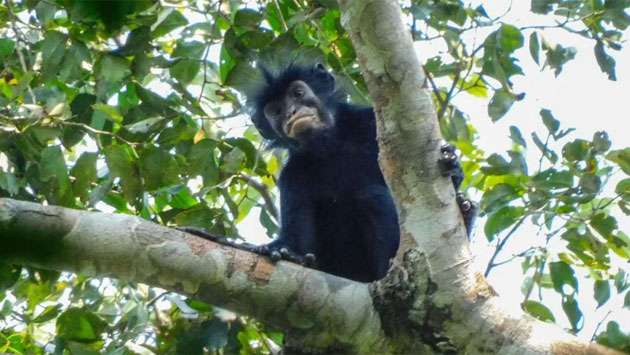
A monkey with distinctive pinkish-orange lips, a black face and dark fur, found deep within the forests of the Democratic Republic of Congo, has been officially confirmed as a new species by scientists.
The elusive primate was discovered in the dense tropical rainforest of Lomami National Park in the country’s central eastern region after years of research.
Conservationists first encountered the unusual monkey in 2008 while working in the park, but only managed to obtain a single blurry photograph.
A second sighting a decade later prompted an international team of researchers to launch a comprehensive study that ultimately confirmed the primate as a species previously unknown to science.
The discovery marks only the fifth new African monkey species to be formally identified in the past 75 years. The findings have been published in the journal PLoS One.
Junior Amboko, a PhD student at Florida Atlantic University who played a leading role in the research, said it was an “amazing feeling” to come face-to-face with an animal that so few people knew existed.
Scientists explained that “discovering” a species in this context means officially documenting and confirming that it is genetically distinct through scientific analysis. While the monkey is new to science, some local communities have long been aware of its existence and know it by the name Likweli.
According to Amboko, the monkeys are “kind of shy” and spend much of their time hidden high in the forest canopy.
“As part of our search, we interviewed people in 52 villages close to where the animals live. And only people in eight villages [had ever seen] them,” he recalled.
The research involved experts from the DRC, the United States and Germany, who named the species Colobus congoensis in recognition of the country’s rich biodiversity.
The newly identified primate belongs to the colobus monkey group. “These are really important African monkeys that don’t have thumbs,” explained Prof Kate Detwiler of Florida Atlantic University.
“They’re these herbivores of the canopy that are a critical part of the ecosystem. We think they have a lot to do with processing seeds and germination in the forest.”
Prof Detwiler suggested the monkey’s striking facial colouring may serve as a visual signal to other members of the species, possibly helping attract mates or enabling individuals to recognise one another.
Researchers also noted that the monkeys produce a distinctive “roaring” call. “You often hear them, but don’t see them,” Amboko said.
Scientists believe the species is both rare and confined to a limited section of forest that provides the specific food sources and habitat it requires for survival.
Because the monkeys are hunted for bushmeat, researchers hope that the formal recognition of Colobus congoensis as a distinct species will strengthen conservation efforts and lead to official protection.
Although the species has now been scientifically described, researchers say much remains unknown. Future studies will focus on estimating the monkey’s population size, understanding its behaviour and improving conservation strategies to ensure its long-term survival.