



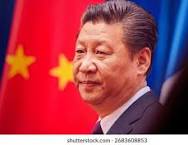
China’s President, Xi Jinping, has described relations with Pyongyang as an “invincible friendship” upon his arrival in North Korea on Monday, marking his first overseas trip of the year after a series of high-level summits in Beijing.
Beijing remains North Korea’s closest economic and diplomatic backer, serving as its largest trading partner for decades and providing crucial support that has helped the country withstand extensive international sanctions. The visit comes as tensions over North Korea’s nuclear programme remain unresolved.
According to state media footage from Xinhua News Agency, military personnel lined a red carpet as an Air China aircraft carrying Xi landed in Pyongyang. It is his first visit to the country since 2019.
North Korean leader Kim Jong Un and his wife, Ri Sol-ju, personally received Xi, who was accompanied by First Lady Peng Liyuan. The leaders exchanged handshakes as children presented bouquets to the Chinese president and his wife. A large banner welcoming Xi and praising the “unbreakable friendship” between both nations was displayed beneath their flags.
The diplomatic visit follows Xi’s recent meetings in Beijing with both U.S. President Donald Trump and Russian President Vladimir Putin, amid continued deadlock in negotiations over North Korea’s nuclear programme.
The White House previously stated that Xi and Trump had “confirmed their shared goal to denuclearise North Korea” during their talks. However, Kim’s sister, Kim Yo Jong, reinforced Pyongyang’s position on the eve of the visit, calling the country’s nuclear arsenal “the line of no retreat”.
South Korean President Lee Jae Myung also reiterated Seoul’s position, stating that efforts toward denuclearisation must continue and warning that North Korea is still actively producing nuclear materials.
Experts suggest China’s approach may be shifting. Minseon Ku, a diplomacy professor at DePaul University, said Beijing may have effectively accepted North Korea’s nuclear status while prioritising regional stability.
“Beijing probably has accepted North Korea as a nuclear state”, Ku said, adding that Xi is likely to emphasise stability over confrontation.
She further noted that China continues to balance its global rivalry with the United States while managing its strategic interests in the region.
Seong-Hyon Lee of the Harvard University Asia Center said Beijing appears to be focusing more on ensuring regime stability in Pyongyang rather than pushing for denuclearisation.
“China’s broader regional strategy benefits from a stable, heavily armed, and aligned buffer state that absorbs U.S. and allied military bandwidth,” he told AFP.
North Korea has repeatedly declared itself an “irreversible” nuclear power since negotiations between Kim and Donald Trump collapsed in 2019 over disagreements regarding sanctions relief and disarmament.
Pyongyang has since strengthened ties with Moscow, receiving military and economic support after sending troops to assist Russia in the war in Ukraine.
Some analysts believe Xi’s visit may also be aimed at counterbalancing Russia’s increasing influence over North Korea, although others argue China remains the dominant external power.
“Moscow-Pyongyang power relations are more equal than Beijing-Pyongyang; Moscow needs Kim for their war in Ukraine as much as Kim needs technology sharing and food from Russia,” Ku explained.
In a front-page article published by North Korea’s Rodong Sinmun, Xi reaffirmed long-term cooperation between both countries.
“No matter how the times change or how the international situation evolves, the traditional friendship between China and North Korea is always invincible,” Xi wrote.
Xi last met Kim in September during a visit in which he invited the North Korean leader to a military parade in Beijing marking the 80th anniversary of the end of World War II.
Meanwhile, public sentiment along the border reflects hopes for economic improvement. Jun Sang-gab, a 65-year-old South Korean tour guide living near the inter-Korean border, said he hopes Pyongyang will adopt economic reforms.
“If they (the North) establish themselves economically, there won’t be any incidents like armed unification or war” on the Korean peninsula, he told AFP.
Despite past diplomatic efforts, including Trump’s high-profile summits with Kim, progress on denuclearisation has remained limited.
North Korea continues to maintain the only formal military alliance with China, a relationship some analysts believe could serve as a strategic counterbalance to U.S. allies such as South Korea and Japan.
Observers also note growing geopolitical tensions in the region, including deteriorating China-Japan relations following remarks on Taiwan by Japanese leadership.
Analysts say Beijing is increasingly seeking to pull Pyongyang deeper into its diplomatic orbit as global power competition intensifies.