



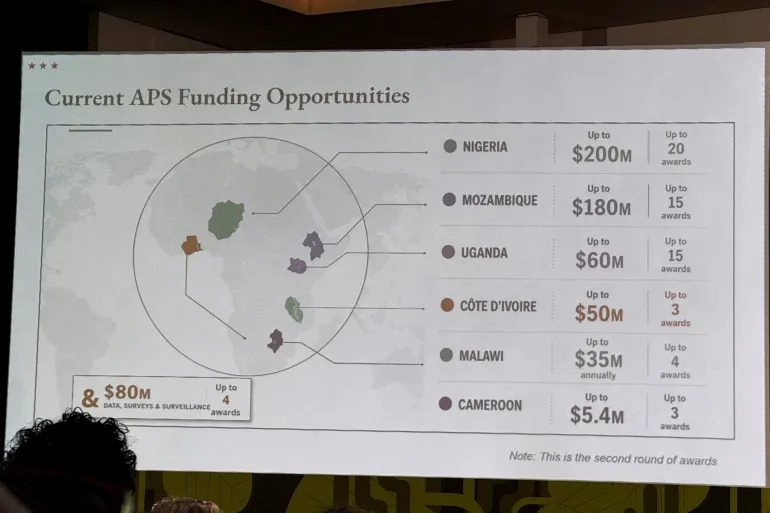
The United States Department of State has apologised after Nigeria was incorrectly identified on a map of Africa displayed during an official presentation at the AIDS 2026 Conference in Rio de Janeiro, Brazil.
The map, which highlighted six African countries including Nigeria, Mozambique, Uganda, Côte d’Ivoire, Malawi and Cameroon, contained multiple geographical errors.
Nigeria was incorrectly shown as a landlocked country, while the other nations were also misplaced on the continent. Video footage reviewed by the Reuters news agency showed the map pop up halfway through a presentation of the US State Department’s health agreements with African countries, with the map appearing to show Nigeria in the Sahara while Mozambique, which is in southeastern Africa, was placed in the eastern Horn of Africa. Ivory Coast, in West Africa, was placed on the opposite side of the continent, while boundaries on the map were mere blobs and did not represent any real countries.
The error, which drew widespread criticism after images of the map circulated online, prompted an apology from the State Department. “This was an unfortunate error caused by a team member who hastily altered the slide deck immediately before the presentation at the AIDS 2026 Conference,” a State Department spokesperson said. The spokesperson added, “We take full responsibility for the confusion and misrepresentation it caused for attendees, including our African partners.”
Reuters found that the map contained a watermark showing it was likely created with OpenAI tools, with the company saying it is investigating the incident, although the State Department has not attributed the error to artificial intelligence. Top US health envoy Jeff Graham, who heads the President’s Emergency Plan for AIDS Relief and was speaking at the conference, had past deployments including Ghana and Ethiopia according to his State Department profile.
Reacting to the incident, Cameron Hudson, a former US State Department and National Security Council official for Africa, linked the mistake to recent staffing cuts within the department. “This is a reflection of what happens when you fire one-third of the State Department, eliminate multiple layers of bureaucracy and have too junior staff performing work under-supervised,” Hudson wrote on X. “There isn’t just a cost savings when eviscerating staff and expertise. There’s a real cost in reputation and effectiveness,” he added.
The incident has sparked renewed debate over the quality of official US government presentations and its engagement with African countries. Before the Trump administration’s decision to pause HIV funding last year pending a review, PEPFAR supported up to 20 million people across the world and especially in Africa with life-saving antiretrovirals.
The programme was launched under the George Bush administration, and while PEPFAR’s core work has resumed, the US is still scaling back HIV prevention and surveillance, with Washington also planning to end the program in South Africa, which suffers the world’s largest HIV burden. The State Department said discussions at the conference were “substantive and constructive” despite the error and that it remains committed to fighting AIDS.