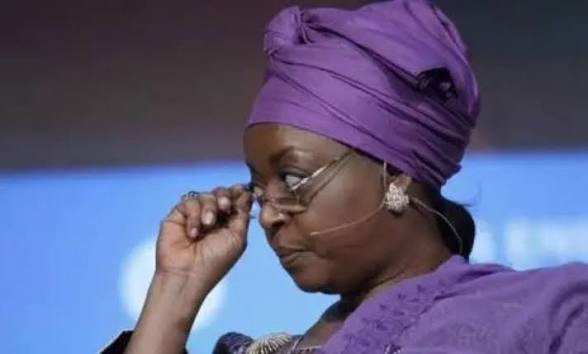
Former Nigerian Minister of Petroleum Resources, Diezani Alison-Madueke, has accused UK authorities of severely damaging her reputation following a lengthy corruption investigation that ended with her acquittal.
Speaking after being cleared of all charges, she described the 13-year probe by the UK’s National Crime Agency (NCA) as an ordeal that was both “painful and traumatic.”
In an exclusive interview with the BBC, Alison-Madueke said the prolonged legal process had disrupted her life and career. “I’ve not been allowed to travel. I’ve not been allowed to work. They destroyed my reputation and my integrity,” she stated.
The former minister was found not guilty on Wednesday at Southwark Crown Court of five counts related to accepting bribes and conspiracy to commit bribery. The trial, which began in January, centered on allegations that she benefited from lavish gifts and services provided by oil businessmen seeking government contracts.
Alison-Madueke, 65, served as Nigeria’s petroleum minister from 2010 to 2015 and made history as the first woman to lead the Organisation of the Petroleum Exporting Countries (OPEC). Reflecting on the impact of the investigation, she said, “When your freedom is taken away from you…it has a very deep impact upon you psychologically.”
Maintaining her innocence throughout the proceedings, she added: “I knew that I had never done anything nefarious and I had never done any of the heinous things I was being accused of doing.”
The former minister was initially arrested in 2015 but was not formally charged until 2023. Prosecutors alleged she received benefits from oil magnates, including luxury goods valued at £2 million from Harrods, chauffeur-driven vehicles, and access to high-value properties in London and Buckinghamshire.
During the trial, defence lawyers challenged the prosecution’s case, arguing that key evidence supporting Alison-Madueke’s innocence had disappeared in Nigeria. According to her, the missing materials included receipts that allegedly showed reimbursements had been made for expenses paid on her behalf by the businessmen.
“Those items were taken away by our intelligence forces” from her Abuja residence in 2015, she said, noting that she has never been informed of their whereabouts.
Former President Goodluck Jonathan, under whose administration she served, submitted evidence to the court indicating that ministers on official overseas assignments often had transportation and accommodation costs covered by third parties.
When asked who should be held accountable for the shortcomings in the case, Alison-Madueke responded: “There’s a bit of blame everywhere.”
She further argued that Nigerian authorities should reassess how such investigations are conducted. “The Nigerian authorities need to look into the processes and practices that they deploy in these cases,” she said.
Addressing the role of the NCA, she remarked: “The long arm of the law when you go into other countries, particularly in politically motivated cases, needs to have a lot more sensitivity.”
Alison-Madueke also suggested that investigators targeted her because she was perceived as an easy target. She said her efforts to reform Nigeria’s oil sector and challenge corruption had been overlooked, while her position exposed her to powerful adversaries.
“I was the first female to enter this sort of position as petroleum minister and as head of Opec in a very misogynistic society,” she said.
Criticising the agency’s approach, she added that the NCA should have “taken a step back and looked with a little more depth at the truth of the situation on the ground.”
Following the verdict, an NCA spokesperson said the agency respected the jury’s decision. The BBC reported that it had sought additional comments from the organisation.
The case also involved Alison-Madueke’s older brother, Doye Agamas, a 69-year-old Pentecostal archbishop based in Manchester, who was acquitted of conspiracy to commit bribery charges.
Meanwhile, oil industry executive Olatimbo Ayinde, 54, was cleared of bribery-related offences, including bribery of a foreign public official. Ayinde had previously assisted Nigerian anti-corruption authorities as an informant.
Despite the acquittals, allegations surrounding Alison-Madueke’s tenure continue to attract international attention. In 2023, the United States Department of Justice announced the recovery of assets worth $53 million that had been seized from two oil businessmen linked to the case.
At the time, a department spokesperson alleged that “Alison-Madueke used her influence to steer lucrative oil contracts” to companies owned by the businessmen.
Responding to those claims, Alison-Madueke told the BBC: “I was never given the opportunity to fight that because I wasn’t even charged” and insisted that the contracts followed “the exact due process that they are supposed to go through.”
Separately, Nigeria’s Economic and Financial Crimes Commission (EFCC) announced in 2022 that it had recovered approximately $153 million and more than 80 properties connected to the former minister.
Asked about those recoveries, Alison-Madueke said: “The assets that have been forfeited were not actually traced directly to me… I don’t know what has happened to these matters at all. It’s now that I’ll have the freedom to find out what exactly has gone on there.”