



At least four people have lost their lives and five others sustained injuries after a powerful 8.0 magnitude earthquake struck the Philippines, police authorities confirmed.
Tsunami activity was reported across six areas of Mindanao following the undersea quake, according to the Philippine Institute of Volcanology and Seismology.
The highest wave recorded reached 1.4 metres, with most affected zones located along the southern coastline.
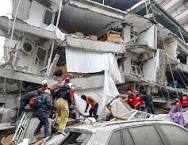
Officials also reported more than 138 aftershocks, ranging in magnitude from 1.3 to 6.7, while initial assessments indicate that around 37 structures—primarily commercial buildings—have sustained damage.
The earthquake occurred offshore near Mindanao at approximately 7:37am local time and originated at a depth of 10 kilometres, according to the German Research Centre for Geosciences.
In response, tsunami warnings were issued in both the Philippines and neighbouring Indonesia, although no significant damage has yet been confirmed in either country.
Footage circulating on social media captured the moment panic unfolded at Davao Occidental’s Mahayhay Elementary School, where schoolchildren had gathered for a morning flag-raising ceremony when the quake struck. Teachers were seen shielding and comforting students as buildings trembled around them.
A school statement later confirmed the situation was handled according to safety protocols, saying:
“Upon noticing the tremor, teachers and learners immediately followed the school’s safety and disaster preparedness protocols to ensure everyone’s safety,” it read.
“We are grateful that all pupils, teachers, and personnel remained calm and orderly throughout the situation. No injuries were reported, and classes were suspended after the necessary safety assessment.”
Additional videos from affected areas showed a building under construction swaying violently, with cranes shaking as workers stood nearby in alarm. In another incident, a branch of fast-food chain Jollibee collapsed, sending debris and dust into surrounding streets.
Post-disaster images from General Santos revealed extensive damage to a convenience store, while police chief Benjie Ancheta of Alabel in Sarangani reported structural cracks in a police facility during their flag-raising ceremony. He also noted that some individuals fainted, though there were no immediate fatalities.
“This is the strongest earthquake we’ve experienced,” he told Reuters.
In the Pacific region, the Joint Australian Tsunami Warning Centre initially issued a tsunami watch for parts of Australia, including the Northern Territory and Christmas Island, before later cancelling the alert after no threatening waves were detected.
“At this stage no tsunami waves have been observed that may threaten Australia,” it wrote.
“If a tsunami has been generated, it may start affecting the following States and
Territories after these local times: Northern Territory after 2:30 PM ACST Monday and Christmas Island after 12:00 PM local time Monday.
“The Joint Australian Tsunami Warning Centre is closely monitoring the situation
and will advise immediately if there is cause for concern.”
Meanwhile, authorities across the region remain on alert. Evacuation orders have been issued for coastal communities in the Philippines, while power and communications outages have been reported in parts of Sarangani near the quake’s epicentre.
Japan issued tsunami advisories for sections of its Pacific coastline, stretching from the southern Okinawa islands to Ibaraki Prefecture. In addition, the United States Tsunami Warning System warned that “widespread hazardous tsunami waves are possible within the next three hours” across several Pacific nations including the Philippines, Indonesia, Palau, Taiwan, and Papua New Guinea.
Philippine President Ferdinand Marcos Jr. urged residents in affected coastal areas to move to safer ground immediately.
“To our kababayans (countrymen) in the affected provinces, please heed the tsunami warning,” he says.
“Move to higher ground now. Do not wait. Your life is more important than anything left behind.
“The national government is moving, and we will not leave Mindanao behind,” he says.
According to the US tsunami advisory system, wave heights could reach between 1 and 3 metres above normal tide levels in some areas.
Authorities have described Monday’s earthquake as one of the most severe in recent memory. The Philippines, located within the Pacific “Ring of Fire,” experiences frequent seismic activity, averaging 20 to 30 earthquakes daily, though only a small fraction are strong enough to be felt.
The region’s vulnerability was further highlighted in October last year when a 6.9 magnitude earthquake killed 79 people and injured more than 1,200, while widespread destruction affected homes, schools, hospitals, and infrastructure across central parts of the country.