




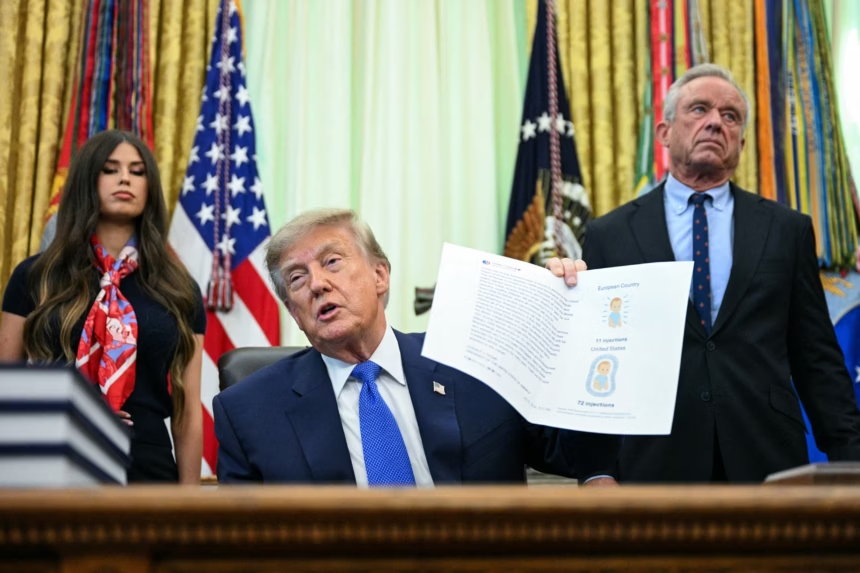
US President Donald Trump has signed an executive order calling for major changes to childhood vaccination recommendations. These include reducing the number of vaccines routinely recommended for all children. The order also calls for eventually separating the combined measles, mumps and rubella vaccine.
According to BBC, Trump signed the order on Monday as he renewed his criticism of the current childhood vaccination schedule. The new policy recognises immunisations against 11 diseases as core recommendations for all children. Meanwhile, several others would be targeted at high-risk groups or left to parents and doctors through shared decision-making.
The order does not directly change vaccination requirements for schoolchildren across the United States. Those rules are largely determined by individual states.
‘We’re reducing them’
Speaking in the Oval Office, Trump argued that American children receive too many vaccines. He also said they should receive them over a longer period.
“We’re reducing them,” he said. “It’s not only that you’re doing fewer vaccines, or jabs, as they say, but you’re doing them in a series of visits to the doctor.”
The 11 immunisations recommended for all children under the order cover measles, mumps, rubella, diphtheria, tetanus, pertussis, polio, Haemophilus influenzae type B, pneumococcal disease, human papillomavirus and chickenpox.
Other vaccines, including those for hepatitis A, hepatitis B, influenza and COVID-19, would fall under different recommendation categories. This would depend on risk and consultation with healthcare providers.
Trump pushes separate MMR shots
One of the most controversial provisions concerns the MMR vaccine, which currently combines protection against measles, mumps and rubella.
Trump wants the three vaccines administered separately once individual versions become available in the United States. The order also encourages childhood vaccines to be spread across separate medical visits where possible.
The president questioned the safety of administering the combined MMR vaccine, describing it as potentially “quite lethal.”
When asked what evidence supported that assertion, Trump replied: “What I’ve heard is that there are some people that say it is that way.”
However, extensive research has found no evidence that the MMR vaccine causes autism. Meanwhile, health authorities have maintained that the combined vaccine is generally safe.
Trump again linked the expansion of childhood vaccination to rising autism diagnoses. He argued that children received fewer vaccines decades ago when autism rates were lower.
That connection has been repeatedly rejected by scientific studies.
Doctors criticise Trump vaccine order
The American Academy of Pediatrics strongly criticised the changes, warning against altering established vaccination schedules without supporting scientific evidence.
AAP President Dr Andrew Racine described the move as dangerous and warned that delaying or skipping vaccines could expose children to preventable diseases. This is particularly concerning while measles continues to circulate.
Republican Senator Bill Cassidy, who is also a physician, publicly rejected the president’s position.
“The President does not have the expertise to make these changes,” Cassidy said.
“Vaccines are overwhelmingly safe, are effective, and DO NOT cause autism.”
Cassidy played a crucial role in confirming Robert F Kennedy Jr as Health and Human Services secretary. However, he has repeatedly challenged changes to vaccine policy that he believes lack sufficient scientific evidence.
Kennedy says parents will retain choice
Kennedy defended the administration’s approach. He argued that the changes are intended to expand parental choice rather than prevent children from receiving vaccines.
The executive order preserves access to vaccines that are no longer placed in the universally recommended category.
It also directs health officials to study the timing and sequencing of childhood vaccinations. Additionally, it instructs them to develop alternatives to aluminium-based vaccine adjuvants.
Medical authorities say small amounts of aluminium salts have been safely used in some vaccines for decades. These help to strengthen the body’s immune response.
MMR-autism link rejected by research
Trump’s comments about autism revive a controversy that has persisted for decades despite extensive scientific research.
One major Danish study involving more than 650,000 children found no evidence that MMR vaccination increased the risk of autism.
Health authorities have also warned that separating the MMR vaccines could leave children unprotected against individual diseases for longer periods. It could also increase the possibility of missed appointments.
The CDC has traditionally recommended two doses of the combined MMR vaccine. The first is given between 12 and 15 months and another between ages four and six.
Trump’s executive order now directs federal agencies to advance the new recommendations where permitted by law. It also encourages states to review their own vaccination requirements.
The changes are expected to deepen the debate over vaccine policy under an administration that has repeatedly challenged longstanding federal public health recommendations.