




South Korea has launched a government app that allows stalking victims to track the real-time location of offenders. This comes as the country continues to confront rising cases of violent stalking.
According to BBC News in an Instagram video, the South Korea stalking app uses data from electronic monitors. In addition, it shows the real-time location of offenders on a map.
The video highlighted the case of a woman whose name was changed and voice adjusted to protect her identity. Speaking in Korean, she recalled how a man refused to accept a breakup and later became violent.
Translated into English, she said, “After the breakup, he could not accept that the relationship had ended, so he came to my sister’s house, kicked the front door and tried to force his way in.”
The report added that the woman was later killed by him. It describes the case as one example of violent stalking in South Korea.
Stalking reports have more than doubled in the country since 2021. This has increased pressure on authorities to introduce stronger protection measures for victims.
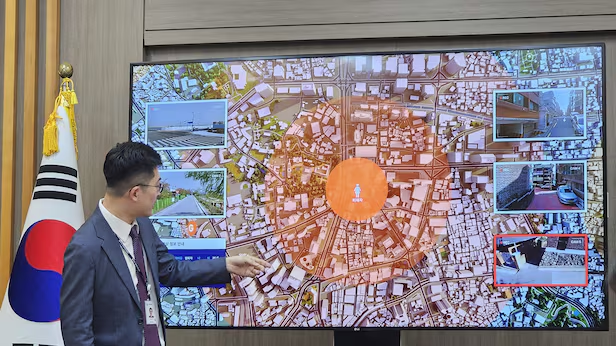
The new South Korea stalking app allows victims to see where monitored offenders are in real time. It also sends an alert to authorities if an offender comes within a specified distance of the victim.
The app also displays nearby roads and buildings. Officials say this feature will help victims move to safety more quickly if they face danger.
Government officials believe the app will improve protection for stalking victims and help law enforcement respond faster to threats.
However, the launch has sparked debate over privacy and surveillance concerns. Furthermore, critics have questioned whether the app places too much responsibility on victims by making them monitor the movements of their stalkers.
Some experts argue that technology can support victim protection. However, they say it cannot fully address the wider problem of violence against women in South Korea.
They say stalking remains part of a broader pattern of gender-based violence. Addressing this requires stronger policing, faster legal intervention, better victim support and cultural change.
The South Korea stalking app has therefore drawn mixed reactions. Supporters see it as a practical safety tool. On the other hand, critics warn that tracking technology alone cannot prevent violence if authorities fail to act quickly when victims report threats.
For now, officials say the app forms part of wider efforts to protect vulnerable people. It aims to reduce stalking-related attacks across the country.