





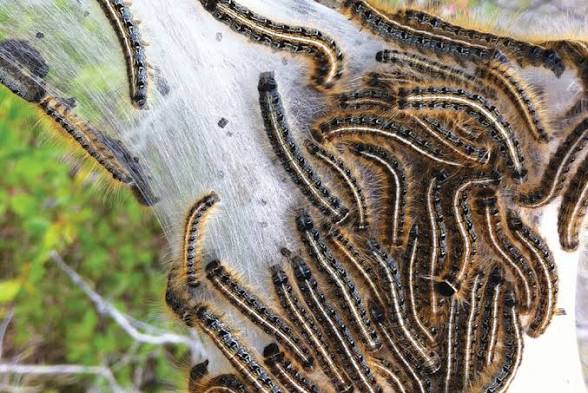
Authorities in several parts of Germany are responding to a growing outbreak of oak processionary moth caterpillars, with a number of parks and public green areas temporarily closed due to health concerns.
Berlin has emerged as one of the worst-hit locations, where officials have introduced restrictions in multiple districts to protect residents and visitors.
The caterpillars are dangerous because they carry microscopic, barbed hairs containing toxins. Contact with these hairs can lead to various health issues, including skin irritation, eye problems such as conjunctivitis, and breathing complications.
The risk extends beyond direct contact, as the tiny hairs can detach from the insects and travel through the air over long distances. Their spread has increased concerns in populated areas where people may unknowingly come into contact with contaminated spaces.
The insects also create white, silk-like nests on oak trees, and these structures contain the same harmful hairs, creating additional hazards around affected trees.
In Berlin, districts including Charlottenburg-Wilmersdorf, Spandau and Friedrichshain-Kreuzberg have recorded serious infestations. Several well-used parks have been transformed into restricted areas, with warning signs, barriers and safety tape installed to prevent public access.
Among the most affected areas is Wilhelm-von-Siemens-Park in Spandau, a 39-acre recreational area where authorities have advised residents to stay away. Nearby schools, childcare facilities and surrounding streets have also reported impacts, according to Berlin’s official state and city information portal.
Specialist teams equipped with protective clothing have been assigned to remove the nests. Using elevated platforms and industrial vacuum systems similar to those used during asbestos removal operations, workers are carefully extracting the nests from trees.
A city official supervising the removal effort told CNN that approximately 2,000 trees in the park are currently affected and have been closed off. He added that eliminating the caterpillars completely is not realistic, with current efforts focused on reducing risks in areas frequently used by the public.
The official said teams are targeting around 20 trees each day, although the amount of work differs depending on the severity of the infestation. Some trees require far more attention, with one crew reportedly spending several hours removing up to 800 nests from a single tree over a weekend.
Residents have been advised to take precautions after visiting affected areas, including washing clothing carefully and keeping windows and doors closed when possible to prevent exposure.
Beyond Berlin, regions such as Hamburg and parts of North Rhine-Westphalia have also recorded outbreaks. The spread is being monitored through EPS-Radar, a digital platform designed to track reported infestations.
The platform was developed by designer Britta Wunderwald, who said she created it with assistance from an AI tool after becoming concerned about exposure risks when a child she knew developed symptoms connected to the caterpillars.
She said there was no current public map providing updated information on infestation areas and expressed hope that authorities would adopt stronger monitoring measures in the future.
Urban nature expert Derk Ehlert has warned Berlin residents through official city communications not to touch the caterpillars or their nests. He also said this year’s population appears to be higher than in previous years.
In previous remarks published on the Nature Conservation Foundation of Berlin website, Ehlert explained that the species originated in southern Europe before gradually expanding further north.
The oak processionary moth population grows more easily during hot and dry periods. While the species has existed in Germany for years, experts say its wider spread is linked to climate change and increasing environmental pressures, including biodiversity loss, according to EPS-Radar.
Health experts warn that exposure to the caterpillars’ hairs can result in itching, skin reactions, breathing problems and, in severe cases, serious allergic responses such as anaphylactic shock.