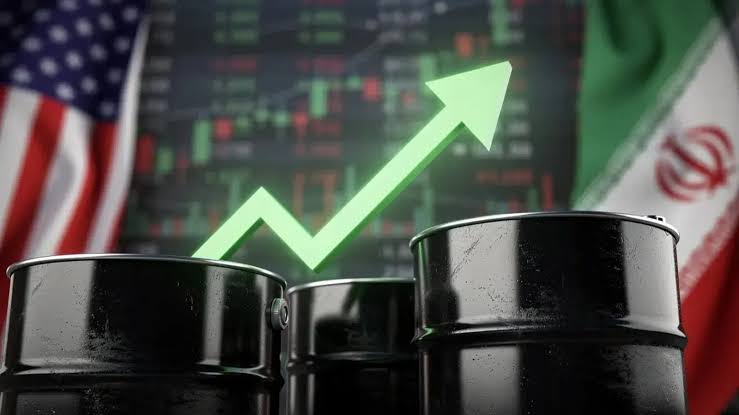
Oil prices extended their gains on Tuesday while most stock markets struggled as fading hopes of a deal between the United States and Iran renewed concerns over energy supplies and inflation.
According to AFP, efforts to secure an agreement that could reopen the Strait of Hormuz remained uncertain a day after the deadline for a truce between Washington and Tehran expired, leaving Brent crude trading above $91 a barrel.
Oil rises for third straight day
Brent crude futures gained about 0.4 per cent to $91.20 a barrel during Asian trading, extending their rally into a third consecutive session. West Texas Intermediate also climbed, rising about 0.6 per cent to $84.99 a barrel.
Both major crude contracts had gained more than two per cent on Monday as investors grew increasingly worried about the possibility of prolonged disruption to global energy supplies.
Although weaker US economic data has reduced expectations of an immediate interest rate increase by the Federal Reserve, traders remain concerned that elevated oil prices could keep inflation high.
The pressure has also been felt in the bond market, where long-term US Treasury yields have risen to levels not seen since June 2007. Rising government borrowing and heavy corporate bond issuance linked to artificial intelligence investment have added to the increase.
US-Iran agreement remains distant
Prospects for a breakthrough between Washington and Tehran weakened after US President Donald Trump said he would not extend the 60-day truce contained in a June memorandum of understanding.
Iran dismissed the arrangement as “irrelevant”, accusing the United States of violating the agreement before its expiration.
Trump’s envoy and son-in-law, Jared Kushner, however, said discussions between the two countries were continuing.
Kushner described the negotiations as “very positive and active conversations” but acknowledged that “there’s really not a lot of trust between America and Iran after all these years”.
“President Trump is going to be very patient… he doesn’t want to rush to a deal,” Kushner told Fox News.
“He’ll make the right deal when the right deal is ready,” he added.
Trump had earlier said Iranian officials “want to make a deal, but they’re not going to make the kind of a deal that I feel is necessary”.
Hormuz uncertainty keeps markets on edge
The Strait of Hormuz remains central to the dispute because of its importance to global oil shipments.
Trump has also threatened Oman over its role in discussions with Tehran concerning control of the strategic waterway, warning that Washington could take action if Muscat “gets in the way” of an agreement.
Investors fear that Washington’s willingness to wait for a deal could leave oil prices elevated for a prolonged period.
US Treasury Secretary Scott Bessent has also threatened further economic pressure on Tehran, warning last week that Iran could face economic isolation “like the world has never seen before”.
Trump, meanwhile, said Washington was taking a measured approach to Tehran.
“We are low-keying it,” he said, adding that the US was watching Iran amid its economic difficulties.
Asian stocks mostly retreat
Stock markets were mixed as investors weighed higher oil prices, rising bond yields and uncertainty surrounding the Middle East.
Seoul initially gained more than two per cent after reopening following a long weekend, although it later surrendered some of those advances. Sydney, Wellington and Jakarta also moved higher.
Tokyo, Hong Kong, Shanghai, Singapore, Taipei and Manila, however, recorded losses.
Japan’s Nikkei 225 fell about 1.6 per cent, while Hong Kong’s Hang Seng Index dropped 0.6 per cent and the Shanghai Composite declined 0.2 per cent.
Wall Street had also ended lower on Monday, with the Dow Jones Industrial Average falling 0.5 per cent.
Investors face converging risks
Stephen Innes, global strategist at Quintex Intel, said investors had previously treated the war involving Iran, volatile oil prices and pressure on long-term Treasury yields as separate problems.
“For weeks, investors had been willing to treat the Iran war, oil volatility and the pressure building in the long end of the Treasury curve as separate irritants,” Innes said.
He explained that markets had been relying on diplomacy to contain geopolitical risks while expecting oil prices to remain manageable and strong corporate earnings to support equities.
“That calculus becomes less comfortable once those risks begin to converge,” he said.
With negotiations between Washington and Tehran still showing little sign of producing an immediate breakthrough, investors are likely to remain focused on developments around the Strait of Hormuz and their impact on oil supplies, inflation and global financial markets.