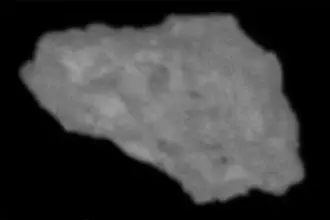
A newly identified near-Earth asteroid, 2026 JH2, is expected to pass extremely close to Earth on Monday, May 16, in an event that poses no risk of impact.
The space rock will come within about 56,000 miles (90,000 km) of the planet, roughly a quarter of the average distance between Earth and the Moon.
Its approach will also bring it closer to Earth than some artificial satellites in orbit.
The asteroid was recently added to the Minor Planet Center database following its discovery by astronomers working with the Mount Lemmon Survey in Tucson, Arizona, and the Farpoint Observatory in Kansas. It has been classified as an Apollo-type near-Earth object, meaning its orbit intersects Earth’s path around the Sun. Its trajectory is highly elongated, stretching from Earth’s vicinity toward the outer regions of the solar system, though it does not extend as far as Jupiter’s orbit.
Astronomers continue to monitor objects like 2026 JH2 closely because their orbital paths bring them near Earth at certain points, even though no collision threat has been identified. At present, the asteroid’s exact size remains uncertain, but based on its estimated absolute magnitude of 26.14, researchers believe it may measure between 50 and 115 feet (15–35 meters) wide. That places it in a similar size range to the object responsible for the 2013 Chelyabinsk airburst over Russia.
Interest in the asteroid has increased due to its expected brightening as it approaches Earth. Observations suggest it will increase in brightness from magnitude 21.3 on May 12 to around magnitude 12.8 by May 19, making it potentially visible through modest amateur telescopes under dark-sky conditions. The Virtual Telescope Project has announced plans to livestream the flyby beginning at 3:45 p.m. EDT on Monday, May 18, allowing global viewers to observe the asteroid near its peak brightness shortly before closest approach.
In a broader context of notable asteroid encounters, attention also remains fixed on asteroid 99942 Apophis, which is expected to make an exceptionally close pass on Friday, April 13, 2029. During that flyby, it will come within about 20,000 miles (32,000 km) of Earth—closer than many geosynchronous satellites. First discovered in 2004, the roughly 1,230-foot (375-meter) asteroid was once thought to pose a potential impact threat, though that risk has since been ruled out for at least the next century. It earned the nickname the “god of chaos” due to early uncertainty about its orbit, and its approach will provide scientists a rare opportunity to study how Earth’s gravity may influence its rotation and surface properties. The encounter is expected to make it visible from dark-sky regions including Tenerife, Morocco, and Mauritania.
Historical precedent for large impacts is often referenced in discussions of asteroid monitoring, particularly the Tunguska Event. On June 30, 1908, an asteroid estimated at about 330 feet (100 meters) wide entered Earth’s atmosphere and exploded over Siberia, flattening approximately 770 square miles (2,000 square kilometers) of forest. The event remains the largest recorded asteroid-related explosion on Earth and is now commemorated annually as Asteroid Day under United Nations recognition.