





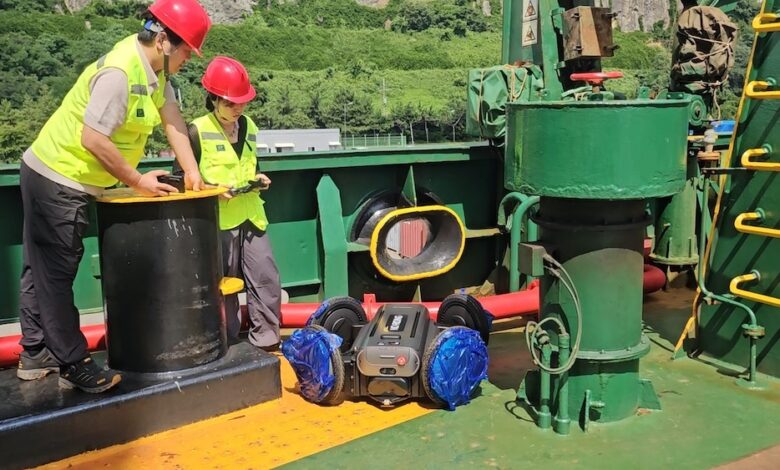
Hyundai Motor and Kia’s mobile robot platform, MobED, has successfully carried out what is described as the world’s first onboard autonomous driving demonstration on an operational vessel, marking a development that could help advance the adoption of smart ships. The companies believe such vessels could eventually use robots for tasks including cargo-area safety inspections and material transportation.
The trial was conducted by classification society Korean Register in collaboration with Hyundai Motor and Kia, South Korean liner HMM, its ship management subsidiary HMM Ocean Service, and Goseong Engineering. The demonstration took place aboard the multipurpose vessel Hyundai Dubai, which was docked at CJ Logistics’ dedicated steel pier in Changwon, South Gyeongsang province.
The exercise was designed to test whether an autonomous robot originally developed for land-based operations could maintain performance in the unstable and constantly moving conditions found onboard a ship.
MobED is equipped with four independently operating wheels that use Hyundai’s drive-and-lift technology. The system enables the platform to maintain a level upper body while moving steadily across slopes, thresholds and areas affected by vessel movement. Depending on the required operation, the robot can be equipped with delivery tools, inspection devices or cameras to perform different functions.
During the demonstration inside the vessel’s cargo area, the robot successfully completed straight and curved driving, low- and high-speed movement, route learning and fully autonomous navigation. In narrow passageways, MobED was able to complete route learning and low-speed movement, but limited space prevented fully autonomous operation, requiring a transition to remote manual control.
The organisations involved said the test proved that robots could operate in large cargo spaces without requiring separate modifications to existing ships. They added that the technology could provide support in areas that are challenging or dangerous for crew members to access, including cargo spaces containing explosive or toxic materials.
However, the partners noted that further development is needed before robots can expand their operations throughout vessels. Engine rooms and confined passageways will require additional sensors or the creation of a smaller robotic platform capable of navigating tighter spaces.