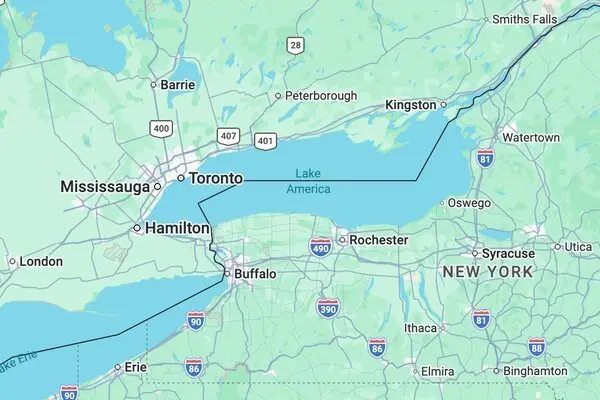
Google Maps has changed the name of Lake Ontario to “Lake America” for users in the United States, following President Donald Trump’s executive order renaming the body of water amid escalating trade tensions with Canada.
The tech giant made the change after the US Geographic Names Information System, the official federal database for geographic names, updated its records. The change took effect on Sunday, August 30, 2026.
Canadians will continue to see “Lake Ontario” on their Google Maps, while users outside the US and Canada will see both names . The policy mirrors Google’s approach to the Gulf of Mexico, which was renamed “Gulf of America” for US users in January 2025 .
“Since we update Google Maps to reflect name changes in official government sources, which is GNIS for the US, people using Maps in the US will see ‘Lake America,’ those in Canada will continue to see ‘Lake Ontario,'” Google said in a blog post .
Trump signed the executive order on Thursday, August 27, telling reporters in the Oval Office: “We’re gonna be changing the name of Lake Ontario, effective immediately, to Lake America” .
The move came after trade talks between the US and Canada collapsed, with Washington imposing 50 percent tariffs on about $20 billion worth of Canadian goods .
Canadian Prime Minister Mark Carney immediately rejected the name change, saying in a social media post that the name “Lake Ontario” comes from the Wendat word “Ontari’io,” meaning “the lake is beautiful, the lake is big” and is more than 400 years old .
“Things must be called by their name, and this lake is called Lake Ontario – today and forever,” Carney said .
Ontario Premier Doug Ford also pushed back, saying Trump’s order “was like something out of ‘Saturday Night Live'” and that “no one’s going to call it Lake of America” . He unveiled a large lakeside sign on Saturday reading “Lake Ontario: Now and Always” .
The Seneca Nation also condemned the executive order, with President J. Conrad Seneca calling the move a “blatant disrespect” for the Indigenous people who gave the lake its name . He said the renaming violates the 1794 Treaty of Canandaigua, which promised perpetual peace and friendship between the US government and the Haudenosaunee confederacy .
While Trump has the authority to change how the US government refers to geographic landmarks, he cannot compel Canada or the rest of the world to follow .