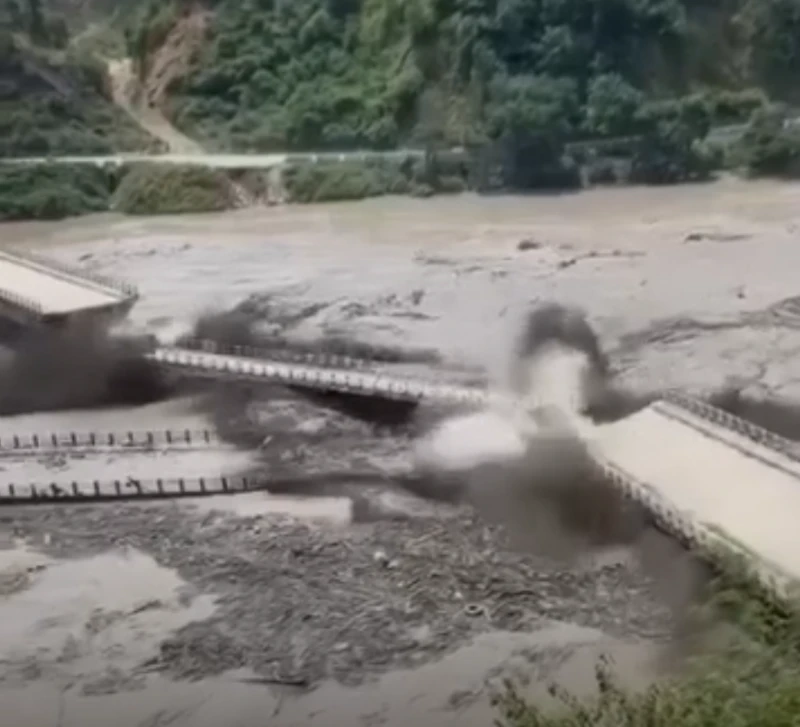
Climate change likely played a significant role in creating the conditions that led to a devastating glacier and rock collapse in the Himalayas in late August, scientists have said.
The disaster triggered flooding across parts of Nepal and Tibet, reportedly killing about 1,400 people, while thousands remain missing.
Researchers with the World Weather Attribution group said sustained warming in the region has accelerated glacier loss and contributed to the thawing of permafrost beneath Himalayan rock formations, according to CNA.
Scientists said it remains difficult to determine precisely how much climate change contributed to the collapse of an estimated two square kilometres of rock and glacier ice on Langtang Lirung mountain.
However, they said the unusually warm conditions had weakened the mountain environment and made a collapse more likely.
“There’s absolutely no doubt that human-induced climate change played a role here in the preconditioning of the disaster through permafrost thawing, through thinning of the glaciers, through having more rainfall instead of snow,” said Friederike Otto, a climatologist at Imperial College London.
The WWA, which applies peer-reviewed methods to assess the influence of global warming on extreme events, estimated that temperatures across the Himalayan region were about 5°C above normal in August.
Of that increase, approximately 1.5°C was attributed to human-induced climate change.
Snow and Meltwater Added Pressure
Researchers also identified unusually heavy snowfall during October and November last year as another possible factor.
The additional snow increased the amount of water available for melting when temperatures subsequently rose, potentially adding to the instability of the already vulnerable mountain slope.
The study found that Himalayan glaciers have been losing approximately half a metre in thickness each year since 2000.
That continuing retreat has altered the stresses acting on surrounding rock, while the thawing of frozen ground beneath the surface may have further weakened the mountain wall.
Scientists also examined the possible influence of the magnitude 7.8 earthquake that struck the area in 2015. The earthquake may have weakened the underlying rock, although researchers said its precise contribution to the latest collapse could not be established.
Walter Immerzeel, a mountain hydrologist at Utrecht University, said the slope was already vulnerable because of its geological characteristics and may have been weakened further by the earlier earthquake.
“We conclude that this was a geologically vulnerable slope, potentially weakened by the 2015 earthquake, but it was destabilised further by glacier and permafrost retreat and by the excessive meltwater and exceptional warmth in the final period before the collapse,” Immerzeel said.
The researchers said the disaster illustrates how rising temperatures can interact with existing geological vulnerabilities in high-altitude regions, increasing the risk of sudden and destructive mountain failures.