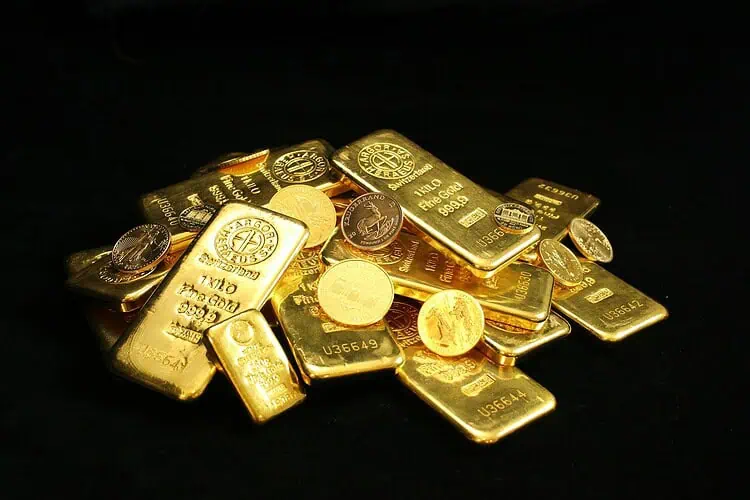
Spot gold prices have declined to their lowest level in two months, placing attention on a critical technical support range around the 200-day Simple Moving Average.
Analysts warn that a decisive move below the $4,395–$4,400 region could trigger further losses toward earlier consolidation levels.
In the Nigerian market, gold has mirrored the global downturn, recording a decline of about two to 3.5 per cent in naira terms over the last month. A gram of gold is currently valued slightly below N200,000, while the retail spot price of 24-karat gold trades between N195,000 and N199,000 per gram.
According to Nairametrics, local market performance is expected to remain under pressure unless international spot prices regain momentum above the 21-day and 50-day Simple Moving Averages, currently positioned above $4,586 and $4,625 per ounce respectively.
Despite the recent drop, gold has maintained a strong year-to-date performance, gaining more than 16 per cent in spot value and approximately 34 per cent on asset-backed local trackers. Analysts say this sustained performance continues to reinforce gold’s role as a hedge against the weakening naira, particularly in active trading hubs such as Kano and Lagos.
Market watchers also noted that a key resistance level for local gold prices remains around N6.7 million per ounce. Even with the present correction, gold’s one-year performance remains firmly positive, supported by investor demand for assets that can preserve value against the depreciation of local currencies.
Meanwhile, renewed geopolitical tensions and recent US military operations in Iran have unexpectedly boosted the US Dollar Index (DXY), putting additional pressure on bullion prices. The stronger dollar, alongside persistent concerns over inflation and interest rate policies, has contributed to short-term selloffs in safe-haven gold assets.
Gold prices fell further as escalating tensions between Washington and Tehran raised fears that peace negotiations could collapse, potentially sustaining inflationary pressures globally. Bullion reportedly declined by as much as two per cent to nearly $4,365 per ounce after reports emerged that US forces carried out strikes on a military installation and other targets near the Strait of Hormuz.
Traders in the metals market remain concerned that even the possibility of a ceasefire may not be enough to ease fears over rising oil prices and prolonged inflation. Analysts believe central banks may keep interest rates elevated longer than previously expected due to the ongoing Iran conflict. Since gold does not generate interest, higher-rate environments typically weaken its appeal to investors.
In response to the attacks, the Islamic Revolutionary Guard Corps claimed responsibility for targeting the US military base linked to the operation. At the same time, Kuwaiti Air Defenses disclosed that they were responding to missile and drone threats, underlining growing instability in the Middle East and the risks facing diplomatic negotiations in the region.
The developments unfolded shortly after US President Donald Trump expressed dissatisfaction with ongoing discussions with Iran, saying he was “not satisfied” with the talks. Trump also declined to outline measures the United States would take to ensure unrestricted maritime passage through the Strait of Hormuz, one of the world’s most important oil transit routes.
Signals from the options market suggest traders are beginning to scale back their bullish expectations for gold. Implied volatility tied to State Street’s SPDR Gold Shares, the world’s largest gold-backed exchange-traded fund, has fallen sharply, indicating expectations of fewer dramatic price swings ahead. In addition, premiums tied to speculative or hedging positions for the next three months have dropped close to their lowest levels since December.