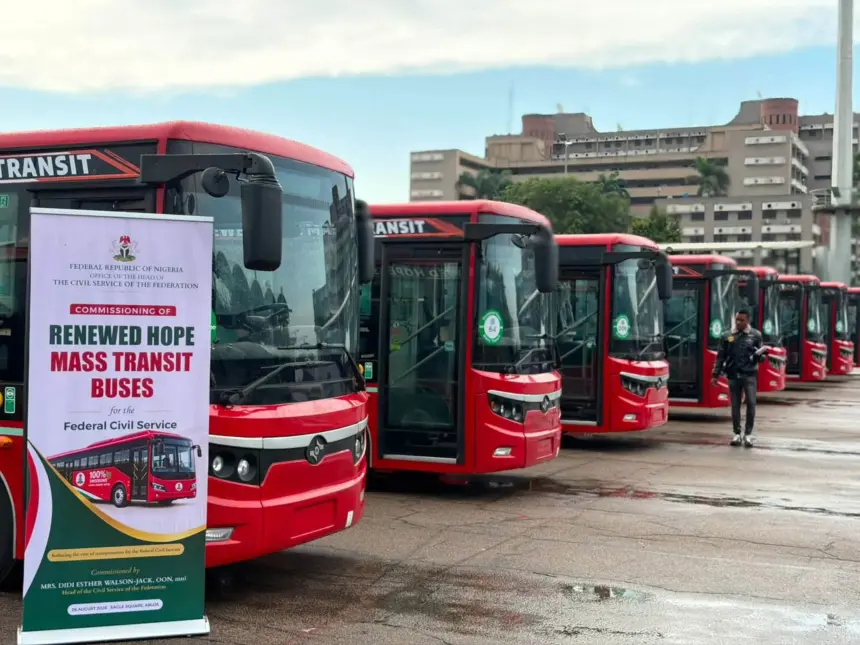
The Federal Government has commissioned 100 electric buses under the Renewed Hope Mass Transit Programme to ease transportation challenges for federal civil servants and improve workers’ welfare.
The buses were launched on Wednesday at Eagle Square, Abuja, with the Head of the Civil Service of the Federation, Mrs Didi Walson-Jack, describing the initiative as a major milestone in efforts to improve the welfare of civil servants.
The first phase of the programme comprises 37 of the 100 buses approved under the Renewed Hope Mass Transit Programme, as reported by Vanguard.
Walson-Jack described the commissioning as her “parting gift” to federal civil servants, coming less than 24 hours before the end of her tenure as Head of the Civil Service.
“What we have here is 37 buses, being the first instalment of the 100 Electric Buses,” she said.
She said transportation had a significant impact on workers’ finances, safety, punctuality and productivity, adding that affordable and reliable transportation would help reduce the burden on civil servants.
“For many Civil Servants, the daily commute shapes their finances, their safety, their punctuality, and ultimately their productivity,” she said.
According to her, the intervention would enable workers to save money, reduce commuting risks and arrive at work with more energy to deliver quality public service.
The HoS disclosed that operations would begin with a pilot phase on selected routes before a full rollout, adding that the buses would also be deployed to Federal Secretariats across the states.
“A Special Purpose Vehicle has been established to ensure their proper management, maintenance and long-term sustainability,” she said.
Meanwhile, the Minister of State for Industry, Trade and Investment, Senator John Owan Enoh, described the project as more than a transportation intervention, saying it combined workers’ welfare, productivity, industrialisation and technology.
He said each of the 100 electric buses could accommodate up to 200 passengers and travel a minimum of 200 kilometres on a full charge.
Also, Director General of the National Automotive Design and Development Council, Olu Osanipin, in a statement on his X handle, said the “first deployment marks the beginning of a phased rollout, with the full complement of 100 electric buses expected to be deployed by December 2026.”
Enoh commended NADDC and other stakeholders involved in the project, urging local manufacturers to invest in factories, deepen local content and produce globally competitive products.
He said the Federal Government remained committed to ensuring that its economic reforms translated into industries, jobs, infrastructure and improved living standards for Nigerians.