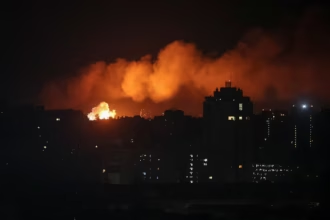
Drone attacks have emerged as the most lethal factor in Sudan’s ongoing conflict, with experts warning that both the national army and the rival paramilitary Rapid Support Forces are receiving external support from multiple countries across the Middle East and beyond.
“Armed drones have now become by far and away the leading cause of civilian deaths,” or over 80% of conflict-related deaths, United Nations human rights chief Volker Türk said this week, urging restrictions on drone transfers into Sudan.
According to the UN, at least 880 civilians were killed by drones between January and April.
The conflict, which erupted in April 2023, has already claimed at least 59,000 lives, displaced about 13 million people, and pushed several regions toward famine conditions.
In recent weeks, RSF forces have intensified drone strikes on strategic locations, including Khartoum International Airport and surrounding areas near the capital, which had previously been seized by the army last year.
Analysts say the inflow of advanced foreign drone technology has expanded the reach of both sides, enabling repeated strikes on densely populated areas while further complicating peace negotiations and increasing fears of a wider proxy confrontation.
“On the battlefield, drones have emerged as a force multiplier, enabling ground offensives and weakening enemy defenses,” said Jalale Getachew Birru, East Africa senior analyst at the U.S.-based Armed Conflict Location & Event Data project.
He added that both the army and RSF are using drones to secure disputed territories, disrupt rival mobilization efforts, and spread instability in contested regions.
Data from ACLED shows at least 2,670 people, including civilians and fighters, were killed in 2025, alongside a 600% surge in drone-related deaths and an 81% rise in drone strikes compared to the previous year.
Drone attacks have repeatedly targeted civilian infrastructure such as hospitals, schools, markets, dams, and displacement camps. Most civilian fatalities from such strikes have been recorded in Sudan’s central Kordofan region, according to Volker Türk.
On May 8, drone strikes in South Kordofan and near el-Obeid in North Kordofan reportedly killed 26 civilians. Earlier in the year, more than 70 people were killed in similar attacks on densely populated areas in Kordofan, according to the Sudan Doctors Network.
The Emergency Lawyers, a Sudanese rights group, said on Tuesday that nine drone strikes targeting civilian vehicles over a 10-day period across seven provinces had killed at least 36 people. The group accused both warring sides of responsibility and raised concerns that some drones may be equipped with visual tracking systems capable of distinguishing targets, suggesting attacks may be more precise than indiscriminate.
Researcher Gabriella Tejeda of The Soufan Center said the RSF only began widespread drone use last year and is now rapidly expanding its capabilities. She noted that both sides are competing to acquire newer systems, particularly from China, while the RSF has been modifying existing drones and “increasingly competing to acquire newer, more sophisticated models, with the UAE likely supplying them,” though the United Arab Emirates has denied providing such support.
Nathaniel Raymond of the Humanitarian Research Lab at the Yale School of Public Health said evidence points to external technical backing for the RSF, including alleged UAE-linked support, with satellite imagery reportedly showing Chinese-made CH-95 and FH-95 drones in use.
He pointed to el-Fasher in North Darfur as a key example, where at least 6,000 people were killed over a three-day period last year. In that city, RSF drones have reportedly disrupted civilian communications and targeted individuals attempting to seek help. “The RSF couldn’t have seized the city without these capabilities, he added.”
“The sophistication of how they use drones in el-Fasher is unique because it’s the first time you’ve seen this layered, hunter-killer concept of operations to kill people, basically in a kill box or trapped inside a wall, in this case to prevent them from crying for help,” Raymond said of the city, where U.N. experts said the violence indicated “hallmarks of genocide.”
The Sudanese army has also faced accusations of drone strikes on civilian infrastructure, including an attack on Al Daein Teaching Hospital in East Darfur that killed at least 64 people. While the military denied responsibility, two officials reportedly said the intended target was a nearby police station.
Raymond said there has been an “alarming increase” in army drone strikes on protected civilian sites such as schools and markets over the past four to six months, although the army maintains it does not target civilian infrastructure.
ACLED has reported that the army’s drone capabilities are supplied by Turkey, Russia, Iran, and Egypt, while RSF supply networks are linked to the United Arab Emirates via transit routes through Ethiopia, Chad, and Libya.
Earlier this month, Sudan’s government accused Ethiopia of involvement in recent drone attacks, including strikes near Khartoum airport, while also alleging UAE support. Both countries have denied the accusations.
“Ethiopia is a central partner to the UAE, so the allegations are not unfounded and reflects an attempt by the UAE to try to influence the outcome of the war,” Tejeda said.
Experts warn that while cross-border drone activity may be contributing to rising civilian casualties, confirming the extent of foreign involvement remains difficult. As Tejeda noted, “Both the warring parties’ battle tempo only increasing, and their backers actively still investing in the war, makes it clear that neither side is interested in a resolution.”