The Federal High Court sitting in Lagos has declared unlawful the National Assembly’s controversial N110 billion vehicle and allowance schemes, ruling that the spending breached procurement laws, constitutional obligations, and public trust.
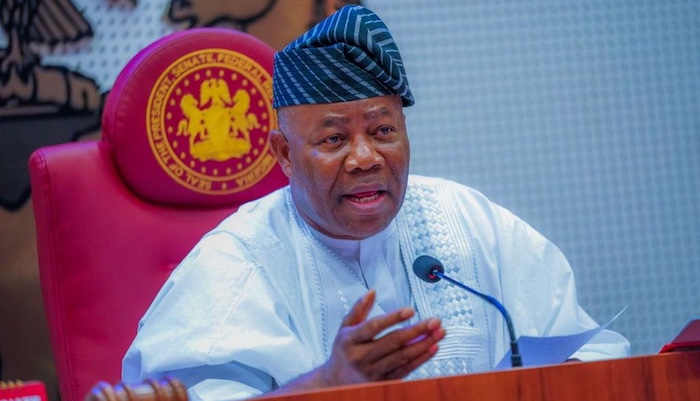
The court ordered the Senate President, Godswill Akpabio, and Speaker of the House of Representatives, Tajudeen Abbas, to ensure that all future procurements or expenditure of public funds by the National Assembly comply strictly with due process requirements and are guided by the principles of transparency, accountability and value for money.
The judgment was delivered on Wednesday, May 6, 2026, by Justice Yellim Bogoro in a suit filed by the Socio-Economic Rights and Accountability Project against the National Assembly.
SERAP had filed the lawsuit in August 2023 following plans to spend N40 billion on 465 vehicles and N70 billion in allowances for new lawmakers amid worsening economic hardship across the country.
In her judgment, Justice Bogoro held that “looking at the magnitude of the expenditure, coupled with the absence of demonstrable due process, leads me to conclude that the procurement is arbitrary, disproportionate and inconsistent with statutory procurement standards.”
She also held that “the beneficiaries of the expenditure are the very officials approving it, and the expenditure confers direct pecuniary and material benefits. This to my mind constitutes a case of self-dealing and conflict of interest.”
Justice Bogoro further stated that she had taken judicial notice of the economic realities in Nigeria and the widespread financial hardship affecting Nigerian citizens, noting that the allocation of N110 billion for the benefit of lawmakers demonstrates a failure to prioritise national interest.
On jurisdictional objections, she ruled that legislative autonomy does not shield illegality, stressing that courts can intervene where constitutional breaches occur.
“The Defendants have urged the Court to decline jurisdiction on grounds of legislative autonomy. It should be noted that the doctrine of separation of powers does not operate as a shield for illegality. It is noteworthy to state that the Court is concerned on the legality and constitutionality of legislative spending,” she said.
“The allocation of N110 billion for the benefit of lawmakers also undermines the fiduciary duty owed to the Nigerian people. Public office must not be used for personal enrichment. Public officers must act within constitutional boundaries and in good faith. I hold that the conduct complained of is inconsistent with the oath of office.”
SERAP Deputy Director, Kolawole Oluwadare, described the ruling as “a major victory for transparency, accountability and responsible management of public resources in Nigeria,” adding that the judgment shows that “public office is a public trust.”
The court also declared that the vehicle procurement and allowances breached the Public Procurement Act, the Code of Conduct rules, and constitutional oath provisions, and ordered strict compliance with due process in future spending.