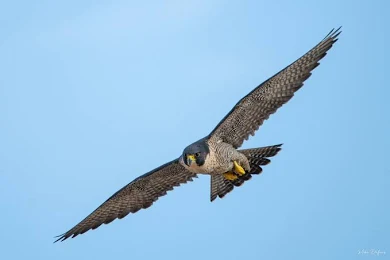
Climate change could create new opportunities for some birds of prey in the United Kingdom, with peregrine falcons potentially benefiting from an expansion of suitable habitats over the coming decades, according to new research.
The findings suggest that while rising temperatures and changing environmental conditions threaten numerous wildlife species, their effects on bird populations will not be entirely negative or uniform.
The study, conducted by Connor Panter of the University of Nottingham’s School of Geography, examined how different climate change projections could influence the distribution of 16 species of breeding birds of prey across the UK. The research was published in the journal Frontiers in Ecology and Evolution.
The investigation considered two possible climate futures: a moderate emissions scenario and a more severe climate change projection.
According to the findings, peregrine falcons, scientifically known as Falco peregrinus and recognised as the world’s fastest animals, could experience a substantial increase in suitable living environments.
Currently, the UK has approximately 42,570 square miles of land considered suitable for the species. However, the research projects that this area could grow by 40.6 per cent by 2060 under the moderate climate scenario. Under the more severe projection, suitable habitat could expand by as much as 73.5 per cent by 2080.
Explaining the importance of the research, Panter said: “We know that climate change is altering where wildlife is found across the world, but scientists’ understanding of how different birds of prey may respond to these changes is still relatively limited,”
“Raptors play important ecological roles as predators, and understanding how their distributions might change is important for informing future conservation efforts.”
Different Species, Different Climate Outcomes
Peregrine falcons are not the only birds of prey that could benefit from changing environmental conditions. The research identified several other species that may experience an expansion in suitable habitats.
These include hen harriers, golden eagles, little owls, long-eared owls, western barn owls and western marsh harriers.
Meanwhile, the projected changes indicate that some familiar British raptors, including common buzzards, European sparrowhawks and tawny owls, may experience relatively little change in the availability of suitable habitats across the different climate scenarios.
However, the outlook is less favourable for several other species.
British short-eared owls, red kites, merlins and Eurasian goshawks could face considerable reductions in the areas capable of supporting them as climatic conditions continue to change.
The findings demonstrate that climate change could reshape the distribution of birds of prey in significantly different ways, even among species occupying similar geographical regions.
Habitat Expansion Does Not Guarantee Population Growth
Despite the potentially positive projections for peregrine falcons and other species, researchers have cautioned against interpreting an increase in suitable habitat as an automatic indication of population growth.
Panter stressed that several ecological and environmental factors will determine whether birds can successfully establish themselves in newly favourable locations.
“It is also important to recognise that an increase in the area suitable for a species does not necessarily mean that its population will grow or that it will become more widespread,” Panter says.
He further explained that “whether peregrine falcons can occupy newly suitable areas will depend on numerous other factors, including the availability of prey, nesting opportunities, threats from humans and interactions with other species.”
The research highlights the need for conservation strategies that account for the different ways individual species respond to climate change.
Rather than adopting a single approach to protecting all birds of prey, conservation planners may need to develop species-specific measures that address both emerging opportunities and growing environmental pressures.
Ultimately, although some raptors could benefit from an expanded geographical range, others may face shrinking habitats and increased pressure on their survival. Understanding these contrasting outcomes will be essential to protecting the UK’s bird populations as the climate continues to change.