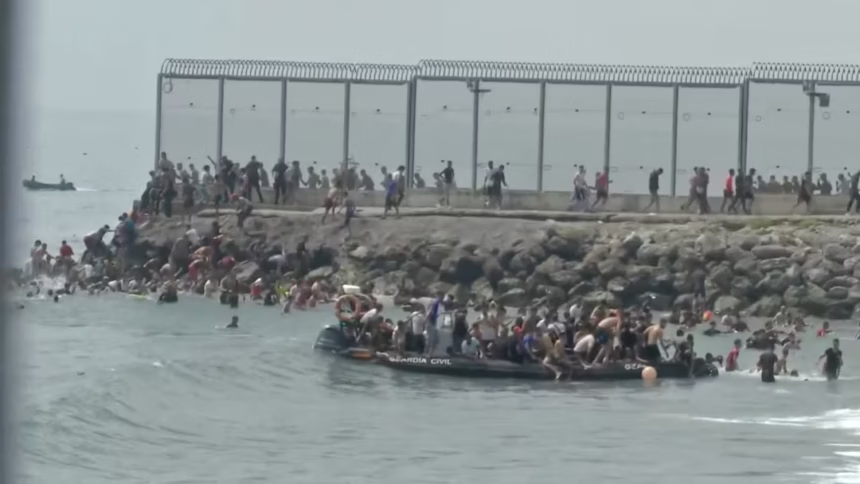
An unprecedented Ceuta migrant crossing has reportedly brought more than 49,000 people into the Spanish enclave from Morocco within 24 hours.
According to Reuters, Spain’s Department of National Security published the estimate on Friday, citing the Interior Ministry. However, officials later deleted the statement without immediately explaining why.
The figure therefore remains an official estimate rather than a confirmed final count. Spain’s Interior Ministry is expected to provide updated migration figures after reviewing the situation.
At least 19 bodies were recovered from the water as thousands attempted to reach Ceuta by land and sea. Spain and Morocco have since reinforced the border to prevent another large-scale crossing.
Ceuta is a small Spanish territory on Morocco’s northern coast. Alongside Melilla, it forms one of the European Union’s only land borders with Africa.
The territory has a population of about 85,000 people. The estimated number of arrivals within one day would therefore represent more than half its population.
Spain and Morocco reinforce Ceuta border
Moroccan authorities deployed additional officers and water cannon trucks around the gates leading into Ceuta on Friday.
Security personnel pushed back crowds gathered near the crossing and appeared to have blocked most entry points. Spanish forces also reinforced their side of the border.
The remains of a bus and seven cars could be seen near the crossing after clashes between security forces and crowds. The vehicles had been destroyed by fire during the unrest.
Although the main gates appeared closed, groups continued moving along the Moroccan coastline. Some searched for routes around the border fence, while others prepared to swim.
Many migrants entered Ceuta by going around coastal barriers or swimming through the Mediterranean. Others reportedly crossed when large crowds overwhelmed security personnel stationed near the fence.
Spain’s Guardia Civil association said too few officers were available when the surge began on Thursday. It argued that the limited deployment made it difficult to monitor the entire border.
Deadly Ceuta migrant crossing leaves 19 dead
The mass movement resulted in several deaths as people attempted dangerous sea crossings.
Authorities recovered at least 19 bodies from the water, although further details about the victims were not immediately available.
Some migrants reportedly drowned while swimming towards Ceuta. Others faced dangerous conditions caused by strong currents, overcrowding and panic near the coastal barriers.
Women, children and migrants from sub-Saharan African countries were among those seeking entry. Many had travelled to the Moroccan border town of Fnideq before attempting the crossing.
Thousands remained in Fnideq overnight despite the increased security presence. Some returned after discovering that authorities had effectively closed the gates.
A 32-year-old man identified only as Brahim said he travelled from Tangier hoping to cross through the border. However, he arrived after security forces had blocked the route.
Spanish authorities plan returns
Spanish authorities said they would work to return people who entered Ceuta irregularly as quickly as legally possible.
However, the process faces restrictions following a recent ruling by Spain’s Supreme Court.
The court ruled that migrants intercepted at sea while travelling towards Ceuta or Melilla could not automatically be returned under special border rejection procedures.
Territorial Policy Minister Ángel Víctor Torres said the judgment may have contributed to the sudden increase in crossing attempts.
However, authorities have not established whether those who entered Ceuta knew about the ruling before beginning their journeys.
Torres said the government responded immediately and would eventually return migrants who did not qualify to remain. He added that officials would respect court decisions and individual rights.
Spain has previously used special border procedures to return migrants directly to Morocco. The latest ruling requires officials to follow additional legal steps in some cases.
Sánchez visits Ceuta amid crisis
Spanish Prime Minister Pedro Sánchez was due to visit Ceuta on Friday with Interior Minister Fernando Grande-Marlaska.
The visit would allow both officials to assess the humanitarian and security situation following the unprecedented arrivals.
Ceuta’s authorities had already warned that accommodation centres and public services were struggling before Thursday’s surge.
The arrival of tens of thousands of people created additional pressure on reception centres, healthcare services and security agencies.
Local authorities have requested more support from Madrid to provide temporary shelter, food and medical assistance.
Spain’s central government also faces the challenge of identifying the migrants and determining who may qualify for asylum or legal protection.
European countries tighten controls
The Ceuta migrant crossing triggered political concern across Europe as governments considered measures to prevent secondary movements from Spain.
French Interior Minister Laurent Nuñez said he had ordered an immediate increase in checks along France’s border with Spain.
France and Spain belong to the Schengen Area, where travellers normally move between participating countries without routine border inspections.
However, governments may temporarily restore checks during exceptional security or migration-related situations.
Nuñez did not immediately explain how the strengthened controls would operate or how long they would remain.
Italian Prime Minister Giorgia Meloni said Italy could take extraordinary measures to protect its borders. She also raised the possibility of suspending open-border arrangements with Spain.
Finland’s interior minister supported Italy’s position and urged the European Union to consider similar measures.
Marine Le Pen, the French National Rally’s presidential candidate, also called for tighter restrictions. She said France should strengthen its border controls following the arrivals in Ceuta.
Italy and Spain clash over migration policy
The crisis also led to a diplomatic disagreement between Spain and Italy.
Italian Foreign Minister Antonio Tajani criticised Spain’s programme for regularising undocumented migrants already living and working in the country.
Tajani argued that the policy could encourage human trafficking and further irregular migration into Europe.
However, the Spanish programme offers eligible migrants legal residency and work permits. It does not automatically grant them Spanish or European citizenship.
Spanish Foreign Minister José Manuel Albares described Tajani’s remarks as inappropriate. He said Spain expected solidarity rather than political attacks from a European partner.
Albares also announced plans to summon the Italian ambassador to protest against the comments.
Spain’s Socialist-led government maintains that migration can strengthen the economy by increasing the workforce and supporting an ageing population.
The government has promised to remain firm against irregular border crossings while providing legal routes for migrants already established in the country.
Europe faces renewed migration debate
The Ceuta crisis has renewed divisions among European governments over border security and migration policy.
Right-wing parties have gained support across Europe since the 2015 migration crisis, when more than one million people entered the continent.
Many arrived after fleeing conflicts, including the war in Syria, while others travelled in search of economic opportunities.
Governments have since disagreed over border controls, asylum rules and how responsibility for arrivals should be shared.
Spain has adopted a more welcoming approach than several other European countries. Italy, France and some northern European governments have supported stricter controls.
The scale of the Ceuta migrant crossing is likely to intensify those disagreements.
For now, Spain and Morocco appear to have largely halted the mass movement. However, thousands remain near the border, and authorities continue to monitor possible crossing routes.