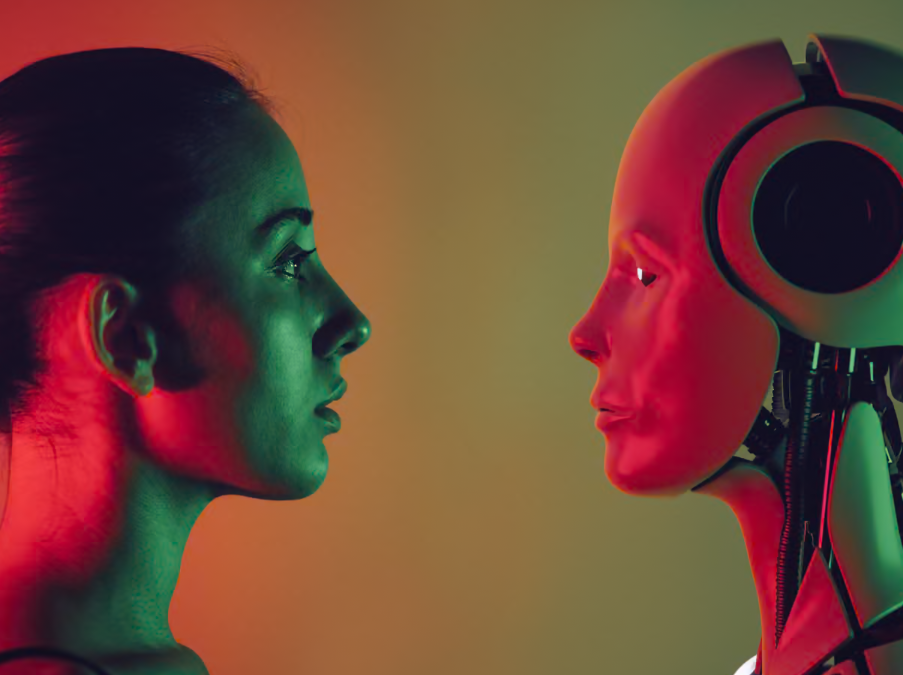
Cambridge Dictionary has named “human” as its Word of the Year for 2026, a choice that reflects the growing need to distinguish people from machines in an age increasingly shaped by artificial intelligence.
The dictionary defines “human” as “having the qualities, faults, and feelings that people have, as opposed to gods, animals, or machines.”
Colin McIntosh, an editor of the dictionary, said the meaning and use of the word had become more important in the age of the chatbot, as AI is “changing the way we talk about being human.”
“The growth of AI means it is now necessary to explicitly say ‘human’ for things that once could only be done by humans,” McIntosh said.
His research revealed a four-fold increase in the use of the word “human” since 1900, alongside a rise in compound terms such as “human-made” and “human-driven” to distinguish the work, qualities, and skills of people from AI.
“Fears about what humans may lose when we outsource our thinking has made us reconsider the extent to which we rely on AI, from top mathematicians to teachers of young children,” he added.
The dictionary’s choice comes as AI advances have sparked questions about whether computers can achieve consciousness. The evolutionary biologist Richard Dawkins said he was “left with the overwhelming feeling that they are human,” while sceptics argue there is a vast difference between how a human brain evolves and how an AI system is built.
Prof Rachel Adams, an expert on AI governance and human rights at the University of Cambridge, said: “AI brings us back to questions that we’ve asked for millennia: who are we, what does it mean to be human? The answer to these questions has never been fixed or stable, but the act of asking it is something we have in common.”
Examples of current usage included actors Scarlett Johansson challenging “an assault on human creativity” and Matthew McConaughey protecting himself against unauthorised digital reproduction of his voice or image.
Microsoft co-founder Bill Gates, on learning of the dictionary’s choice, said: “The measure of AI’s success should be how much it improves human lives.”
Other tech-related words on the shortlist included “agent,” the term for an AI system that can operate without human control, and “analogues,” relating to non-digital activities. A non-tech contender was “wholesome,” a word to describe something likely to improve your life physically, morally, or emotionally.
Earlier this month, “mogging” — meaning to outperform or outshine someone — was named the Collins word of the year. Tech-adjacent words also stood out among new additions to the Cambridge Dictionary, including “looksmaxxing” and “aura farming,” both terms associated with social media culture.