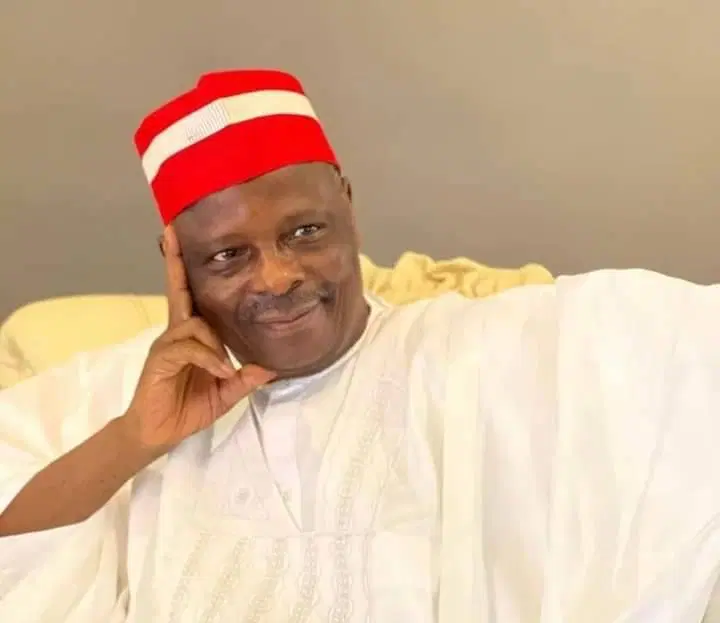
Mustapha Rabiu Kwankwaso, son of former Kano State Governor and Senator Rabiu Musa Kwankwaso, has issued a 48-hour ultimatum to the state’s Commissioner for Information, Sanusi Bature Dawakin Tofa, demanding the withdrawal of alleged defamatory comments and a public apology or face legal action.
Mustapha, a former Kano State Commissioner for Youth and Sports, made the demand in a statement released on Tuesday morning, following remarks allegedly made by Bature during a television programme.
The controversy followed the circulation of a promotional video from an edition of Gabon Talk Show, which surfaced on social media on Monday night. The footage attracted considerable attention after the commissioner allegedly made claims about Mustapha’s personal life, his relationship with his father and his supposed involvement with drugs.
During the programme, Bature reportedly alleged that Senator Kwankwaso had taken his son to several rehabilitation centres in an effort to address his alleged behavioural challenges. He further claimed that the former governor established the Kiru Reformatory Institute because of concerns surrounding Mustapha’s alleged drug-related problems.
The commissioner also reportedly expressed the view that Senator Kwankwaso might regret his son’s emergence as the deputy governorship candidate of the Nigeria Democratic Congress (NDC).
Reacting to the allegations, Mustapha accused the information commissioner of deliberately attempting to tarnish his public image and undermine his reputation through statements he described as baseless and politically motivated. He argued that the comments were designed to shift public attention away from pressing governance issues in Kano State.
Describing the allegations as “false, malicious, and a deliberate attempt to assassinate my character and distract the people of Kano from real issues of governance,” Mustapha rejected the claims and questioned the motives behind their public circulation.
A significant part of his response addressed the alleged connection between his personal circumstances and the establishment of the Kiru Reformatory Institute. He challenged the narrative presented by Bature, maintaining that the historical circumstances surrounding the institution’s creation did not support the commissioner’s claims.
According to Mustapha, the facility was established during his father’s second administration as governor, when he was residing in Dubai. He explained that the institution was conceived as a broader intervention to tackle social problems among young people through rehabilitation, reform and reintegration initiatives.
He described the original vision behind the facility as “a visionary state policy to reform, rehabilitate and reintegrate young people and give them a second chance in life”.
Mustapha further argued that associating the establishment of the institution with his alleged personal difficulties misrepresented its purpose and undermined the efforts of those who had benefited from its programmes.
He also challenged suggestions reportedly made by Bature that his father lacked confidence in his ability to manage certain business interests and responsibilities, including Skyline University, Mewar University and the family’s agricultural enterprise.
Rejecting the claims, the former commissioner maintained that his professional and business achievements were not products of financial dependence on his father. He said his upbringing equipped him with the discipline and independence required to manage personal and professional responsibilities without relying on parental handouts.
“My father has mentored me, trained me, and raised me to be independent. He did not raise me to depend on him for handouts.”
Providing further details about his business activities, Mustapha disclosed that he had independently established several enterprises, including a rice mill. He said the facility contributes to economic development and provides employment opportunities for residents of Kano State.
He maintained that his business record and previous contributions to public service should not be discredited through allegations he considered unsupported by facts.
The disagreement also extended to comments reportedly made about his former appointment as Commissioner for Youth and Sports. Mustapha particularly objected to Bature’s alleged description of the appointment as “executive rehabilitation”.
He dismissed the characterisation, insisting that his selection for the position was based on his qualifications and ability to contribute to the administration rather than any alleged need for personal rehabilitation.
Emphasising his record in office, he stated, “I was not appointed to be rehabilitated. I was appointed to serve. And I served diligently,”
Mustapha also criticised what he considered an inappropriate use of the office of Commissioner for Information, arguing that the position should be focused on communicating government activities and explaining policies to the public rather than making personal allegations against political figures.
He challenged Bature to justify whether his reported remarks were consistent with the responsibilities attached to his appointment, questioning the purpose of the office in the state’s political environment.
“Were you appointed as Commissioner of Information to inform the people of Kano State about government policies, programs and achievements — or were you appointed to be an attack dog?” he asked.
Beyond questioning the commissioner’s conduct, Mustapha sought clarification on whether the allegations reflected Bature’s personal views or were made on behalf of the state’s political leadership.
He argued that the public deserved to understand the circumstances surrounding the comments, particularly because they concerned a political figure and were allegedly made by a serving government official.
“Are these reckless lies your personal invention, or are you doing it on behalf of your principal? The people of Kano deserve to know,” he said.
In outlining his next course of action, Mustapha gave the commissioner 48 hours to retract the disputed statements and issue an unconditional public apology. He insisted that the apology should extend beyond him to include his family and the people of Kano State.
He warned that failure to meet the demands within the stipulated timeframe would leave him with no option but to pursue legal remedies against the commissioner.
Issuing a final warning, he said, “Failure to do so, he should expect to hear from my lawyers. I will not allow my name, my family’s name, and my record of service to be dragged through the mud for cheap politics,” he said.
Mustapha reiterated his determination to use the available legal channels to defend his reputation and challenge statements he believes have damaged his character. He also maintained that the controversy would not derail his political aspirations or diminish his commitment to contributing to Kano State’s development.
The ultimatum places the commissioner under pressure to respond to the allegations and demands within the specified 48-hour period, with the possibility of legal proceedings if no agreement is reached.
As of the time of filing this report, Mustapha had publicly communicated his demands, but no response from Sanusi Bature Dawakin Tofa was contained in the statement.