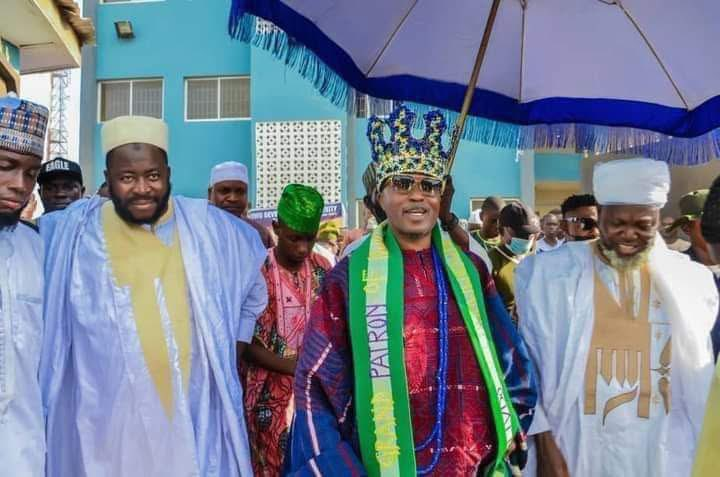
The Tawunu Human Rights Initiative has dragged the Osun State Government before the Federal High Court in Osogbo over a caution letter issued to the Oluwo of Iwo, Oba Abdulrasheed Akanbi, challenging the state’s authority to restrict the monarch’s freedom of expression on religious matters.
The suit, marked FHC/OS/CS/205/2026, was filed through the group’s counsel, Prof. Abdul Rasheed Musa Yusuf, with the Commissioner for Local Government and Chieftaincy Affairs and the Attorney-General of Osun State listed as first and second respondents, while the Oluwo is the third respondent .
The controversy stems from a letter dated November 2026, with reference number CD.17/1/VOL.VIII/377, signed by Wale Alliyu on behalf of the Permanent Secretary of the Ministry of Local Government and Chieftaincy Affairs, and received by the monarch’s secretary on November 3 .
The letter cautioned the Oluwo over alleged inflammatory statements capable of igniting religious confrontation and inter-town conflicts. It accused the monarch’s activities of “raising communal tension, sowing seeds of communal and religious discord and discrediting traditional values” .
“You cannot, and you must not, conduct yourself in any way that can foment religious crisis through serial attacks on people of other faiths,” the letter warned, directing the Oluwo to stop further attacks on people of other faiths and fellow traditional rulers .
The group is seeking declarations that the Oluwo’s rights to freedom of thought, conscience, religion and expression are guaranteed under Sections 38 and 39 of the 1999 Constitution .
It wants the court to declare that the Commissioner “has no constitutional or statutory authority to impose an extra-constitutional restriction upon the Third Respondent’s freedom of expression merely because his personal religious or philosophical opinions are considered unpopular, controversial, inconsistent with prevailing traditional practices or offensive to sections of the traditional institution” .
The suit also seeks a declaration that “the existence of a traditional institution, traditional council, customary authority or recognised chieftaincy structure does not confer upon the Ministry of Local Government and Chieftaincy Affairs any inherent power to censor, suppress or prohibit the constitutionally protected personal opinions of a traditional ruler” .
It further asks the court to declare that any attempt to compel the Oluwo “to abandon, retract or refrain from expressing his sincerely held religious or philosophical convictions solely to conform to an officially preferred interpretation of Yoruba traditional religious practices constitutes an infringement of his constitutionally protected freedom of conscience and expression” .
The applicant is seeking perpetual injunctions restraining the Commissioner and the Attorney-General from “unlawfully censoring, intimidating, threatening, sanctioning or otherwise interfering with the Third Respondent’s exercise of his constitutionally guaranteed freedom of expression and conscience” .
It also wants an order directing the Commissioner to “withdraw, rescind or formally disclaim any restraining directive or administrative communication issued against the Third Respondent” .
The suit is backed by Sheikh Daood Imran Molaasan, the Grand Mufti of Yorubaland and leader of the Ta’awunu Movement, who has publicly criticized the government’s letter.
Speaking during a Friday sermon in Iwo, Molaasan said the Ministry of Local Government and Chieftaincy Affairs had no business intervening in religious matters and warned that the ministry could be sued over the letter .
“Your office is about chieftaincy matters and not religious matters. The issue between the Oluwo and those who came to report him to you is about religion, so those who wrote the letter should be careful,” he said .
He also claimed that if the letter had been written before the August 15 governorship election, it would have affected Governor Ademola Adeleke’s votes in Iwo .
“Had that letter been written before the August 15 election, it might have affected the governor’s votes. If it would not have affected him in any other place, it would have in Iwo, because we will not allow someone who wants to remove our monarch to remain as governor,” Molaasan said .
He, however, maintained that Governor Adeleke and the state government were not against the Oluwo, adding that there was no animosity between them .
The caution letter followed a series of public comments by the Oluwo that appeared to challenge traditional religious practices.
On July 1, 2026, the monarch described traditional rites and seclusion associated with the installation of new kings as avenues through which monarchs could be drawn into idolatry .
In a video shared on his Facebook page on October 10, he questioned the significance of ancient Yoruba crowns, arguing that crowns were made by the monarchs who wore them and that new kings should make their own crowns .
He also reportedly declared that palaces without idols were greater than mosques, churches and shrines, while criticizing traditional rulers who maintained deities in their palaces .
The Oluwo had previously challenged the government’s authority to remove him, declaring in a video that nobody, including the governor, could remove him from the throne .
This is not the first time the Oluwo has been taken to court. In May 2026, three ruling houses in Iwo dragged him before the Osun State High Court seeking his removal over the alleged exhumation of remains of past monarchs from the palace premises .
The suit, marked HoS/56/2026, was instituted by princes from the Ogunmakinde Ande, Adegunodo and Alausa ruling houses, who sought a declaration that Oba Akanbi was “no longer a fit and proper person to occupy” the throne .
The Oluwo dismissed that suit, describing the claimants as “noise makers” and insisting that no one could remove him .