



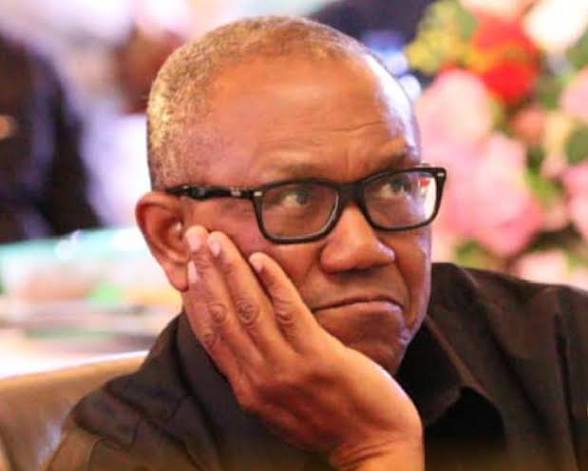
The Nigeria Democratic Congress may find it difficult to win even a single ward for its presidential candidate, Peter Obi, in Anambra State during the 2027 general elections if the alleged exclusion of existing party executives persists, the state chairman, David Chukwudifu, has cautioned.
Chukwudifu accused Obi and his associates of marginalising the party’s established leadership in Anambra while allegedly allowing another group to carry out political activities without involving the existing state, local government and ward executives.
He warned that the alleged exclusion had weakened the party’s organisational structure in the state and could negatively affect its performance in the forthcoming general elections.
The chairman spoke against the backdrop of a reported leadership crisis between the NDC’s existing executives and Obi’s supporters, who joined the party on May 3, 2026, ahead of the 2027 presidential election.
Chukwudifu insisted that the dispute had nothing to do with a personal disagreement with Obi, whom he said he had never met, but stemmed from what he described as the presidential candidate’s failure and that of his associates to recognise the party’s existing leadership.
He said he conducted the NDC state congress on May 4, 2026, a day after Obi joined the party, before proceeding to Abuja for the party’s national convention on May 9.
According to Chukwudifu, he remained in Abuja after the convention and made several attempts, alongside members of his state working committee, to reach Obi.
He alleged, however, that none of their calls or messages received a response.
“I would not call it a disagreement. I would rather describe it as ill-treatment of me and the state executives of the party because Peter Obi and I have never sat down to discuss anything,” he said.
The chairman alleged that tensions escalated when another group began selling nomination forms, screening aspirants and organising a primary election without consulting the leadership recognised by his faction.
He named Chris McCool Nwosu, whom he identified as a native of Anambra South, as one of the individuals involved in the activities.
Chukwudifu also mentioned Ikem Uzoezie, a former member of the Anambra State House of Assembly who served under the All Progressives Grand Alliance (APGA), alleging that he had organised a meeting for aspirants in Awka.
He claimed that the individuals involved had moved alongside Obi from the African Democratic Congress (ADC) to the NDC before beginning political activities independently of the existing state leadership.
According to the chairman, their actions had effectively sidelined executives who emerged through the party’s established processes, leaving them with little or no participation in the organisation’s political affairs.
He further alleged that some of the individuals currently directing the party’s activities in Anambra had previously been members of the Labour Party and APGA.
Chukwudifu claimed that the group had been operating from hotels before his faction formally inaugurated its own party office in the state.
The NDC chairman also dismissed suggestions that his previous public statements about Obi were evidence of a personal relationship between them.
He explained that, following his emergence as state chairman, he granted an interview in which he discussed Obi’s widely known political philosophy of building a country where individuals could advance through merit rather than personal connections.
Chukwudifu maintained that his remarks were intended to express support for the principle and did not suggest that he personally knew the former Anambra governor.
He alleged that the crisis reflected what he considered a recurring pattern in the political activities of Obi and his associates during their involvement with the Peoples Democratic Party (PDP), the Labour Party and the ADC.
According to him, the same approach had now found its way into the NDC.
The chairman also recounted an alleged telephone conversation between Obi and an associate of the presidential candidate.
Chukwudifu claimed that the associate contacted Obi on speakerphone and that, during the conversation, Obi reportedly indicated that he would not work with the existing executives, adding that the chairman was free to seek legal redress if he wished.
The chairman said the situation reportedly took a different turn on June 27, 2026, when Obi met one of the NDC’s local government chairmen along the Benin-Asaba Road.
According to Chukwudifu, Obi denied knowing that the party’s executives were being excluded and instructed the local government chairman to contact Senator Tony Nwoye.
He alleged that Nwoye subsequently challenged the individual’s claim to the position of local government chairman.
Chukwudifu added that neither the local government chairman nor members of his faction received any further communication following the encounter.
The NDC chairman said the unresolved leadership dispute had disrupted the party’s efforts to mobilise supporters and coordinate political activities across Anambra State.
He explained that members of the public continued to contact him through the party’s online portal, seeking information about meetings, volunteer opportunities and other party activities, but the crisis had left him unable to provide clear answers.
He described the situation as a source of instability, arguing that the party’s activities were increasingly concentrated online rather than supported by an effective physical and grassroots presence across the state.
Chukwudifu further alleged that Obi had not visited the NDC secretariat in Anambra since becoming the party’s presidential candidate.
He said several individuals, including some of Obi’s kinsmen, had offered to facilitate a meeting between the two sides, but none of those efforts had produced any result.
The chairman said he had attempted to resolve the disagreement through the party’s internal dispute-resolution procedures before contemplating legal action.
He disclosed that he wrote to the relevant party authorities on May 26 and 27, 2026, requesting their intervention in accordance with the NDC constitution.
According to Chukwudifu, he submitted the complaints through email, text messages and WhatsApp, while hard copies were also sent from Anambra to Abuja through DHL and delivered to the party’s national secretariat.
He said the correspondence was addressed to the party’s National Chairman and National Secretary, but neither official had responded to his complaints.
Chukwudifu maintained that the party’s zonal and national appeal structures were responsible for addressing internal disagreements before aggrieved members resorted to litigation.
However, he expressed concern that political interests surrounding Obi’s home state might be preventing the national leadership from intervening effectively in the dispute.
The chairman warned that the crisis could undermine the NDC’s prospects in the 2027 elections, particularly given APGA’s entrenched political influence in Anambra State.
He noted that APGA had maintained a dominant position in the state since assuming power in 2006, making it a formidable competitor for the NDC.
Chukwudifu argued that the party would face significant challenges in building electoral support against APGA’s established grassroots network if its own members remained divided.
He also identified the political tension between Obi and the state government as an additional reason for the NDC to establish a well-coordinated campaign structure capable of competing effectively across Anambra.
“We already know that we are the opposition party in Anambra. APGA has been ruling the state for almost 24 years and has a strong political structure. It will be a major party to contend with in any election,” he said.
Chukwudifu argued that political parties needed to retain their supporters and avoid alienating members through internal disputes, stressing that every vote could make a difference in determining an election’s outcome.
He maintained that party leaders should accommodate differing interests and resolve disagreements through dialogue rather than push members away.
The chairman also questioned the alleged exclusion of 326 ward chairmen, 21 local government chairmen and 29 members of the state working committee from the party’s activities, asking how the NDC could establish a strong electoral presence after leaving so many officials out of its operations.
He insisted that the existing executives must be recognised and fully involved in the party’s political activities if the NDC hoped to mount a credible challenge in Anambra State during the 2027 general elections.
“We cannot achieve anything in Anambra if the party continues on this path,” he said.