



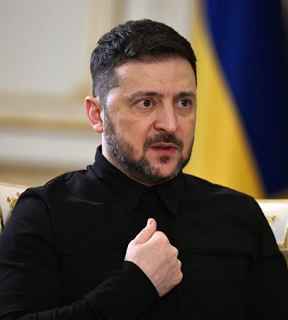
Poland’s hard-right President, Karol Nawrocki, on June 19 revoked Ukrainian President Volodymyr Zelensky’s Order of the White Eagle, Poland’s highest state distinction, deepening tensions between the two allies over historical disputes linked to World War II.
The decision followed anger in Warsaw after Zelensky approved the naming of a Ukrainian military unit after the Ukrainian Insurgent Army (UPA), a nationalist organisation accused of involvement in the wartime massacre of Polish civilians.
Despite the diplomatic fallout, Poland has remained one of Ukraine’s strongest supporters since Russia launched its full-scale invasion, welcoming hundreds of thousands of Ukrainian refugees and serving as a key route for Western military and humanitarian assistance to Kyiv.
However, disagreements over the interpretation of WWII-era events have repeatedly created friction between the neighbouring countries.
Nawrocki withdrew the Order of the White Eagle from Zelensky despite appeals from both Kyiv and Polish Prime Minister Donald Tusk to avoid further escalation. The move came less than a week before Poland was scheduled to host the annual Ukraine Recovery Conference, where Zelensky’s participation had already become uncertain due to the dispute.
“Historical truth is not, and can never be, a bargaining chip. Remembering the victims is a moral obligation of the Polish state,” Nawrocki, who took office last year, said in a statement.
The Polish president said Warsaw had asked Ukraine to reverse its decision regarding the military unit’s name but claimed Kyiv had refused to do so.
“Therefore, in light of President Volodymyr Zelensky’s consent to name one of the units of the Armed Forces of Ukraine ‘Heroes of the UPA’… I have decided to revoke the Order of the White Eagle from the President of Ukraine,” Nawrocki said.
Ukraine criticised the decision, describing it as a “strategic mistake” that would benefit only Moscow.
Ukrainian Foreign Minister Andriy Sybiga said he intended to return an award he received from Poland in 2022, calling Nawrocki’s move “unjustified, impulsive and disrespectful.”
From 1943 to 1945, thousands of Polish civilians were killed in the Volhynia region by UPA Ukrainian nationalist fighters. The territory, now part of Ukraine, was under Polish control before World War II.
Nawrocki said Ukraine’s decision to honour the UPA was “not only outrageous” but also “deeply disappointing”, arguing that it damaged efforts toward reconciliation between the two nations.
Tusk, whose government has frequently clashed politically with Nawrocki, also described Zelensky’s decision to name the unit after the UPA as a “bad decision.” However, he said the Ukrainian president had assured him that he “did not have the slightest intention to offend Poles.”
The Polish prime minister urged both countries “not to waste” the solidarity developed during Russia’s invasion and warned against allowing historical disputes to damage future cooperation.
Poland, which is home to hundreds of thousands of Ukrainian refugees and migrants, has recently witnessed several anti-Ukrainian incidents. Activists and critics of Nawrocki’s nationalist position have warned against escalating anti-Ukrainian rhetoric.
The Polish government expects thousands of officials and business leaders to attend the Ukraine Recovery Conference in the Baltic port city of Gdansk, an annual gathering aimed at encouraging investment in Ukraine. Zelensky has traditionally participated in the event.
Tusk did not confirm on Friday whether Zelensky would attend the conference but said he hoped the dispute would not affect Poland’s efforts to organise the event.
“I hope nothing like that will undermine all the effort, mainly on Poland’s part, to organise this huge undertaking,” Tusk said.
Hours before Nawrocki announced his decision, Polish Foreign Ministry spokesman Maciej Wiewior told AFP, when asked about the Gdansk conference, that “what unites us is the future and ensuring both Ukraine and Poland are safe. I think that is the priority today.”
The conference is scheduled to begin in Gdansk next Thursday. The city is the hometown of both Tusk and Nawrocki.
Poland has promoted the event — previously held in Rome, Berlin, London and Switzerland’s Lugano — as a major diplomatic and economic achievement and has spent weeks preparing for the gathering.
Zelensky has not yet issued a public response to Poland’s decision.