



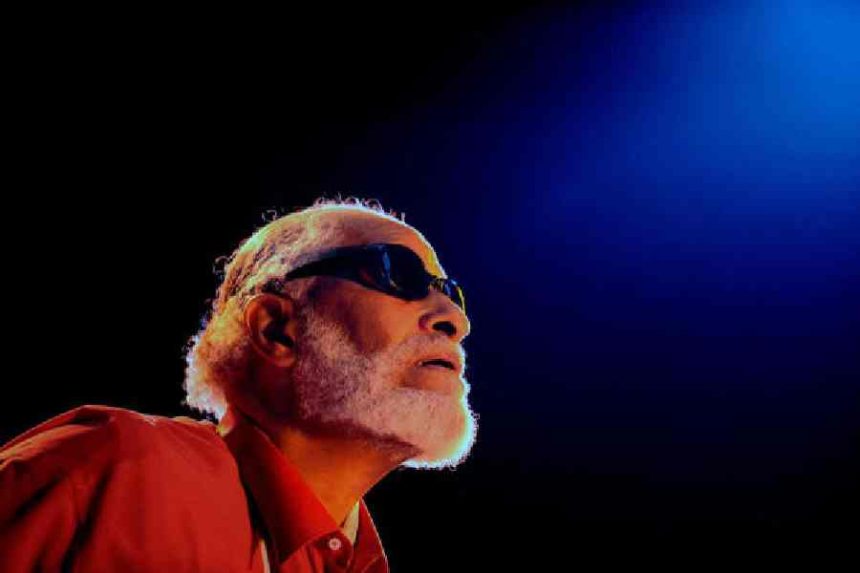
Legendary jazz saxophonist, Sonny Rollins, has died at the age of 95 at his home in Woodstock, New York, bringing to a close one of the most influential careers in jazz history.
In 1968, Rollins stepped away from music at the height of his fame in search of spiritual enlightenment.
The tenor saxophonist later travelled to India, seeking deeper meaning beyond the stage and recording studio.
“I was drinking. I was smoking. I was using drugs. I didn’t have anything firmly that said: ‘Oh, this is it.’ So I was looking for spiritual uplift. I came upon yoga, taught myself, and then went to India to pursue it further at an ashram,” he recalled years later. Arriving in Bombay — specifically Powai — with little besides his saxophone and a small bag, Rollins later reflected: “It worked out well.”
Born and raised in Harlem, Rollins developed a passion for music at an early age. He initially played piano before turning to the saxophone, an instrument gifted to him by his mother when he was seven.
“My mother gave me my first saxophone, an alto, when I was seven years old. I went into the bedroom and started playing — and that was it,” he told Jazz Times. “I was in seventh heaven. I love playing by myself. I’m practising, but I’m also communicating with my musical muse.”
During the late 1940s, Rollins distinguished himself from many young jazz saxophonists with a rich, powerful tone inspired by Coleman Hawkins. His rise as a bandleader accelerated in the 1950s, although he notably paused his career for more than two years after releasing 21 albums between 1953 and 1959. Fellow jazz great Miles Davis once described Rollins’ mid-1950s output as “something else. Brilliant”.
Rollins emerged during the rise of bebop, mastering its complex harmonies and bold rhythms while also expanding the genre’s boundaries. Throughout his long career, he experimented with avant-garde jazz, fusion and several other musical styles. After making his first recordings in 1949 with singer Babs Gonzales, he became a sought-after collaborator on New York’s jazz scene, performing alongside artists such as Thelonious Monk and Bud Powell.
Two albums released in 1956 remain among his most celebrated works: Tenor Madness, featuring his only recorded collaboration with John Coltrane, and Saxophone Colossus.
Rollins also earned acclaim for his piano-less recordings, including The Freedom Suite, known for its groundbreaking 19-minute title track, and East Broadway Run Down. His improvisational approach transformed jazz performance, with compositions often taking shape spontaneously during live sessions.
“A lot of people couldn’t comprehend why I would stop playing,” he told DownBeat in 2001. “But I learned something. It was necessary for me to do, to have the kind of confidence I need to play music like this.”
Before travelling to India, Rollins composed and recorded the soundtrack for the acclaimed 1966 British film Alfie. After several years away from recording, he returned in 1972 with Next Album. His admiration for India endured, and at the inaugural Jazz Yatra in Bombay in 1978, he performed a memorable rendition of Isn’t She Lovely by Stevie Wonder.
In the 1980s, Rollins reached an even broader audience after appearing on Tattoo You by The Rolling Stones, playing on the track Waiting on a Friend alongside drummer Charlie Watts, a long-time admirer.
“There are people who burn bright and fade quickly, and there are those who burn bright and keep going,” Watts said in 2010. “Sonny has never made a bad record — ever.”
Although some critics questioned his use of guitars and backbeats during that period, Rollins defended his artistic choices.
“I was trying to find different ways to make my music relevant. I’ve never thought of myself as being on some pinnacle where I can’t play a calypso or a backbeat.”
Rollins often acknowledged the support of his wife, Lucille Pearson, who also served as his manager and co-produced many of his albums. In 2004, he received a Lifetime Achievement Grammy before retiring roughly a decade later following a diagnosis of Pulmonary Fibrosis.
Despite his retirement, Rollins maintained an unrelenting drive to evolve artistically.
“People say, ‘Sonny, take it easy. Your place is secure. You’re the great Sonny Rollins; you’ve got it made.’ I hear that and I think: ‘Well, screw Sonny Rollins. Where I want to go is beyond Sonny Rollins. Way beyond.’”