





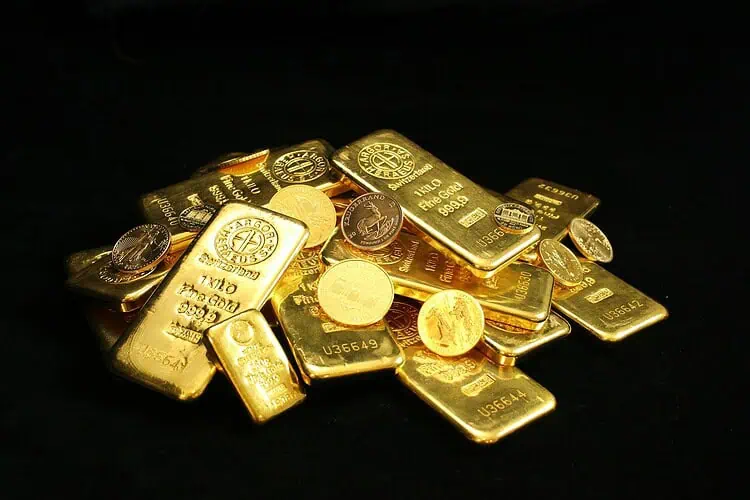
A study has revealed that gold’s resistance to corrosion goes beyond its reputation as a chemically inactive metal.
Gold’s remarkable ability to retain its shine through centuries in tombs, shipwrecks, and museum collections has long fascinated scientists.
Unlike iron, which rusts, copper that develops a green coating, or silver that tarnishes, gold appears almost untouched by environmental exposure, according to ZME Science.
Researchers found that atoms on the metal’s surface can reorganize themselves into structures that make reactions with oxygen far more difficult.
The discovery sheds new light on why gold artifacts can remain intact for millennia. It may also open new possibilities for improving gold’s performance in industrial catalysts, pollution reduction technologies, and clean-energy applications.
Gold is categorized as a “noble” metal because it rarely reacts with oxygen, water, or many common chemicals. This characteristic has made it highly valuable for jewelry, currency, and ceremonial objects throughout history.
For most metals, oxygen is responsible for rust and tarnish. The process begins when oxygen molecules split into individual atoms that bond with the metal’s surface. Although gold generally resists this process, tiny gold particles — especially nanoparticles — have demonstrated an unexpected ability to catalyze oxygen-related chemical reactions.
To better understand this contradiction, researchers at Tulane University investigated how oxygen molecules interact with gold at the atomic scale. Computational chemists Santu Biswas and Matthew M. Montemore used quantum mechanical simulations to study oxygen behavior on two common gold surfaces.
“People have generally thought gold doesn’t tarnish simply because it doesn’t interact strongly with oxygen,” said Matthew Montemore, an associate professor of chemical engineering at Tulane University.
“What we show is that for two of the most common gold surface types, the surface atoms actually rearrange themselves in a way that makes the gold much more resistant to oxidation.”
The researchers explained that when a fresh gold surface is created through cutting, scratching, or crystal formation, atoms on the exterior can shift positions in a process known as surface reconstruction.
Their simulations revealed major differences between reconstructed and unreconstructed surfaces. Unreconstructed gold formed looser, square-like atomic patterns that allowed oxygen molecules enough space to split apart. By contrast, reconstructed surfaces arranged atoms into tightly packed hexagonal patterns, making it far more difficult for oxygen molecules to break apart.
According to the study, oxygen dissociation on reconstructed gold surfaces slowed dramatically — by factors ranging from a billion to a trillion compared with unreconstructed surfaces.
“Just how much more reticent the reconstructed gold was to oxidize was ‘definitely a surprise,’” Montemore told Science News. “It’s something like a billion to a trillion times slower oxidation once you rearrange.”
The findings help explain why bulk gold used in jewelry, coins, electronic wiring, and historical artifacts can preserve its appearance over extremely long periods. Researchers noted that the metal naturally settles into a stable, low-energy surface arrangement that strongly resists oxidation.
Although the protection is not entirely absolute, scientists say the study changes how gold’s durability is understood. Rather than merely avoiding reactions with oxygen, the geometry of the metal’s surface appears to play a critical role in determining its resistance.
The research also ties into a major development in chemistry that emerged during the 1980s, when scientists discovered that gold nanoparticles could serve as effective catalysts despite gold’s reputation for chemical inactivity.
The new study suggests nanoparticles may behave differently because they contain more unreconstructed, square-like surface regions or because their small size prevents atoms from fully reorganizing into tightly packed structures. Those imperfect regions may provide enough space for oxygen molecules to split and react.
Oxygen activation is essential for many industrial chemical processes. Catalysts capable of splitting oxygen molecules are used in reactions that convert carbon monoxide into carbon dioxide, manufacture industrial chemicals, and support oxidation processes in large-scale production systems.
Gold already contributes to several catalytic technologies. Gold-palladium catalysts are used in producing vinyl acetate, an important ingredient in plastics and other materials. Scientists are also examining gold-based catalysts for removing carbon monoxide from exhaust emissions and manufacturing propylene oxide, another widely used industrial chemical.
Researchers say gold offers advantages over more reactive metals, which can corrode easily, bind oxygen too strongly, or create unwanted chemical byproducts. Gold’s natural resistance to oxidation could therefore become highly valuable if scientists can control when and how it activates oxygen.
“If you can trick gold into dissociating oxygen, it can actually become a very effective catalyst for certain reactions,” Montemore said. “Our work suggests a new strategy for potentially doing that by preventing or reversing these surface rearrangements.”
Until now, most efforts to improve gold catalysts focused on combining gold with other metals or placing gold nanoparticles on oxide supports. The new findings point toward another possibility: engineering the surface structure itself. Scientists believe stabilizing square or rectangular atomic patterns may increase gold’s chemical activity while preserving its desirable resistance to corrosion.
The study suggests that the same atomic arrangement responsible for preserving gold jewelry and artifacts through generations may also limit its industrial performance. Altering that arrangement, researchers say, could transform one of the world’s least reactive metals into a far more powerful tool for chemistry and manufacturing.