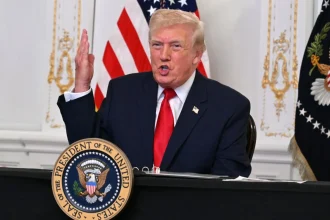





United States President, Donald Trump, has said the ongoing war against Iran could conclude “very soon,” stating that the United States is close to completing its military objectives.
Speaking at a press conference in Miami on Monday, Trump said American forces were making rapid progress on the battlefield.
“We are achieving major strides towards completing our military objective – some might say they are pretty much complete,” the US President told reporters.
He also suggested that operations were advancing faster than expected, adding: “We’re ahead of our initial timeline by a lot.”
During the briefing, Trump repeatedly described the conflict as an “excursion” and argued that it was necessary to safeguard global security. According to him, the campaign was “protecting the world from what these lunatics are trying to do.”
He further claimed that Iran’s missile capabilities had been drastically reduced and that the country’s naval forces had been destroyed.
“We are winning decisively,” he added.
Addressing concerns about global energy markets, Trump said his administration had decided to waive sanctions on certain countries in an effort to boost oil supply. The remarks came amid rising volatility in global oil prices following the escalation of the conflict.
The comments were made as Iran launched new strikes against Israel and several Gulf nations. The attacks marked the first since Mojtaba Khamenei, the son of Ali Khamenei, was announced as the country’s new Supreme Leader.
Israel responded with retaliatory strikes, targeting a rocket engine production facility and “several long-range ballistic missile launch sites,” according to a statement from the Israel Defense Forces. Israeli forces also carried out attacks on Hezbollah infrastructure in Beirut, the capital of Lebanon, with videos circulating online showing the Ramada Hotel Beirut engulfed in flames.
Meanwhile, Turkey, the United Arab Emirates, and Qatar reported intercepting Iranian missiles on Monday.
The intensifying hostilities initially pushed oil prices to nearly $120 per barrel, the highest level in four years, raising fears of a surge in global inflation. However, prices later dropped significantly, falling below $90 per barrel within hours. Prior to the outbreak of the war, oil had been trading at roughly $60 to $70 per barrel.
In the United Kingdom, concerns persist that the conflict could drive up household energy costs. Analysts are forecasting that energy bills could increase by around 10% starting in July.
Trump addressed the issue repeatedly on Monday, attempting to reassure markets about potential supply disruptions. He warned that if Iran tried to block global oil flows, it would “get hit at a much, much harder level.”
Meanwhile, investigative group Bellingcat said a video clip “appears to contradict” Trump’s claim that Iran was responsible for a February 28 strike on a school that killed more than 165 people.
The footage reportedly shows a Tomahawk cruise missile — a weapon known to be used by the United States in the conflict — striking a building and producing a large plume of dark smoke. Both Bellingcat and Associated Press said they geolocated the video to a site close to the school.
When questioned about the allegation on Monday, Trump maintained that several countries possessed Tomahawk missiles, including Iran. However, when pressed further by journalists, he responded: “I just don’t know enough about it.”
He added that “whatever the report shows, I’m willing to live with that report”.
US Defence Secretary Pete Hegseth said authorities were investigating the circumstances surrounding the attack.