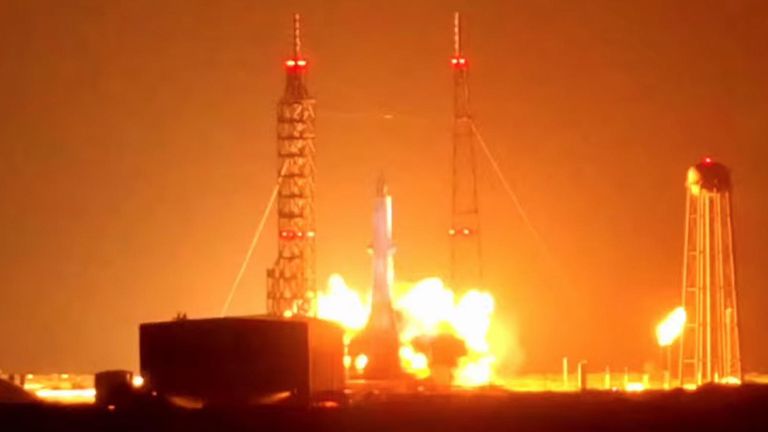
The United States has expressed concern over China’s expanding nuclear capabilities after Beijing conducted a long-range missile test over the Pacific Ocean on July 6, marking another step in its ongoing military modernization programme.
The launch came two years after China fired an intercontinental ballistic missile into waters near French Polynesia, the first such test over international waters in more than four decades.
Security analysts said the latest test highlighted China’s growing ability to strike the U.S. mainland, reinforcing Washington’s view of Beijing as its principal strategic rival despite efforts by President Donald Trump to improve relations.
“At a time when the United States is working harder than ever to prevent nuclear proliferation, China is doing the opposite,” State Department spokesman Tommy Pigott said.
“Beijing’s rapid and opaque nuclear weapons buildup is of great concern to the region and the world,” he said in a statement.
In February, the United States allowed the New START treaty, its last major nuclear arms control agreement with Russia, to expire while pushing for a broader pact that would also include China.
China has rejected those proposals, maintaining that its nuclear arsenal remains significantly smaller than Russia’s, even as it continues to expand.
Washington also called on Beijing to “engage in meaningful arms control discussions and commit to a regularized notification arrangement for all intercontinental-range ballistic missile and space launches.”
Taiwan, the self-governed island claimed by China, identified the missile as a JL-2, which U.S. experts estimate has a range of at least 8,000 kilometres (5,000 miles).
Joseph Wu, the secretary general of Taiwan’s National Security Council, said the missile passed over the Philippines and accused Beijing of increasing regional tensions.
“China just proved itself again to be a bully on the block,” he posted on X.
The Philippines, which has ongoing territorial disputes with China in the South China Sea, condemned the launch, describing it as a “reckless display of military power.”
“This launch serves no peaceful purpose and is a calculated act of taunting and provocation against those who reject China’s illegal expansionism and coercive conduct,” the country’s defense department said in a statement.
New Zealand disclosed that China notified Pacific nations about the missile launch roughly two hours before it took place, although it remained unclear whether the United States received similar advance notice.
Chinese navy spokesperson Wang Xuemeng said in a statement shared on WeChat that the launch formed part of “a routine arrangement of China’s annual military training,” adding that “relevant countries were informed in advance.”
According to monitoring groups, the missile was launched from a nuclear-powered submarine and appeared to land near the Solomon Islands, the Pacific nation that signed a controversial security agreement with China in 2022, which is currently under review by its new government.
Australian Foreign Minister Penny Wong described the missile launch as “destabilizing to the region.”
Japan, which confirmed it had received prior notification of the test, said it had urged Beijing to reconsider the launch and expressed “serious concerns” over China’s expanding military activities.
Russia, a close partner of China, defended the missile test, calling it Beijing’s “sovereign right” and insisting that China “is not threatening anyone in the world.”
Lyle Morris, a senior fellow at the Asia Society Policy Institute, said the launch demonstrated China’s increasing capability to deploy long-range nuclear weapons from sea-based platforms.
“A test of this length is a major development and would indicate that China is moving toward a significantly more survivable and longer-range sea-based nuclear deterrent capability,” he said.
It shows that China’s navy “is capable of targeting the continental United States from bastions close to Chinese waters.”
The missile test coincided with the signing of a major defence agreement between Australia and Fiji, part of Canberra’s broader efforts to strengthen regional security ties amid China’s growing influence following its security pact with the Solomon Islands.
Despite the timing, analysts said there was little evidence of a direct link, noting that missile tests of this nature are typically planned months in advance.